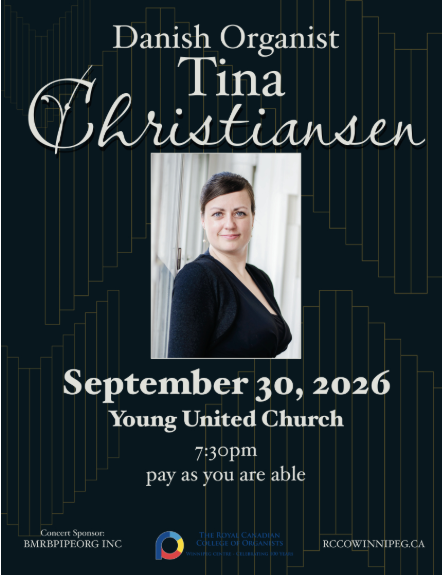
Danish organist Tina Christiansen arrives in Winnipeg on September 30 for a concert that spans more than three centuries of organ music, bringing together works by August Gottfried Ritter, Dietrich Buxtehude, Johann Sebastian Bach, Bedřich Janáček, Herbert Howells and Charles-Marie Widor, along with music from the Danish television series Wild and Wonderful Denmark. The concert takes place at 7:30 p.m. at Young United Church, presented by the Winnipeg chapter of the Royal Canadian College of Organists.
Christiansen is currently touring Canada for the first time, with performances across the Prairies and Ontario following earlier concerts in Vancouver and Victoria. For an organist, however, touring is considerably more complicated than simply arriving at a venue and sitting down at an instrument. Every organ is different, and preparing for a performance means learning the personality, colours and capabilities of each instrument.
A first Canadian tour
Christiansen’s Canadian tour marks her first visit to the country, and the experience has already given her an opportunity to see some of Canada’s landscape as well as its concert halls. She began the tour in Vancouver and Victoria before travelling east to Regina, and later Saskatoon, Winnipeg and Guelph.
“It is my first time touring in Canada, and it’s my first visit in Canada ever,” Christiansen says. “I started in Vancouver and Victoria where I played three concerts before going here to Regina. And I think it’s an amazing country and I’ve seen parts of the nature now also. So when being a Dane from this little country, it’s amazing to visit beautiful big Canada.”
The Winnipeg concert is part of a demanding schedule, but it also gives Christiansen an opportunity to introduce Canadian audiences to a program that reflects both her connection to the organ repertoire and her interest in bringing lesser-known works to audiences.
Every Organ Requires a New Approach
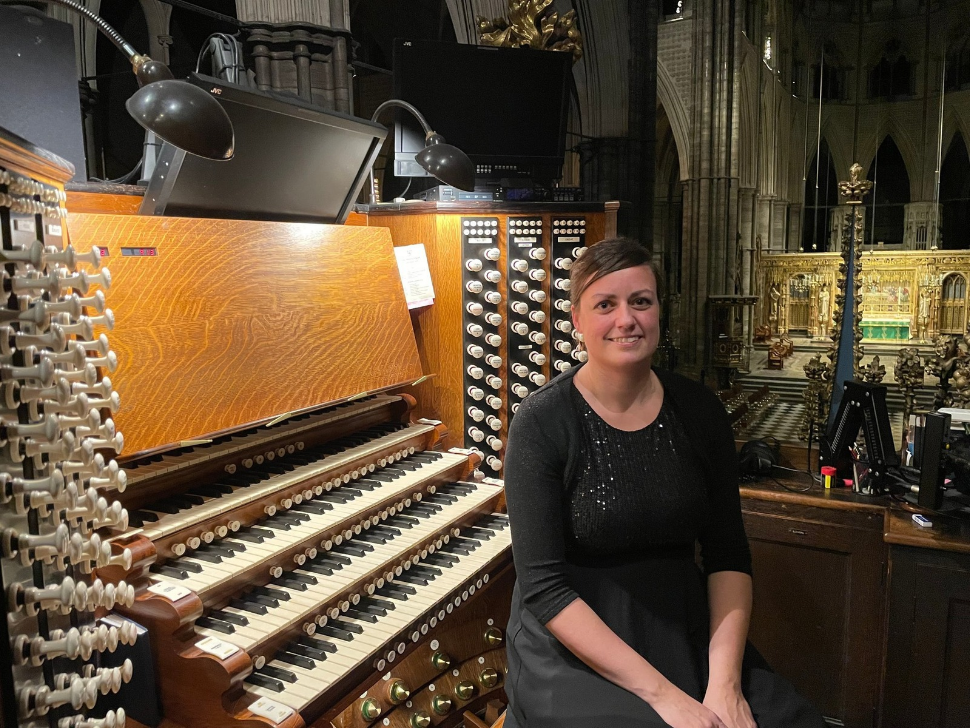
Unlike most touring musicians, organists cannot bring their instrument with them from one concert hall to another. Instead, they have to adapt to the instrument in each venue, learning its stops, tonal colours and capabilities before deciding exactly how each piece will be performed.
That preparation begins well before the concert itself. “It starts already at home because I have to know something about the organ before I decide which kind of music I’m going to play at the organ because every organ is different,” Christiansen explains. “None of them are similar to each other.”
Once she arrives at a venue, the process continues with hours of rehearsal and experimentation. “And the first thing I do is just to get to know the organ. I listen to the sounds, the colors this organ is offering me. And then I just start working with the music.”
For Christiansen, that means preparing the registration and sound colours for every piece on the program. In Regina, she spent approximately seven hours rehearsing before continuing her preparation the following day. “I have to prepare everything. So it takes a lot of time to get familiar with a new organ. I would say 10 hours before I’m ready to play a concert.”
Exploring the organ’s history
The Winnipeg program begins with August Ritter’s Sonata No. 2 in E minor, a work Christiansen describes as being connected stylistically to the music of Felix Mendelssohn. Ritter and Mendelssohn lived during the same period, and Christiansen says their harmonic language reveals similarities.
While Ritter is not as well known today as Mendelssohn, Christiansen believes his music deserves greater attention. Describing the sonata she will perform, she says, “This sonata, it’s more like a fantasy, a free fantasy. It’s only one long movement with big virtuoso parts and slow, beautiful parts ending up with a big conclusion of old organ.”
The program then moves back more than a century to Dietrich Buxtehude and his Ciacona in E minor. Christiansen is particularly drawn to the way Buxtehude develops an extended musical structure from a relatively small musical idea.
“I think it’s amazing how much music he’s he’s making with just this little part of this bass theme,” she says.
For Christiansen, performing Buxtehude is also a way of connecting directly with musical history. “And I think it’s very exciting and interesting to get to know this music and try to play it like you think they did at that time. I really love this music.”
That historical connection continues with Bach’s Toccata, Adagio and Fugue in C major, a substantial work featuring one of the most demanding pedal passages in the organ repertoire. Christiansen describes it as one of Bach’s longest organ pieces and says that, despite its complexity, its appeal remains immediate.
“You can say Bach is in some ways the Bible for the organ… you can play it again and again and work with it again and again,” she says. “But on the other hand, Everyone can listen to it and enjoy this music because it just talks to us.”
Bringing contemporary music to the organ
The second half of the program shifts toward the 20th and 21st centuries. Christiansen sees contemporary organ music as an important part of the repertoire, and she is particularly enthusiastic about introducing audiences to composers whose music may not be familiar to them.
One example is Czech-born composer Bedřich Janáček, who moved to Sweden in 1948 and remained there for the rest of his life. Christiansen will perform his Toccata, written in 2002, just five years before the composer’s death.
“No, Bedřich Janáček and Leoš Janáček were not related to each other,” Christiansen says when discussing the composer and the better-known Czech composer Leoš Janáček. She adds that the work has a personal connection because it was written for one of her former teachers in Sweden.
“And I think it’s just an amazing virtuoso piece and it deserves to get much more well known than it is today.”
Christiansen has also expanded the program beyond traditional organ repertoire with music from the Danish television series Wild and Wonderful Denmark. The original music was not written for organ, but Christiansen heard the orchestral score and imagined how it could work on her instrument.
“When I was listening to this music, I thought this would be great to play on the organ too,” she explains. She subsequently approached the composers about creating transcriptions for organ.
Having performed the arrangements in Denmark, Christiansen is bringing them to Canada as a musical connection between her home country and her first Canadian tour. “So I would like to also bring just a small part of the nature from my little home country, Denmark.”
A concert built around the organ’s full range
The program concludes with music by Charles-Marie Widor, giving Christiansen the opportunity to explore the organ’s enormous dynamic and expressive range.
For an organist, Christiansen says, the instrument’s ability to produce the sound of an orchestra is part of its appeal. “The organ is like a big orchestra too. And of course, when being an organist, it’s a great feeling. So to play loud to.”
Ultimately, Christiansen hopes the Winnipeg audience will come away with both a memorable musical experience and an expanded sense of the organ repertoire.
“Well, of course, I hope they will get a good experience and get to know perhaps some music they don’t know, and also to hear some music by composers that I think they know,” she says. “And I’m just looking forward to sharing this musical evening with the audience in Winnipeg. So I’m looking forward to meeting everyone after the concert too.”
Tina Christensen brings the extraordinary colour and power of the organ to Young United Church, in a program ranging from the timeless music of Buxtehude and Bach to thrilling works by Widor and Howells, plus a unique musical journey through the landscapes of Denmark. It’s a chance to hear a world-class Danish organist in a program designed to showcase just how spectacular the organ can sound.