
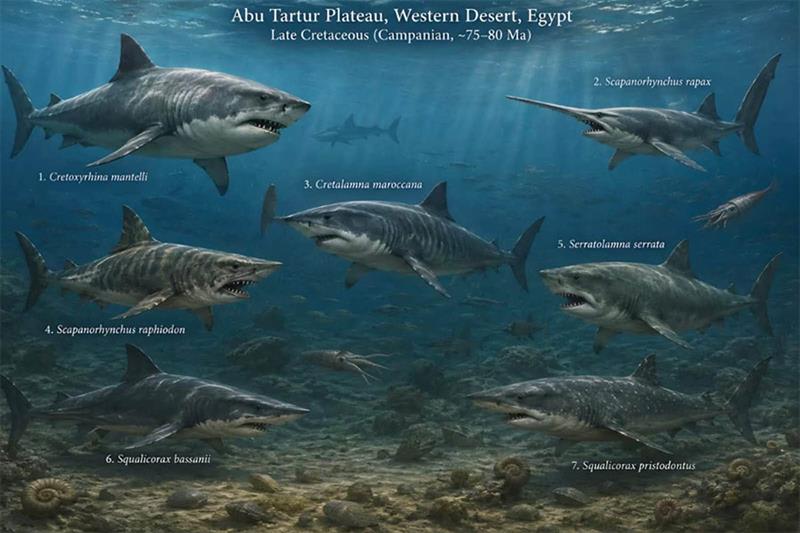
 Egypt’s Western Desert was once home to several shark species (Credit: Cairo University)
A team of paleontologists led by Cairo University’s Dr. Tarek Yassin have unearthed an ancient “shark graveyard” in Egypt’s Western Desert. The discovery was revealed in the journal Cretaceous Research on August 18, 2026. It provides evidence that this now dry landscape was once covered by a shallow, tropical sea filled with marine life, including sharks.
The breakthrough was the result of years of field research. Between 2020 and 2022, the international group of scientists made several trips to the Abu-Tartur Plateau in the heart of the desert. In its dark, phosphate-rich rocks, they uncovered 14 fossilized shark teeth dating back 70 to 80 million years.
The teeth varied widely in shape and function. Some were slender and needle-like for grasping slippery prey. Others were wider with sharp, serrated edges used for slicing. A closer examination revealed that these teeth belonged to five shark species. Two of these species never been found in Egypt before.
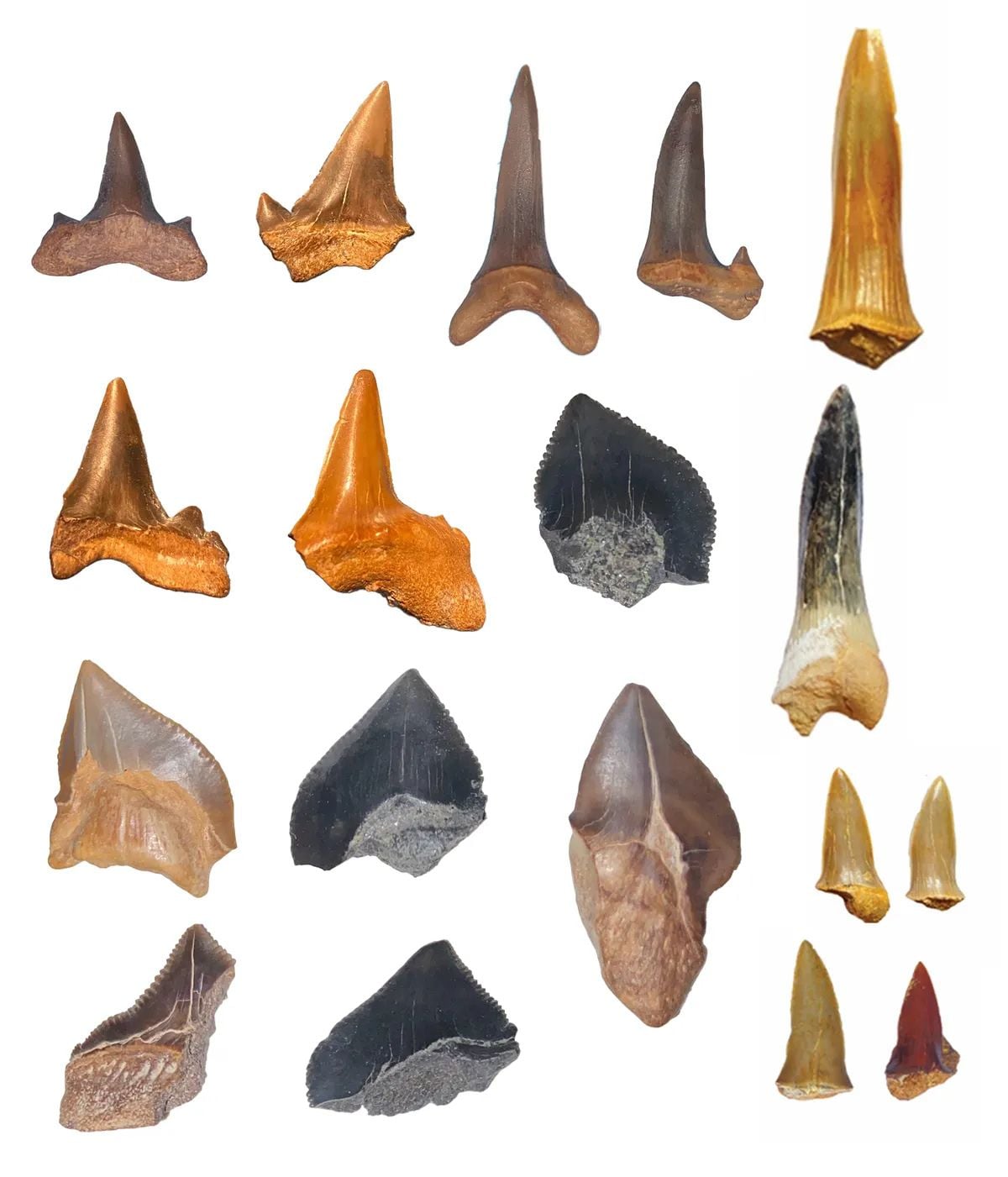 A collection of the shark teeth found in Egypt (Credit: Tarek Yassin)
Among them was an ancient relative of today’s deep-sea goblin shark. This may be the first time this species has ever been found in Africa. It is possibly also the youngest known example of the shark. The team also identified an extinct crow shark. These new finds add to two other shark species found at the site during earlier research.
The scientists explain that the “shark graveyard” was not caused by a sudden disaster. Instead, it formed over millions of years. Generations of sharks shed their teeth on the seafloor, where they became buried in sediment. Over time, this sediment hardened into rock, preserving the teeth inside. Because these teeth built up over such a long period, the different shark species might not even have lived in the sea at the same time.
“What makes this discovery especially significant is that it gives us a glimpse into a much more diverse marine ecosystem than we previously knew existed in this part of North Africa,” said Dr. Yassin. “This discovery is likely only one piece of a much larger story, and we hope to continue exploring the area to uncover more of it.”
Resources: Livescience.com, Sciencealert.com, Yahoo.com