

Listen to this article
Estimated 4 minutes
The audio version of this article is generated by AI-based technology. Mispronunciations can occur. We are working with our partners to continually review and improve the results.
Saskatchewan is going big on nuclear, announcing plans to explore building two large nuclear reactors in the province’s northwest, with a goal of having the first online by 2042.
The Government of Saskatchewan also confirmed it has narrowed down the location of further study for its construction of small modular reactors (SMRs) to the Rafferty site near Estevan.
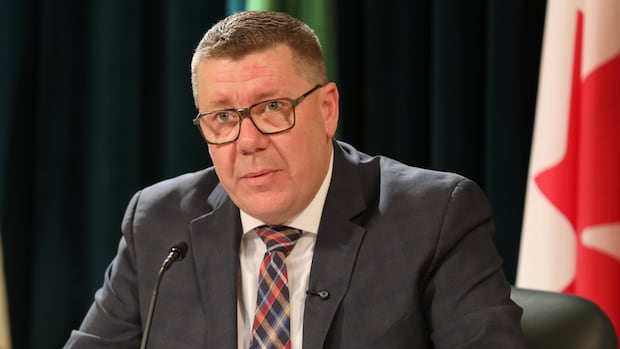
Premier Scott Moe said the province’s new Delivering Energy Security Through Nuclear Power plan establishes an initial target of 2,600 megawatts (MW) of nuclear power generation by 2050.
“We’re charting a path forward for one of the largest energy and economic development opportunities in our province’s history,” Moe said during a news conference at the University of Saskatchewan on Tuesday.
“Six-hundred megawatts can power the equivalent of Saskatchewan’s two largest cities, Regina and Saskatoon; 2,600 megawatts could power the equivalent of 2.6 million homes.”
Moe said the move will secure the electricity needed to support a growing population, large industrial projects and expanding industries.
He refused to engage on the specific dollar investment needed for the project, saying the construction of nuclear reactors across the globe has lowered the cost of construction.
Moe also said that the construction of these reactors could be funded through private companies or other investors.
Crown Investments Corporation Minister Jeremy Harrison said the plan focuses on four priorities for nuclear development:
Building electricity capacity for long-term growth.Incorporating large nuclear reactors into the province’s electricity supply planning.Continuing nuclear development in Estevan.Building on established nuclear capabilities.
Despite confirming that the plans for large nuclear reactors and SMR are being developed at the same time, Harrison appeared to be open to changing the province’s plans.
“I would leave the door open, as well, to large scale deployment in locations not just the northwest but the southeast as well,” he said.
Large nuclear reactors
The 2,600 MW goal for nuclear power generation is a massive expansion of the province’s nuclear plans, which had previously been restricted to SMR development and construction.
For context, SaskPower reported that the total power system demand at 10:30 a.m. CST on Tuesday was 2,829 MW. The record for most power use in the province was 3,910 MW on Dec. 30, 2021.
The SMR technology selected by Saskatchewan, the Hitachi BWRX-300, produces approximately 300 MW from a single unit.
Although SaskPower has previously said it wanted to pursue large nuclear technology, Tuesday’s announcement is the first time the government has provided firm details.
The province did not confirm where the two large nuclear reactors would be constructed on Tuesday, but Moe has previously alluded to potential locations along the North Saskatchewan River.
SaskPower said it will evaluate potential locations while having “meaningful engagement with local communities and Indigenous peoples.”
WATCH | Sask. government wants to build a large nuclear reactor: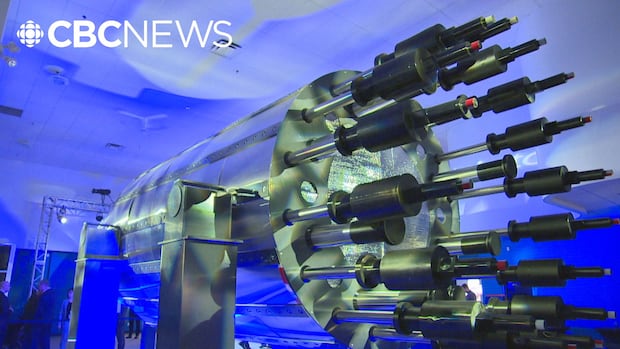
Sask. government wants to build a large nuclear reactor
On Jan. 28, SaskPower and the province announced their hopes to make nuclear power generation happen in Saskatchewan.
The provincial government did not explicitly say what type of nuclear reactor it would use for the large scale reactors, but Westinghouse Canada president John Gorman and AtkinsRéalis president and CEO Ian Edwards are included in the news release.
Westinghouse and Cameco produce the AP1000 Gen III+ reactor, which is referred to in the release.
Some of those large scale reactors are already up and running in China and the U.S., with each reactor producing approximately 1,100 MW.
AtkinsRéalis produces the CANDU technology, as well as the Candu Monark reactor that produces approximately 1,000 MW of power.
Unlike the AP1000 reactor, the Candu Monark would not require enriched uranium as fuel.
Canada does not have domestic uranium enrichment facilities, which means Saskatchewan would need to import enriched uranium.
SMR site selection
SaskPower also confirmed it has further narrowed down the locations for SMR deployment in southeast Saskatchewan.
The Crown corporation has previously indicated it was down to two possibilities: a site on the Boundary Dam Reservoir in the Rural Municipality of Estevan, and a location on the Rafferty Reservoir in the Rural Municipality of Cambria.
SaskPower confirmed Tuesday that it has selected the Rafferty site for “further study.”
SaskPower says Estevan remain a key part of nuclear power plans, with the the goal of delivering at least 600 MW of nuclear power, or two Hitachi BWRX-300 units.
A final site decision is expected sometime this year, according to a SaskPower project schedule.
The first SMR is scheduled to be operational by the mid-2030s according to the same document.