
For Algonquin Anishinaabe artist Jade Rogers-Baptiste, one of the most rewarding aspects of her creative process is watching others interact with her art.
And now, she gets to watch people sit with her art. Quite literally.
Rogers-Baptiste and fellow artist Sylvia Tennisco are the two Algonquin creatives behind the new benches featured in Byron Linear Tramway Park, as part of the City of Ottawa’s public art program around the future Sherbourne LRT station.
“The main thing is to foster curiosity and knowledge for people who are interested in just looking around, taking a moment to stop and maybe read a plaque or sit on a bench,” Rogers-Baptiste said.
While growing up on the Algonquins of Pikwàkanagàn First Nation, Rogers-Baptiste said she was always drawn toward the link between Indigenous teachings and art.
So, when she was selected to design a bench, she chose to pull inspiration from the Seven Grandfather Teachings, which she described as foundational Anishinaabe principles passed down from elders on how to lead a full life and respect the Earth.

Two benches designed by Algonquin Anishinabe artists are now featured in Byron Linear Tramway Park, representing the long-standing presence of Indigenous peoples on this land.
The teachings are visualized on the bench through the footprints of different sacred animals, with the black prints providing a sharp contrast to the light-wood tone of the bench.
“It’s a way to prompt questions and curiosity, because a lot of art tends to be straightforward … but I did it in a way where it’s curious and strange to me,” she said. “Why is there footprints of these different animals? Some people may see it differently, and it would make them investigate it.”
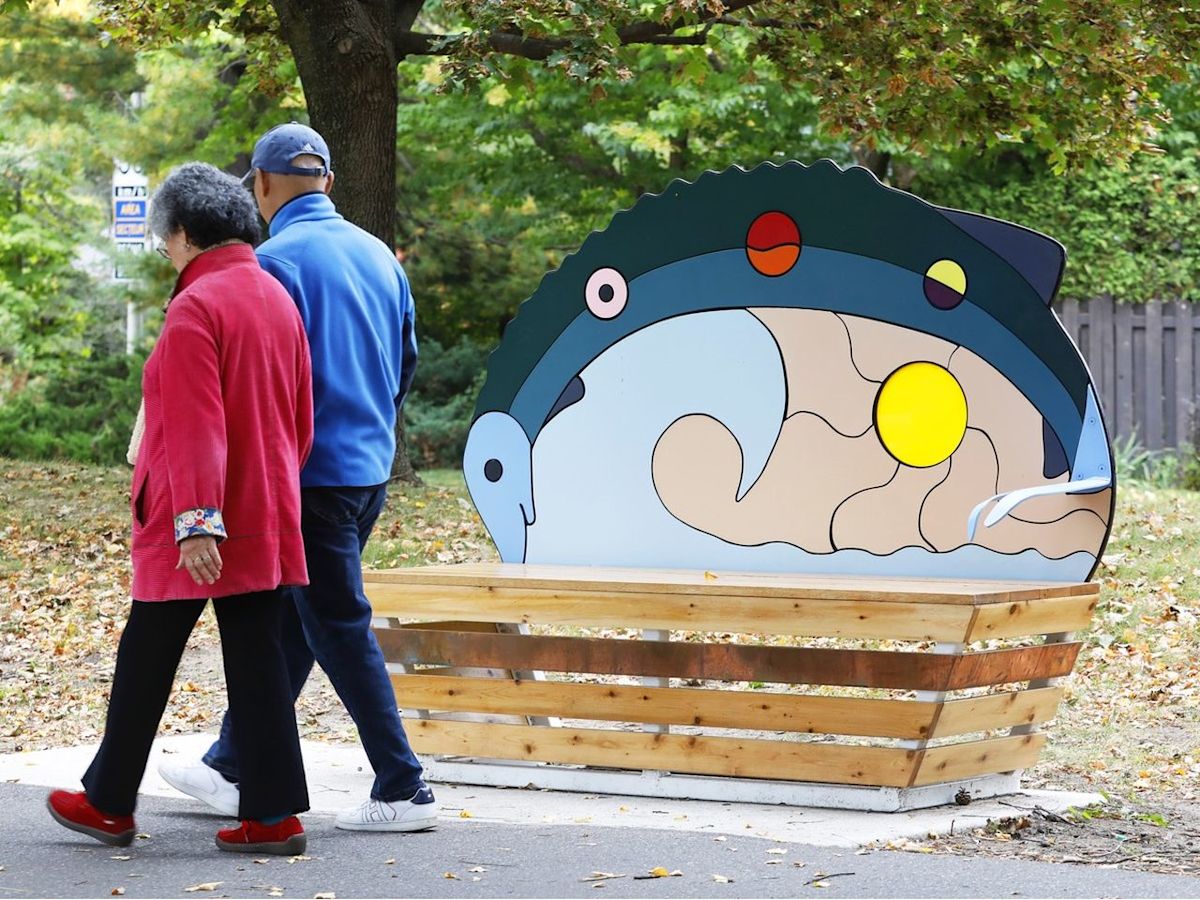
Located nearby is Tennisco’s bright-coloured bench, titled “Sturgeon,” which represents the importance of the freshwater fish species for Algonquin people, especially before major dam projects changed the landscape of the Ottawa River. Now, the sturgeon is facing extinction.
“A sturgeon is very resilient — it’s been around for years,” Tennisco said. “The fact that it’s jumping out of the boat (in the bench design) shows that it’ll keep on surviving, just like our people will keep on surviving.”

Two benches designed by Algonquin Anishinaabe artists are now featured in Byron Linear Tramway Park, representing the long-standing presence of Indigenous peoples on this land.
By featuring the sturgeon, Tennisco also aimed to honour the Algonquin way of storytelling, since the durable sturgeon spine and cartilage would historically be “meticulously woven” into wampum belts, with the material lasting the belt’s entire lifespan.
For both artists, one of the major challenges was learning to incorporate their designs into the constraints and requirements of urban art.
To help bridge the gap, Algonquin Anishinaabe artist Claude Latour, who previously designed a bench of his own as part of a public art project at the Flora Footbridge, was brought onto the project to offer mentorship to both artists, helping them transform their two-dimensional designs into three-dimensional art.
“A call came out with the city, but they realized that it’s two different cultures, and it’s a different understanding of the cultural divide between Indigenous communities that aren’t privy to the urban movement of time,” Latour said.

When Jade Rogers-Baptiste was selected to design a bench, she chose to pull inspiration from the Seven Grandfather Teachings.
Rogers-Baptiste and Tennisco said they both leaned on Latour’s advice to translate their designs onto the benches, while learning to work with the City of Ottawa to ensure it met all the guidelines and accessibility requirements.
“I’ve just done designs, but now we had to make it real,” Rogers-Baptiste said. “So, that was an interesting hurdle, to understand how to properly translate it and understanding the materials needed to make this a real bench.”
For Latour, one of the most important elements of this public art project is that it showcases more Algonquin art on unceded territory. Currently, he said, Inuit art is most prominent in Ottawa’s urban spaces.
“It just reminds me as an Anishinaabe that we’re not conscious of the fact that Ottawa is the heart of our territory,” he said. “We’ve been accepting the fact that our home, quote unquote, is just on reserves, so we need this awakening to spread our wings to share to the population that it is not just our reserves, and it is the entire Ottawa Valley.”
And, in addition to sparking the curiosity and positivity the artists hope their work conveys to the general public, they both said the project aims to inspire future Algonquin Anishinaabe artists to showcase their art in urban spaces.
“I remember when I was a kid, I always wanted to do something like this, but it just seemed so out of reach,” Rogers-Baptiste said.
“I hope to be able to uplift Indigenous youth to know that they can do stuff like this.”
Take control of your search results. Make the Ottawa Citizen a preferred source on Google and see verified local reporting first.
Related