
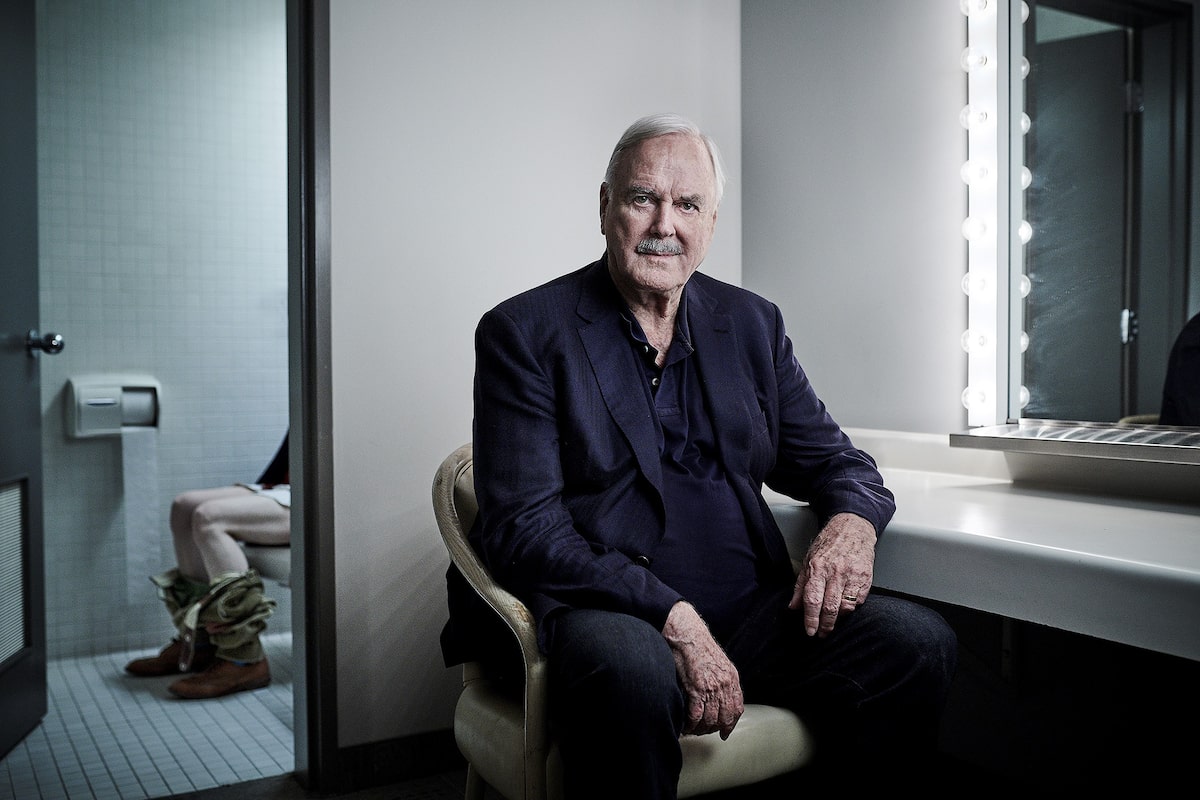
John Cleese’s tour, Not Dead Yet!, is starting off with three screenings and Q&A sessions in Toronto.Supplied
A few years ago in Los Angeles, the Monty Python comedian John Cleese had a precancerous growth surgically removed from his arm. It was a minor procedure that required a few stitches.
“As the guy left the room, he said, ‘Tis but a scratch,’” Cleese says, speaking on a video call.
The pop-culture reference “Tis but a scratch” comes from the 1975 British comedy classic Monty Python and the Holy Grail. Cleese, 86, is travelling with the film on a Canadian theatre tour that begins with three screenings and Q&A sessions at Toronto’s Winter Garden Theatre (Sept. 30 to Oct. 2). The tour then moves on to Kitchener, Ont., Hamilton, Ont., Montreal and Ottawa.
The film is a zany parody of the Arthurian legend, written collectively by Cleese and the other Python members: Eric Idle, Terry Gilliam, Michael Palin and the late Terry Jones and Graham Chapman. Idle later adapted the movie for the stage musical Spamalot, also known as Monty Python’s Spamalot: A New Musical (Lovingly) Ripped Off from the Motion Picture Monty Python and the Holy Grail.
The Monty Python team in 1969, from left to right: Terry Jones, Graham Chapman, John Cleese, Eric Idle, Terry Gilliam and Michael Palin.Michael Ochs Archives/Getty Images
The name of Cleese’s tour is Not Dead Yet!, inspired by a memorable scene from the movie. An old man resists being placed on the plague cart because he’s still alive. Other 51-year-old quotes Python aficionados like to throw around include “Just a flesh wound” and “I fart in your general direction.” Who knew flatulence humour would age so well?
“It’s lovely to think that people have these words in their minds,” Cleese says.
He’s speaking from his place in London’s Chelsea neighbourhood. “It’s a 10-minute walk to Harrods, which pleases my wife very much.”
For those keeping track, Cleese is on his fourth wife. He says their flat is relatively small. “It’s all I could afford after the divorce.” (Cleese went on a tour called A Ludicrous Evening with John Cleese − Or How to Finance Your Divorce in 2009 after expensively splitting with his third wife, psychotherapist Alyce Faye Eichelberger. Another series of shows, dubbed The Alimony Tour, followed.)
Palin as Sir Galahad, Chapman as King Arthur and Jones as Sir Bedevere in Monty Python and the Holy Grail.
Jokey online memes or lines from today’s Saturday Night Live don’t quite stick around the way Monty Python’s catch phrases used to. Comedy fans remember lines from Kids in the Hall, older SNL sketches, SCTV, even the Cleese co-written Fawlty Towers from 1975 like they heard them yesterday. Contemporary equivalents, however, are ephemeral.
“We had much, much better television in England 40 years ago, on just four channels,” Cleese says. “The sad thing about comedy today is that when you come up with something they ask, ‘Can we make it into 12 one-hour segments, and can we put dragons in it?’”
The troupe’s second feature film, 1979’s Monty Python’s Life of Brian, is prescient, even though it was a satire set in biblical times. Cleese wrote a scene − “with a little help from Graham Chapman, who was drinking quite a lot at the time” − in which a man wants to be a woman (named Loretta) and have babies.
Stan/Loretta, played by Idle: “It’s every man’s right to have babies if he wants them.”
Reg, played by Cleese: “But you can’t have babies!”
Stan/Loretta: “Don’t you oppress me!”
It was meant as satire on political thought in the 1970s, when the left in England had become splintered. “What was funny, and is often true, is that they hated the splinter groups more than they hated the original enemies,” Cleese explains.
As for a man wishing to give birth, the idea had to do with the discussion on human rights in the 1970s. “I was trying to think what would be a ridiculous right. Well, it’s the right to have a baby if you were a fellow. So, that got sort of tacked on.”
The troupe released its final feature film, Monty Python’s The Meaning of Life, in 1983. Unlike the narrative-driven absurdity of the previous two movies, it was made up of sketches and musical numbers. Cleese thought it was a backward move and wasn’t happy with some of the sketches and began to branch out on his own.
“My thought was that I didn’t want to go on making other people’s mistakes. I wanted to make my own.”
He first collaborated with British director and editor Charles Crichton on the well-received heist comedy A Fish Called Wanda in 1988. If there were mistakes with the film starring Jamie Lee Curtis, Kevin Kline, Python’s Palin and himself, they weren’t noticed. At the 61st Academy Awards, it was nominated for Best Director and Best Original Screenplay and won a Best Supporting Actor statuette for Kline.
Monty Python last reunited in 2014, when they gave ten concerts at the O2 in London.
“Comedy relies on freshness and newness,” Cleese says. “In the beginning, it was as if were going into a field of flowers nobody had ever been in. We would go around picking flowers, these lovely sketches, but after a time there were fewer and fewer flowers that hadn’t been picked. There’s a certain point where you just run out.”