
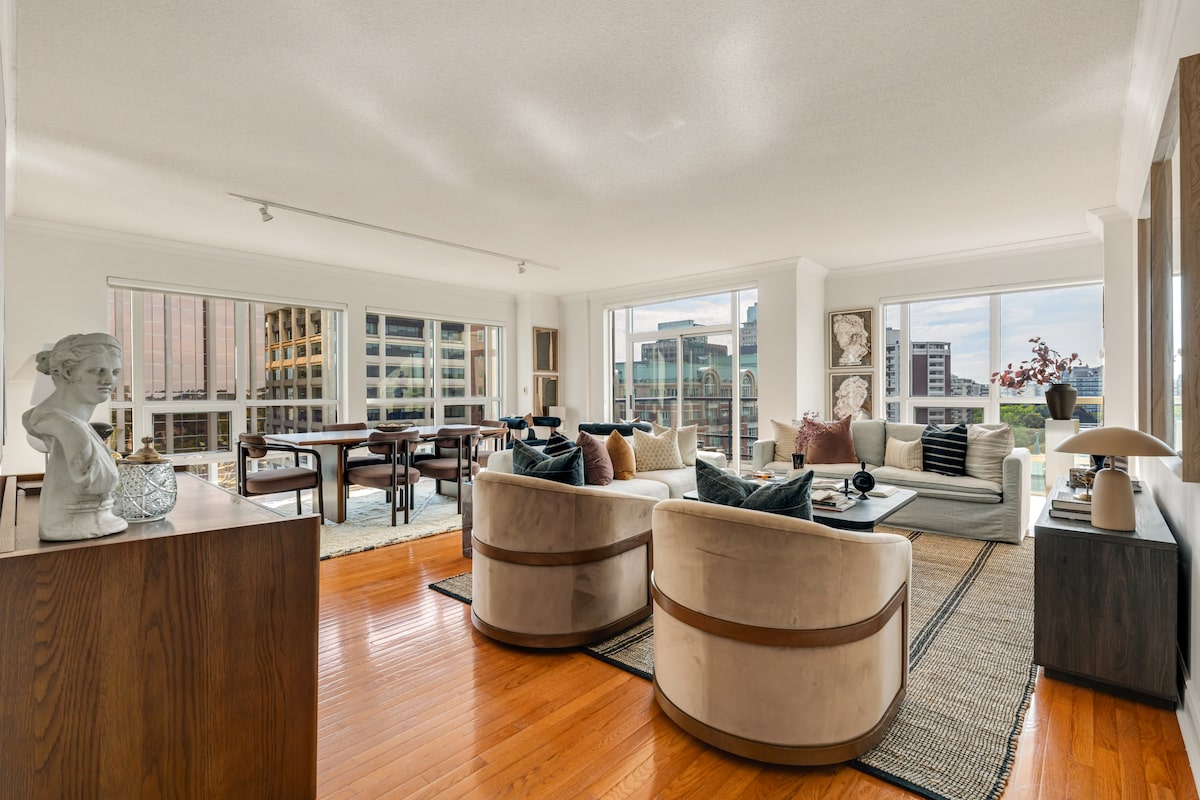
Unit 1106 in this building at 10 Delisle Ave. sold for $1.8-million, or $205,000 above the asking price of $1.595-million.Sotheby’s International Realty Canada
Level-headed sellers and judicious buyers have brought some calm to the troubled Toronto condo segment as lighter supply helps to steady the market.
“It doesn’t feel like we’re free-falling any more. It feels like a lot of the damage has been done,” says Christopher Bibby, broker with Re/Max Hallmark Bibby Group Realty.
Active listings for condo apartments in the 416 region of Toronto shrank by 15.3 per cent in August from the same month last year, according to the Toronto Regional Real Estate Board.
In the same period, sales edged down 0.2 per cent while the average price dipped 2.1 per cent.
Mr. Bibby believes slower sales in August were partly a result of potential buyers wanting to wait for fresh listings in September.
Meanwhile, some potential sellers are deciding to hold off for stronger prices or turning to the rental market instead.
So far, Mr. Bibby has not seen a surge of supply this fall in condos or single-family homes.
“I’m not seeing that big push we usually see post-Labour Day.”
Building tenant wins contest for large lakefront condo
As for buyers, Mr. Bibby says some anticipated that mortgage rates will rise. Some of those with pre-approvals for a three-year fixed-rate mortgage, for example, want to lock in a purchase now.
In September, Mr. Bibby says, some negotiations included a quick closing because pre-approved financing was set to expire after three months.
“People want to put these rates to work.”
Mr. Bibby recently sold a unit in the Wrigley Lofts in Leslieville after negotiations fell apart with the buyer earlier in the summer.
He listed the two-bedroom unit at 245 Carlaw Ave. in February with an asking price of $979,000.
In July, he cut the asking price to $925,000, where it remained when the listing expired in August.
“We were close to a deal – then they travelled, and we vanished,” says Mr. Bibby.
Not long after the listing expired, the buyer had their agent call Mr. Bibby to ask if the unit was still available.
The two sides hammered out a deal for $875,000 in September.
Mr. Bibby says buyers often seem indecisive as they hover around properties. But when listings are terminated or sold to another buyer, they regret missing out.
He received two lowball offers for the unit months earlier.
“It’s sometimes this waiting game – then when it disappears, it’s ‘what happened?’ If you want a loft in a converted bubble gum factory, how many are there?”
Paul Maranger and Christian Vermast of Sotheby’s International Realty Canada, recently drew three offers for a two-bedroom condo with 1,740 square feet of living space near Yonge Street and St. Clair Avenue.
Unit 1106 at 10 Delisle Ave. sold for $1.8-million, or $205,000 above the asking price of $1.595-million.
The two-bedroom condo near Yonge Street and St. Clair Avenue drew three offers.Sotheby’s International Realty Canada
Larger units in walkable neighbourhoods are in high demand, says Mr. Vermast.
Mr. Maranger notes that the downtown area of Toronto is awash in micro condo units, but those are not the units that buyers are looking for in the current market.
“North of Bloor there is a dire shortage of larger suites.”
He estimates that only 11.9 per cent of the condos listed in the city of Toronto in the last week of September have an asking price above $1-million and only 2.6 per cent have an asking price above the $2-million mark.
Those numbers indicate that the large units in desirable neighbourhoods that many empty nesters are seeking are relatively scarce.
Some potential sellers are putting off listing until early 2027 because they are betting on a resolution to the trade conflict with the United States. Others are waiting to see what happens with the federal government’s ban on some categories of foreign buyers, which is set to end on Jan. 1.
Mr. Vermast notes that, as supply contracts, the list-to-sale price ratio is also tightening.
Sellers are probably more sensible in their pricing as well, he notes.
As buyers see more sales, their confidence is bolstered, he adds.
The two say that buyers seem more rational and less fearful this September than last.
“I think it’s a cautiously opportunistic fall market,” says Mr. Vermast.
Mr. Bibby was working to tie up loose ends on four conditional offers as September wound down.
Setting an asking price has become more straightforward, he says, because seller expectations are reasonable. He tends to set asking prices with a small buffer because nearly every buyer is seeking a discount.
“That’s a given,” he says. “We’re going out negotiable.”
Buyers picky, but good location and condition help spur a sale
In the west end, Mr. Bibby sold a penthouse at 22 Southport St. near South Kingsway for $1.057-million after listing the two-bedroom unit with an asking price of $1.099-million.
Mr. Bibby says the unit with 1,709 square feet of interior space and a 525-square-foot terrace sold after about three weeks on the market.
Units with a terrace are rare in the building, he says, and the large outdoor space in this case provides views of High Park and the city skyline.
The last time a unit with a terrace traded hands on the open market was 2003, he says.
Mr. Bibby, who has six new listings landing on the market in the last week of September, says sellers today are clear-eyed about the downturn in prices.
“Nobody’s really testing the market any more. They’re committed to the sale.”
At National Bank of Canada, economists Daren King and Evelyne Gosselin warn that a major headwind for the country’s housing market is looming in the form of rising interest rates.
Since the start of the conflict in Iran, U.S. and Canadian bond yields have surged, they note, and mortgage rates follow the trend set in the bond market.
Recently, however, mortgage rates have not kept pace with the rise in bond yields, which means a rise in fixed mortgage rates is highly likely in the coming weeks.
Rising financing costs are likely to weigh on affordability and further undermine the already fragile recovery in the housing market, caution Mr. King and Ms. Gosselin.
They say that outcome can still be avoided if there is a significant improvement in the geopolitical landscape, which would help to ease inflationary pressures, or a resolution to the trade turmoil between Canada and the United States, which would support the job market.