
Stay up to speed with stories written by drivers, for drivers.
Get automotive news, DIY tips, market trends, in-depth car profiles, and more right in your email inbox.
If there’s a “coolest,” “best,” or “most prestigious” way to arrange the pistons in an internal-combustion engine, it’s to count out 12 of them and put them in a V formation. Big names like Ferrari, Packard, Lamborghini, Mercedes-Benz, and BMW all have V-12s in their back catalog, as this configuration offers advantages in power, power delivery, and smoothness. But V-12s tend to be complex and thirsty, so they’ve mostly gone into high-end cars.
Many vintage cars with 12-cylinder engines still carry high-end price tags, but not all of them. Some offer the creamy thrust of a V-12 for normie money or close to it, and here are a few below. Take this list with a grain of salt, though. Being cheap to buy in this hobby does not necessarily mean cheap to own, and all of these cars will be pricier to keep on the road than your than your average classic.
1992–99 Mercedes-Benz W140
 Mercedes-Benz
Condition #2 value: $35,600–$58,400
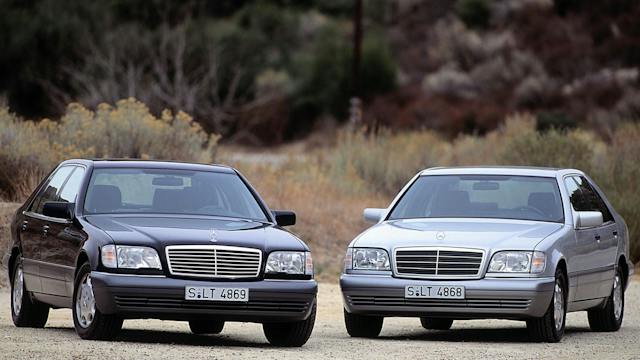
The W140 S-Class is classic Mercedes-Benz overengineering. It’s big and it’s complicated, but it’s also quiet and comfortable. It also came in wide-ranging specs, and today the S-Class carries wide-ranging values. There are six-cylinder turbodiesels that you can find in #2 (excellent) condition for about 12 grand. There are also gas sixes, V-8s, and, of course, the range-topping V-12 in the “600” models.
As Mercedes’ flagship, the 600 series W140 came as a coupe or sedan with two wheelbase lengths. The M120 V-12 underhood was 5987 cc and made 389 horsepower. An early 600SEL (sedan) is particularly pricey, with #2 values in the high-$50K range, while the 600SEC (coupe) comes in significantly less, in the mid-30s. The ’94 model year saw nomenclature changes to S600 sedan and S600 coupe, and the ’98 model year saw another one, to S600 (sedan) and CL600 (coupe), but these all carry similar values.
2002–06 Aston Martin Vanquish
 Aston Martin
Condition #2 value: $71,200 (Vanquish), $83,300 (Vanquish S)
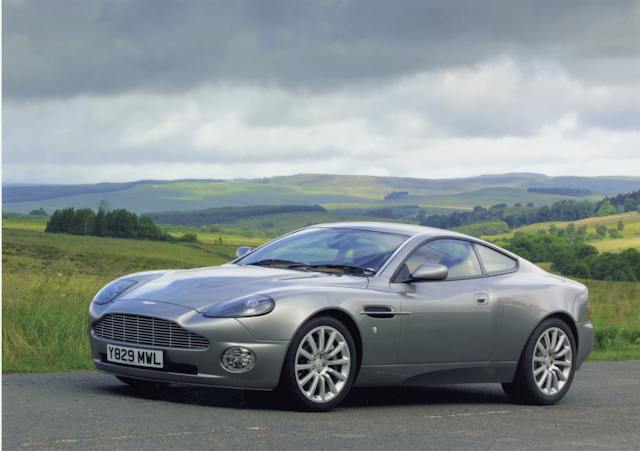
Aston Martin unveiled the original Vanquish at the Geneva Motor Show in 2001. After making a splash in Switzerland, it got even more good press when it marked Aston’s return as James Bond’s ride in 2002’s Die Another Day. The new model resulted in a major redesign at the Newport Pagnell factory, with a new assembly line, paint shop, rolling road, and water test unit. Ian Callum did the styling, and underneath was a bonded aluminum/carbon fiber monocoque, as well as a 5935-cc, 460-hp V-12. In 2004, the Vanquish got an update as the “Vanquish S,” with power raised to 520 hp, a mild facelift to the body, and some handling and braking improvements.
When new, the Vanquish cost more than $200,000, and in price, layout, weight, and performance, it was a direct competitor to the Ferrari 575M Maranello. But few things depreciate quite like a modern Aston, and now you can get one of the most advanced and best-looking cars of the 2000s for less than a third of MSRP. Vanquishes are still worth less than they were a decade ago, even before adjusting for inflation. As for the Ferrari, a 575 is worth over twice as much as the Aston, and a six-speed manual (which wasn’t available on the first gen Vanquish) can double the value of a 575 again.
1946–48 Lincoln Continental
 Broad Arrow
Condition #2 value: $31,800 (Coupe), $47,800 (Cabriolet)
While V-12s have powered many a sports and racing car due to their advantages in power delivery and rev-ability, they also offer smooth running and a lack of vibration. That’s why luxury carmakers, looking to offer quiet comfort and sophistication, have been drawn to the V-12 configuration since the early 20th century.
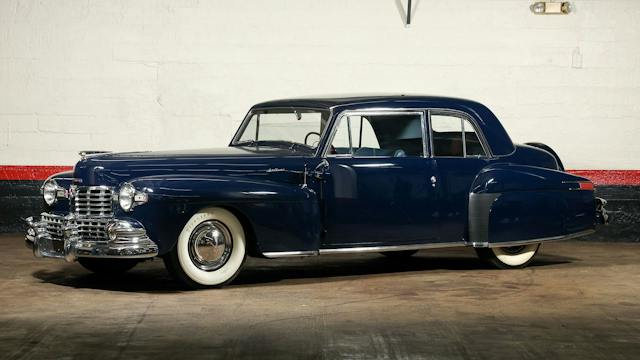
Lincoln started building V-12s in the 1930s, most often seen on its Lincoln-Zephyr line of mid-range luxury cars, but also on the larger, first-generation Continental. Introduced for 1940 and built until the abbreviated ’42 model year, the Continental was essentially a hand-built coupe or convertible. Production resumed in 1946, with revised trim and styling, and that year Henry Ford II paced the Indy 500 in a Continental. At more than $4000, it was one of America’s most expensive cars, and production only reached a few hundred cars annually before Lincoln canceled the model after 1948, which was the last appearance of the Lincoln V-12, as well as the last appearance of the Continental badge until 1956.
Despite their rarity, sophisticated engines, and Full Classic status with the Classic Car Club of America, postwar Continentals aren’t pricey. Condition #3 (good) convertibles currently sit at under 30 grand, and coupes are in the teens. They’re likely to stay cheap, too, as current prices are less than they were 10 years ago across all body styles and conditions.
1976–96 Jaguar XJ-S
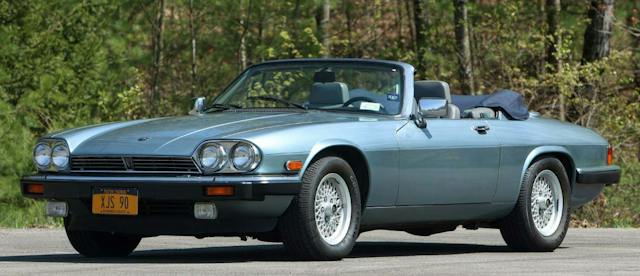
Condition #2 value: $21,000–$29,400
The XJ-S had E-Type-sized shoes to fill when it came out for 1976. Given the context of the car industry in the mid-1970s and the British car industry in particular, the new Jag was never going to live up to the standards of its older siblings, but the XJ-S could at least boast distinctive styling as well as wins in both Trans Am and touring car racing. When it was running right, the 5.3-liter V-12 was also silky smooth. Jaguar sold more than 115,000 copies of the XJ-S over two full decades (badged as XJS from 1991 on). E-Type production, by contrast, was fewer than 75,000.
Rust, electrical issues, and engine maladies have all contributed to the car’s iffy reputation and put them squarely in the cheap-to-buy, expensive-to-maintain camp that is home to many an old luxury car. Jaguar introduced a straight-six–powered version in 1983, and these six-cylinder ones don’t carry a huge discount, since they’re easier to live with.
XJ-S prices actually did see a serious run-up during 2021 and 2022, but they’ve been on a downward trend since 2025, and really nice ones, regardless of year or body style, are typically selling in the mid-$20K range.
1993–2002 Mercedes-Benz 600SL/SL600
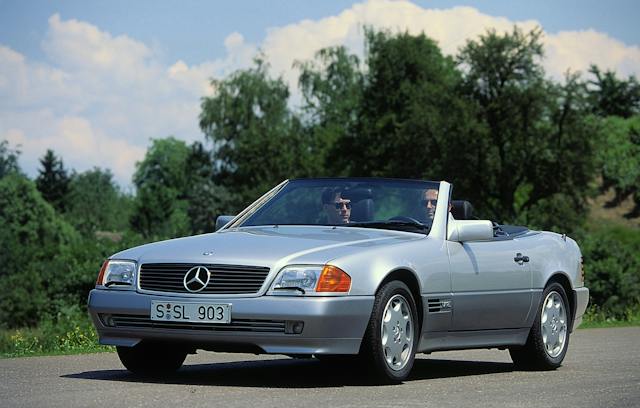 Daimler AG
Condition #2 value: $42,200–$52,300
For 1990, Mercedes-Benz really did need a replacement for the R107-generation SL, which had been going since 1972. That replacement, the R129, brought huge advancements for the SL line, including multilink rear suspension and an automatic roll bar that extended in the event of an accident. Initially, the R129 was available with either 3.0-liter six-cylinder power as the 300SL or with a 5.0-liter V-8 in the 500SL. For 1993, though, the Germans dropped in the 389-hp M120 6.0-liter V-12 to create the 600SL.
A nomenclature change in 1994 rearranged some letters to create the SL600, but the car was largely the same. A minor facelift for 1996 also swapped the hydraulic four-speed automatic transmission for an electronic five-speed auto. Further luxury upgrades came in 1997 and ’99, before the R230-generation car took up the SL torch for 2002.
The 600SL/SL600 carries a decent premium over the V-8–powered 500s, thanks to the prestige of those four extra cylinders. They’ve also appreciated considerably in recent years. In the late 2010s, an SL600 in #2 condition was worth under 20 grand in our price guide. But, considering these 12-cylinder luxury roadsters cost well over 100 grand when they were new, they still look like a screaming deal—until that first big repair bill comes due.