
Hundreds mark National Truth and Reconciliation Day in White Rock
Published 5:00 pm Thursday, October 1, 2026
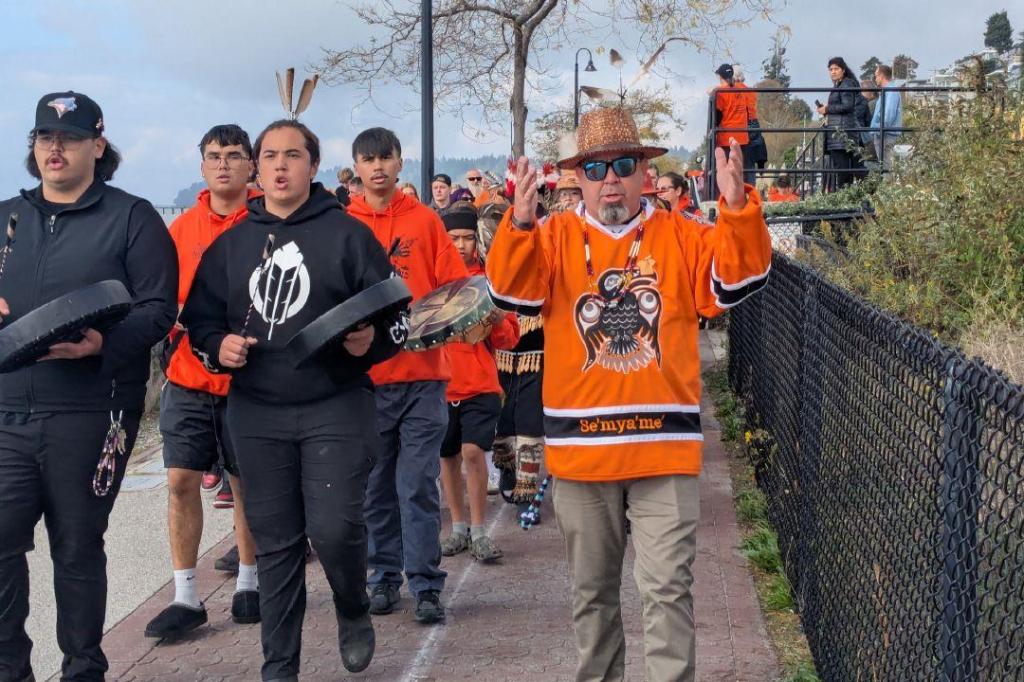
Hundreds of people turned out for the Semiahmoo First Nation’s sixth annual Walk for Truth and Reconciliation on Wednesday, Sept. 30.
An estimated 600 people joined in to mark Canada’s National Day for Truth and Reconciliation in White Rock.
The event started with a walk beginning at Grand Chief Bernard Robert Charles Memorial Plaza on White Rock’s East Beach, near the House Posts, and continuing on to Semiahmoo Park.
Semiahmoo First Nation Chief Harley Chappell offered a welcome at the plaza before leading walkers along the Promenade to Semiahmoo Park.
Chappell expressed frustration and anger that the same conversations with government on Indigenous rights are happening year after year – the same conversations, he said, that his First Nations’ ancestors and elders had.
“My prayer is our children won’t have to take the same positions, and have the same conversations,” he said.
But he warmly thanked all those who came out to show their support, including residents and municipal and provincial politicians, which, he said, demonstrated the strong sense of community among all those who live on the Semiahmoo Peninsula.
“I’m full of hope – I love our home and I love our people,” he added. “We won’t let the hate win…a little bit of love is what’s needed.”
“Reconciliation isn’t made in Victoria, or in Ottawa. It’s made here,” he said.
SFN Councillor Jennine Cook also noted the “community” of supporters for the Walk for Truth and Reconciliation – still growing “six years in.”
Keynote speaker for the event was Phyllis Webstad, CEO and co-founder of the Orange Shirt Society
She recounted that – having spent most of her earliest years at the Dog Creek Reserve in the Southern Cariboo – at six years old, she was sent to the St. Joseph Mission Indian residential school, where a gift from her grandmother, a shiny new orange shirt, was taken away from her.
That moment laid the foundation for what has become a campaign of awareness and advocacy for residential school survivors.
Noting the growth of the campaign, Webstad said that “ever since Orange Shirt Day started it’s been divine guidance – there’s no other explanation for it.”
At the opening ceremony, SFN Councillor Joanne Charles noted her grandmother, mother and aunt were all residential school survivors.
“The inter-generational impacts of the residential schools fell on all of us,” she said. “But we’re strong and resilient people.”
Charles referred obliquely, as Chappell had, to Indigenous groups concerns that the current federal push for the Pacific Link pipeline, under the Building Canada Act, undercuts prior and informed consent principles and violates the United Nations Declaration on the Rights of Indigenous Peoples (UNDRIP).
“It’s hard times this week after coming back from Ottawa,” she said.
She recalled that when she first returned to SFN after completing school some 30 years ago, she had asked her uncle, late Grand Chief Bernard Charles, what she could do to help – and was told that he and colleagues had been having the same discussions on Indigenous rights with government for decades before that.
Some progress has been made over the years, she said – but not enough.
“We’re seen and heard – we have a place at the table,” she said.
“We can all work, and create, together.”
After the walk, the day continued with an Indigenous marketplace, performances and a complimentary lunch hosted by SFN.