
Planting requires little care except for a cleanup in late winter or early spring, followed by a mulching.
Dear Helen: Have you grown alpine (woodland) strawberries? If you have, are they difficult to grow? Are they nutritious?
L.B.
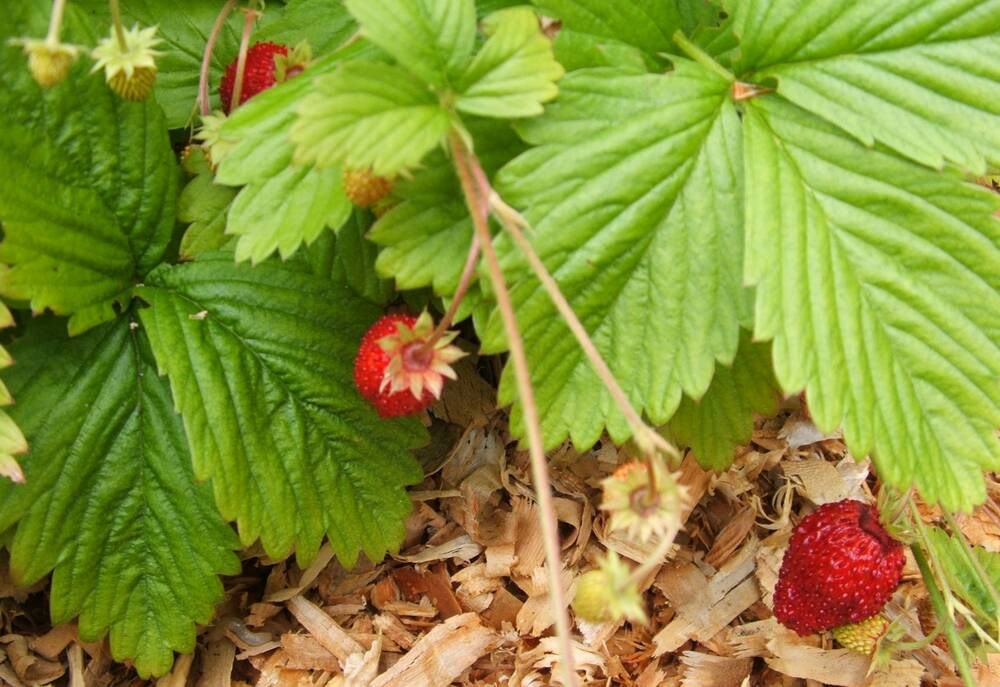
I have a small planting of alpine strawberries that have grown for over a dozen years along the edge of a curved pathway beside the kiwi vines – on the vines’ south side. There are two varieties — Alexandria, and Mignonette. They are not difficult to grow from seed, and the small plants produce berries from late spring through fall.
The small planting requires little care except for a cleanup in late winter or early spring, followed by a mulching with compost covered by wood shavings or aged sawdust to keep the berries clean. The plants do not produce runners.
The little berries are delicious. They are one of my favourite treats for in-garden munching. The berries are high in vitamin C, A and E, and rich in numerous minerals.
Seed sources change from year to year, but Mignonette is usually available from West Coast Seeds and Renee’s Garden; Johnny’s Selected Seeds usually carries Alexandria.
Dear Helen: What are the best storage conditions for onions and potatoes? Can they be kept in the same storage place for the winter?
A.P.
Though some of their ideal storage conditions are similar, there are significant differences as well.
Both need free circulation of air in the storage place, ideally with the vegetables in slatted boxes or arranged in a single layer in shallow boxes. Both require darkness to hold back sprouting and to keep potatoes from developing a green colouring, which indicates the presence of toxic alkaloids.
Onions need dry, cold conditions with temperatures barely above freezing and humidity levels at 70 per cent or lower. In these conditions onions store well for six to seven months.
Potatoes require high humidity levels and storage temperatures between 3 and 5 C. Colder temperatures affect the taste. In these conditions potatoes keep for five to six months.
I have in the past wintered both these vegetables together in a storage room off the carport, with results that were not perfect but acceptable to me. Now, I keep just a few potatoes at a time out on carport shelving, covered with newspaper to maintain darkness. The rest of the potatoes remain out in the garden, well mulched, for digging as needed.
Dear Helen: If you grow snow peas, where do you buy the seeds, when do you plant and what variety or varieties do you grow? Can they be preserved for use in winter dishes?
S.C.
I love snow peas. I grow several varieties each year, and if I get the first seeding in early enough there is often time for a second one. They are one of my favourite in-garden snacks. My best variety this year was Swiss Giant, from Salt Spring Seeds. I see on their website that this variety is currently sold out
I make my first seeding, of several varieties, as early as conditions allow – late February or early March if possible.
This is the first year I’ve tried freezing snow peas, because the Swiss Giant vines produced so abundantly. I washed, and cut the pods in two or three pieces, diagonally, before steam-blanching them for two to three minutes and cooling them quickly over ice packs and drying them with a clean tea towel before freezing the, on trays for several hours, and packaging them.
I haven’t tried the home-frozen version of snow peas yet. Stay tuned.
GARDEN EVENTS
Abkhazi Garden plant sale. Abkhazi Garden, 1964 Fairfield Road in Victoria, is selling plants and a large selection of bulbs at great prices until Thanksgiving Monday, Oct. 12. All proceeds go to the care and maintenance of the Garden. Open hours are 11 a.m. to 4 p.m. Please note the garden is closed on Monday, Oct. 5 and Tuesday, Oct. 6.
Fruit identification. Dinter Nursery, 2205 Phipps Rd. in Duncan. Is offering an apple tree identification event on Saturday, Oct. 3, 12 to 3 p.m. Bring four of the largest apples (unwashed) you want identifying, with stems on. Collect from the sunny side of the tree and store cool in paper bags. Information helpful in identification: When the apples were picked. When does the fruit usually ripen. How long does it keep in cool storage. Is it better eaten raw or cooked?