
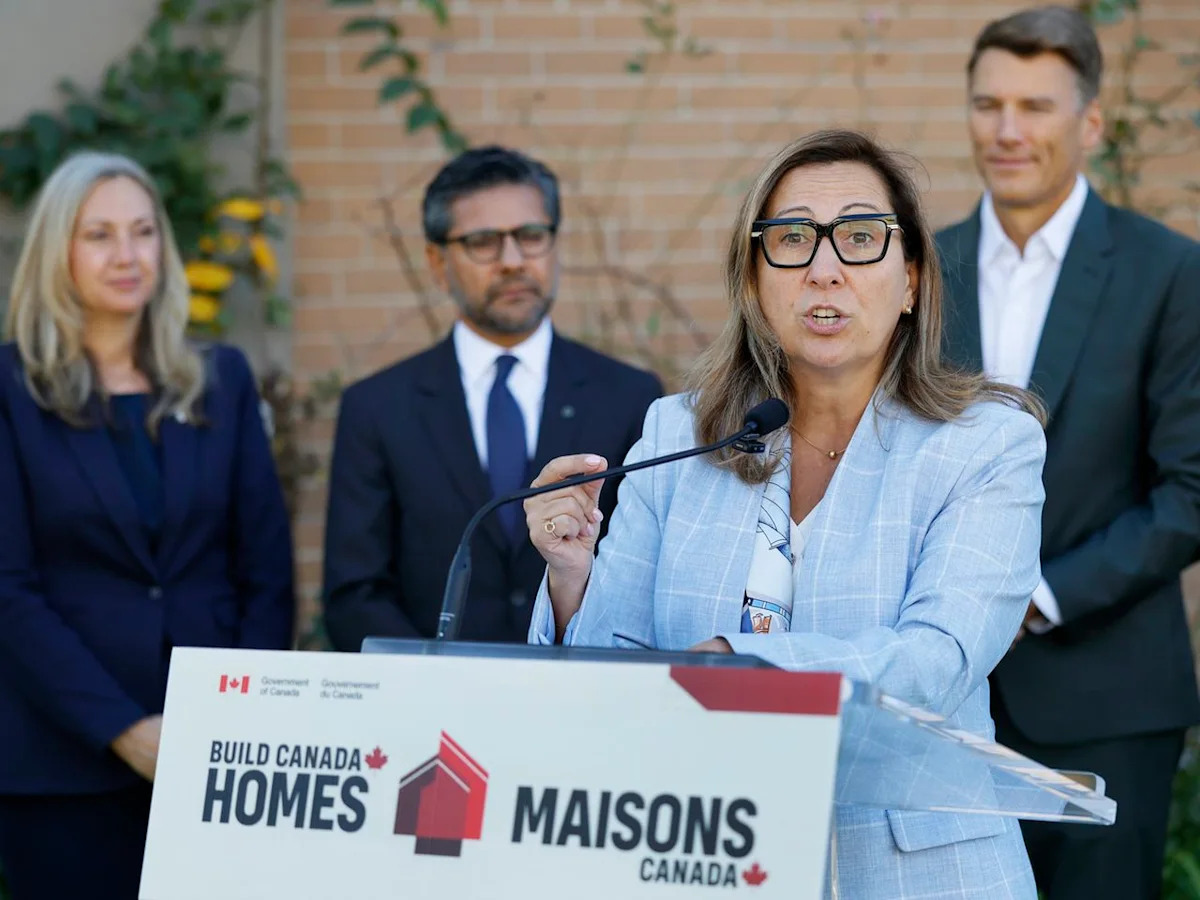
 Build Canada Homes chief executive Ana Bailão takes part in a housing announcement in Ottawa on Sept. 22, 2026. (Credit: Blair Gable/Postmedia files)
Build Canada Homes, the federal government’s housing agency, committed to building 19,000 homes in its first year, 2,300 of which are currently under construction. It’s part of Ottawa’s effort to speed up the delivery of affordable housing across the country.
“We think sometimes to deliver housing, the only issue is funding, and it’s not,” said Build Canada’s chief executive Ana Bailão during an Empire Club of Canada event in Toronto on Friday.
“Sometimes the issue is more on the delivery, the things not being aligned between governments, such as taking too long to take your permits and then funding doesn’t come at the same time,” she said.
The federal housing agency has struck 19 financial partnerships over the past year, including agreements with provinces and municipalities such as Quebec, British Columbia, Ottawa and Toronto. In addition to the 2,300 homes currently being built, there are about 3,000 supportive and transitional housing units, Bailão said.
The agency has also helped unlock nearly $12 billion worth of investment and designated 24 sites across more than 1,100 acres of federal land for affordable housing.
Bailão described the agency’s first year as “steady progress against stiff headwinds.”
“If you ask me if I’m satisfied with the results, the answer is no,” she said. “But if you ask me if I’m encouraged, the answer is yes.”
Bailão said Build Canada is trying to address delays by getting governments and other partners aligned earlier. The agency has signed agreements with 10 provinces and territories and created implementation tables to coordinate projects, investments and priorities.
She also previewed a yet-to-be announced partnership to build 1,000 affordable homes across several small and mid-sized communities. The initiative will bring together municipalities, a modular housing manufacturer, non-profit housing providers, financing partners and the provincial government.
“We are creating a multi-year, multi-project delivery system,” Bailão said. “It is repeatable, it is scalable, and it stretches our public dollar much farther.”
Benjamin Tal, deputy chief economist at CIBC Capital Markets, who moderated the discussion, said the stakes are high.
“We have been failing young Canadians,” Tal said. “And we have to change it.”
• Email: shcampbell@postmedia.com