
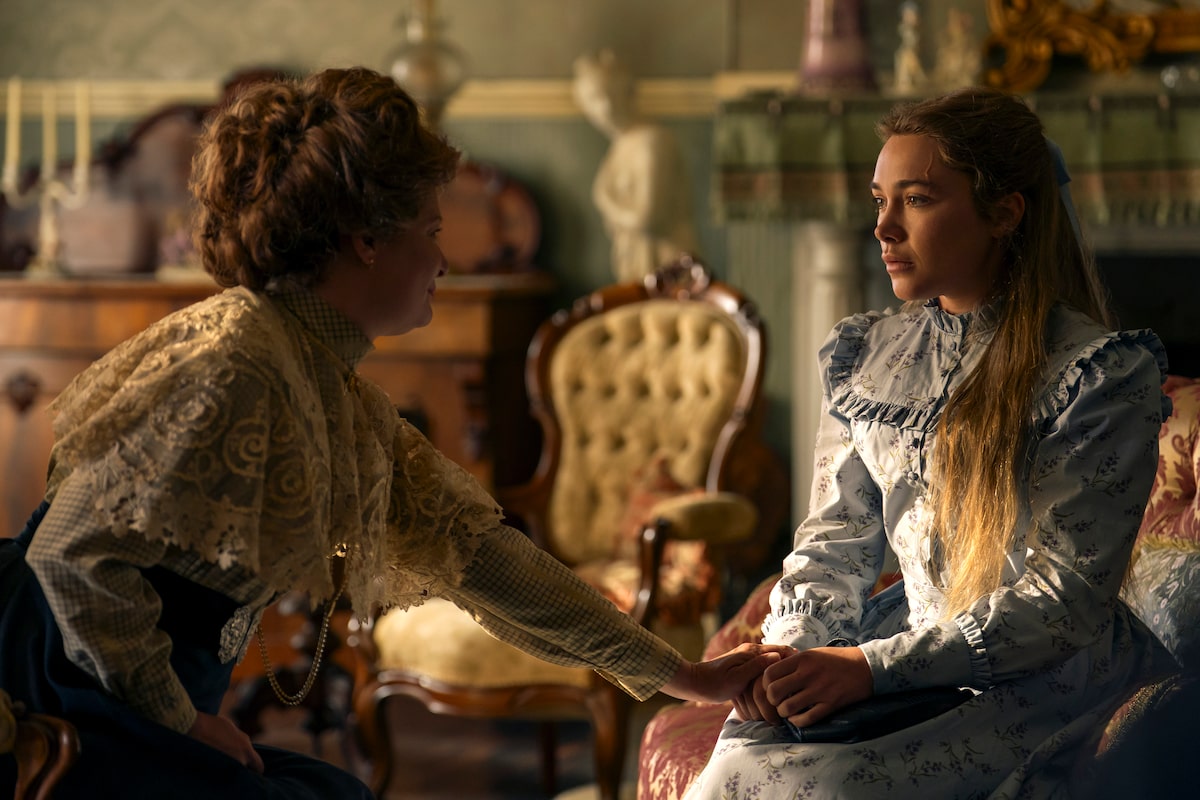
Martha Plimpton (left) as Faye and Florence Pugh as Cathy Ames in the new Netflix adaptation.Geoffrey Short/Netflix
The United States of America is rarely united. It is the Cain and Abel of countries, a land of brothers who split into camps and pit themselves against each other time and time again.
That’s the story of John Steinbeck’s 1952 novel East of Eden, a saga that follows the Trask family from the aftermath of the American Civil War to the Great War.
It may seem perverse then to pit the 1955 film adaptation of Steinbeck’s sprawling book against the new miniseries that’s out this week on Netflix.
The classic movie starring James Dean (clocking in at under two hours), only endeavoured to cover the last quarter of Steinbeck’s narrative – and took creative liberties.
The Netflix version starring Florence Pugh, meanwhile, attempts to reverently cover the novel’s full scope.
Over seven hours, it first dives into one generation of good-and-bad Trask brothers in Connecticut in the late 19th century, then does so again with the next generation of them in California’s Salinas Valley at the start of the 20th.
The performances in the new miniseries are restrained to the point of repression, writes Nestruck.Netflix
The compulsion to compare and contrast these takes on Steinbeck’s multigenerational epic made 70 years apart, however, comes from the family connection between them.
The late legend Elia Kazan directed the movie, while his granddaughter Zoe Kazan is the writer of the miniseries.
Watching the two in tandem this week did not necessarily make me feel like the arc of American screen adaptation was bending toward the better.
Though it was not shot in 3-D as originally planned, Elia Kazan’s film, scripted by Paul Osborn, still is full of performances that leap off the screen.
Dean, whose career was a brief flicker of a candle, gives a nervy portrayal of young Californian Cal Trask. He physically wrestles with his internalized feeling of badness and the shame of a mother who chose the brothel over raising him and his brother from one side of each carefully composed widescreen CinemaScope frame to the other.
Hoon Lee (left) as Lee and Ciarán Hinds as Samuel Hamilton.GEOFFREY SHORT/Netflix
Julie Harris is more anchored and yet equally alive in her portrayal of Abra, a young woman pulled between Cal and his brother Aron.
By contrast, everything feels flat in the new Netflix miniseries – directed by Garth Davis in its first episodes and Laure de Clermont-Tonnerre in its later ones.
The performances are restrained to the point of repression, the writing overly reverent to source and the visuals too often simply drab.
Zoe Kazan’s adaptation of East of Eden begins in Connecticut where a strict father Cyril Trask, a Civil War veteran of sorts, is raising two sons from different moms.
Tracy Letts, in one of the only performances that really lifts off the screen, plays Cyril as a cruel conman. (Letts, the playwright of August: Osage Country, knows his way around an allegorical American family saga.)
Cyril raises his sons to hate each other, beating the peaceful Adam and making him enlist in the army, while forcing the pugilistic Charles to stay home on the farm.
“I love you better,” Cyril tells Adam, in a line pretty much directly lifted from Steinbeck. “Why else would I have given myself the trouble for hurting you?”
After Cyril’s death, his sons Adam (Christopher Abbott) and Charles (Mike Faist) manage to co-exist together on the family farm as adults until a woman, almost beaten to death, shows up to divide them again anew.
Cathy (Pugh) is nursed back to health by the supposedly good Adam – and viewed with suspicion by Charles who sees something of his supposedly darker nature in her.
It’s Cathy who will give birth to the next generation of feuding Trask brothers – twins Caleb and Aron – in California and then shoot her way out of stifling marriage and motherhood to return to brothel life under the name of Kate.
The young adult twins’ dawning realization that their mother is a madam forms the conflict for the final episodes, as it does the movie.
Thematically, Steinbeck’s novel is focused on the choice between good and bad – which he distills down to the Hebrew word timshel or “thou mayst,” which was translated instead as “thou shalt” in the King James Bible.
So it’s a mysterious aspect of the book that Cathy is depicted as inexplicably evil. The narrator insists that Cathy has a “malformed soul”: “She was not like other people, never was from birth.”
In her adaptation, Zoe Kazan has decided the narrator is wrong and, inspired by a brief reference by Cathy to Alice in Wonderland in the novel, invents a childhood moment that curdled Cathy into who she is.
Pugh is often compelling playing grown-up Cathy as a woman who will never let herself be trapped by a male again. But there’s never any sympathizing with her calculated cruelty, at times full-on psychopathy.
Unfortunately, Cathy is not the only character it’s hard to root for. Abbott’s portrayal of Adam Trask is morose throughout, his goodness always shown as flimsy; it’s hard to distinguish the character’s depressive period from the rest of his life.
The only goodness that really convinces comes from Hoon Lee, wonderful as Lee, Adam’s servant who becomes a surrogate parent to Cal and Aron.
The Chinese-American character gets filled out with a trip to San Francisco in an episode co-written by Alexander Chee.
Too many of the others feel trapped in two-dimensional allegory.
Zoe Kazan’s adaptation is judgmental about the American past and pessimistic about its future.
That reflects the general mood south of the border right now, once again splitting apart – but an East of Eden without the hopefulness encapsulated by timshel is a bleak one.