
A joint Scottish-Japanese project to study whisky making in space may pave the way for a new generation of medicines.
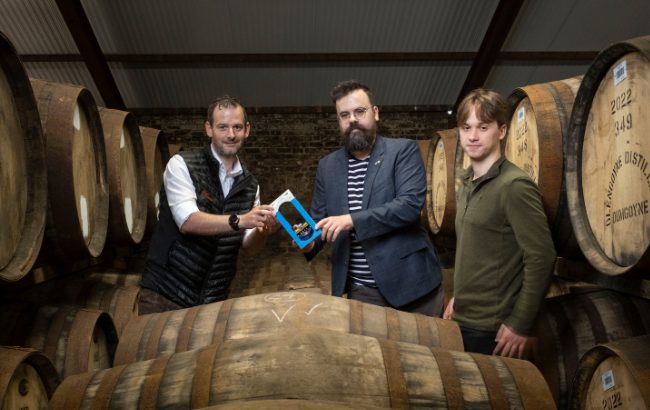
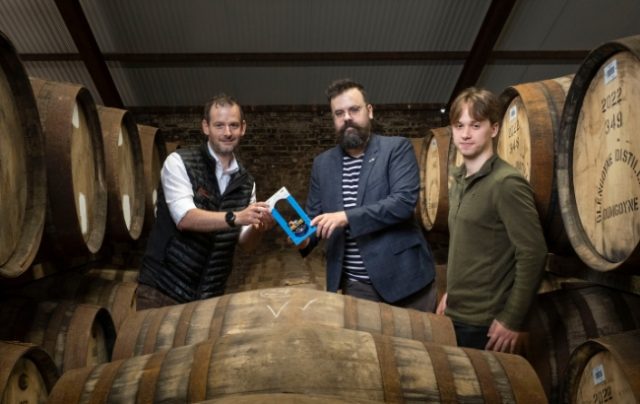 Geoff Nisbet of Allen Associates, Dr Gilles Bailet and Micah Chapman of the University of Glasgow examine prototype space equipment
Researchers from the University of Glasgow and the Kyushu Institute of Technology are preparing to send 10ml of whisky and a cask fragment into orbit aboard a small CubeSat satellite.
The project, which is set to launch in 2028, will see both samples subjected to the microgravity and rapidly changing temperature conditions of space for up to five years.
An artificial ‘tongue’ which allows rapid chemical analysis will monitor both the whisky and the wood to detect changes in their composition over the course of the experiment.
The team behind the project suggested their research would shed light on how ethanol can be extracted in orbit.
This could potentially pave the way for orbital factories capable of creating molecules that are difficult or impossible to synthesise on Earth, especially those with medical applications.
Project lead Dr Gilles Bailet, of the University of Glasgow’s James Watt School of Engineering, said: “Previous research has suggested that the microgravity of space may allow us to grow larger, purer chemical crystals and to fold proteins in new ways.
“Big questions still remain over how me might actually do chemistry in space, however, and this project aims provide some answers.
“Whisky gives us a very recognisable, very well-understood model for studying and monitoring biological and chemical processes in microgravity. This project will provide valuable new insights into how fermentation and chemical evolution can be monitored and controlled in space, as well as how ethanol can be made in orbit.
“Our ultimate aim is that our project could help to scale up chemistry and biomanufacturing in space, where there is a great deal of potential to produce high-value pharmaceuticals and next-generation cancer therapeutics.”
Spirits in the sky
A group of seven final-year mechanical engineering students from the University of Glasgow is currently in Kyushu in Japan, working to co-design the system which will be sent into space, including its battery, radio and on-board computers.
Their trip is being funded by a grant from Stirling-based distillery design consultancy Allen Associates.
The project is receiving further support from University of Glasgow societies, including GU Orbit which helps students to get hands-on experience of space-related projects.
Glasgow engineering student Micah Chapman, currently hard at work on the project in Japan, said: “More than a century ago, a Japanese student called Masataka Taketsuru came to Glasgow to study chemistry.
“While he was here, he visited distilleries and returned to Japan with a detailed knowledge of whisky making. He began work at a distillery and became world-famous as the father of Japanese whisky.
“I’m thrilled to have this opportunity to be part of another project which unites Scotland and Japan in an effort to change the world through the chemistry of whisky. It’s fantastic to have the chance to work on a project that will be launched into space, and I’m excited have this opportunity to work and learn at Kyushu Institute of Technology.”
Chapman is joined on the trip by fellow students Liam Alkire, Fraser Allen, Milo Godwin, Peter Moody, Yuki Suter, and Muhammad Taha Malik.
The Spirits Business has approached the University of Glasgow to confirm the origin of the whisky that will be used in the experiment.
It is not clear at this point whether a Japanese or Scotch whisky will be chosen.
Though this project will mark the first time whisky has been exposed to the vacuum of space, it won’t be the first time whisky has been blasted into orbit.
In October 2011, Islay’s Ardbeg Distillery sent samples of its single malt to the International Space Station (ISS) to study the way they matured in a microgravity environment.
Upon their return in 2015, Ardbeg whisky maker Dr Bill Lumsden noted the samples from the ISS had a markedly different profile than those kept on earth, highlighting the impact of gravity on maturing spirits.
Related news
Ardbeg announces ‘groundbreaking’ space whisky results