
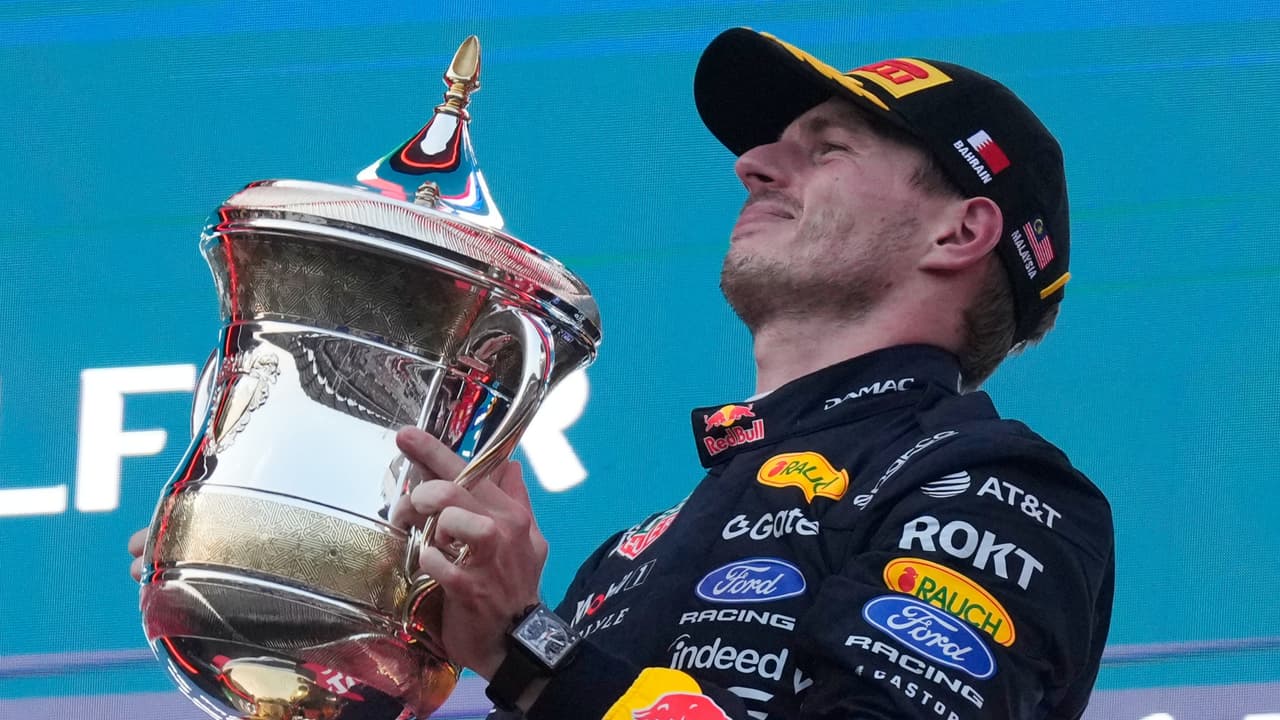
It took a shift to Malaysia for Bahrain to have its first-ever wet grand prix, but it was a spectacle worthy of its bizarre circumstances.
It was a race that had it all: torrential rain, strategy pinch-points, epic recoveries, tremendous wheel-to-wheel battles a historic victory for Max Verstappen and Red Bull’s in-house engine.

And not for the first time, Malaysia had championship consequences for a Mercedes driver to the advantage of another, with George Russell’s late retirement all but locking in a title for Andrea Kimi Antonelli, even at a muted weekend for the hitherto dominant team.
It was a most worthy return for Sepang that had drivers, teams and fans asking for more of the iconic Malaysian track.
VERSTAPPEN’S HISTORIC FIRST
Verstappen’s first pole of the season was no fluke, with his Red Bull Racing car clearly performing at a high level at high-degradation Malaysia.
He was the favourite to win the race, and though his hopes may have looked dented after being blitzed off the line by both Mercedes drivers, it was clear quickly he still had the pace.
He passed Russell without fuss and then Antonelli, after a safety car, just as easily, and he was never really challenged thereafter, including following the late safety car that could have given Kimi a second crack at the lead.
It’s the longest Verstappen has had to wait to claim his first win of the season — and it’s his second consecutive win in Sepang, having won the last race here in 2017.
But this one came with extra punch, being the first victory for Red Bull Powertrains, the energy drinks brand’s in-house engine program in just its first season in Formula 1.
RBPT is the first genuinely new manufacturer to win a grand prix since arguably Mugen in 1996, though the line between the Japanese brand and Honda is extremely blurry. Porsche’s first F1 win with McLaren in 1984 is probably a better comparison.
Ford, though, will claim this is its first grand prix victory since the 2003 Brazilian Grand Prix, when a Ford Cosworth motor won in the back of Giancarlo Fisichella’s Jordan.
“It’s a really nice one after the year that we’ve had and the progression that we made,” Verstappen said. “I’m incredibly proud of everyone. It’s just super nice to win here.
“It’s incredible. I think already we started [well], but to win our first race in our first year with our own power unit is pretty impressive.”
As a coda, Verstappen’s 72nd career victory — all with Red Bull Racing — draws him equal with Michael Schumacher’s 72 victories with Ferrari, making him the second-most successful driver with one team, behind only Lewis Hamilton’s 84 wins with Mercedes.
With a long-term contract in his pocket, he’s in a strong position to reap many more wins if Red Bull Racing continues on this trajectory.
Lando’s blunder costs McLaren late | 00:41
WHAT WAS THAT START ALL ABOUT?
The start of the race was delayed by 40 minutes in torrential rain and got started with what should have been two exploratory laps behind the safety car — nothing unusual there.
But this is the first real running any cars have got in the wet this season, and what happened next was clearly a surprise to almost everyone.
Drivers were travelling slowly behind the safety car when suddenly several of them found they had no power — or that nothing was happening when they hit the accelerator.
First it was pole-getter Verstappen, then Hamilton, and then several others, with every engine manufacturer represented.
It wasn’t the rain. It was what the FIA described as a “bug” in the engine software.
These super-complex — unnecessarily complex, one might argue — and highly controversial hybrid engines have myriad rules governing how they work.
One of them is designed to prevent teams from surreptitiously programming a form of traction control. It does this by completely cutting power to the wheels for 60 seconds when it detects the hybrid motor has been turned down to zero as a sort of deterrent.
This is the rule that several drivers fell afoul of without realising it.
The reason it had never come up before is that these engines have never started a wet race before, when certain other special rules apply.
Namely, hybrid power is reduced from 350kW to 250kW in the wet on safety grounds.
But there are parts of the track where the engine software also cuts hybrid power by 250kW, also on safety grounds, effectively switching off the hybrid engine.
Drivers would enter turn 9 going extremely slowly behind the safety car — so slow that their turbochargers would spool down and no longer offer boost.
Normally the hybrid motor kicks in to get things going again, but the combination of these special rules meant that didn’t happen.
As a result, the engine power was completely cut. Effectively it triggered the traction control ban.
The only way to get the power unit back online was to restart it.
By the time the drivers got going again, the order was comically jumbled, so the FIA threw a red flag to restart and reset the entire situation.
The subsequent 50-minute delay then looked as though the sport was waiting for the track to dry to avoid a repeat.
What was actually going on was a hastily programmed software update that needed to be loaded into every engine to fix the bug.
The grand prix got underway more than 90 minutes after its scheduled start time.
Of the various underwhelming moments of these 2026 engines, this is surely the lowest — and demonstrates why the sport is so determined to move on to something simpler by 2030.
Russell’s title hopes dashed in 2026? | 01:38
DNF KILLS RUSSELL TITLE HOPES
Toto Wolff had a face of thunder after the race.
Andrea Kimi Antonelli had finished a forward-moving but ultimately ineffectual second in an upgraded Mercedes car that just didn’t have the pace to match Red Bull Racing.
Worse, though, was that George Russell suffered another retirement with an engine problem.
“I’m massively annoyed and not in a happy place,” he told Sky Sports, visibly irritated. “First of all, we didn’t have the speed that we were hoping to have before the weekend, so there’s a lot of homework to be done in order to recover, which I’m sure we will.
“To make things worse, a [power unit] failure with a few laps to go to the end with George, which is terrible for his championship and not good at all for our constructors points.
“As much as I love to be here when I look at the pure races, [this is] one of my worst experiences, to be honest.
“The DNFs could cost us dearly, also for the remaining seven races.”
It says more about Wolff’s perfectionism and competitiveness than it does about the reality. Mercedes is 151 points ahead of Ferrari and lost only nine points to the Italian team. The constructors title will likely be won in a couple of rounds.
That could change next season, though, if Ferrari delivers a better engine — or if Red Bull Racing turns a win like this into a genuine trajectory for 2027, or if McLaren can pull itself together.
Unfortunately for Russell, the same applies to him.
The pre-season championship favourite’s power unit popped with five laps remaining. Immediately his body language was of resignation rather than anger as he parked his broken Mercedes, and that was very much the vibe out of the car too.
“You’ve almost got to laugh,” Russell told Sky Sports. “It’s beyond disappointment.
“It’s just so many times this season it’s happened. It’s a real shame.”
The title permutations are dire. He was already a deeply unlikely 66 points behind before the race; now the margin is a season-high 84 points with six or seven weekends remaining.
“I don’t need to say I think it’s gone or whatever,” he said. “But of course it’s exceptionally unlikely, and that’s just the reality.
“I knew if I wanted to come back I needed luck on my side. Unfortunately I’ve had luck not on my side. A three-point loss today, being behind Kimi, turned into an 18-point loss. Of course if the issue had have been on the other side, it would have been an 18-point gain.
“It’s a real shame, but that’s just how it is.”
Russell had had plenty of bad luck this year, this being his third non-score for technical reasons of the season.
But that’s only one more than Antonelli — and as he himself acknowledged, he was behind Antonelli when his car failed.
Misfortune might see the championship wrapped up earlier than it would have been, but Russell’s resurgence hasn’t really fired.
Ferrari’s gamble backfires spectacularly | 01:05
HAMILTON WINDS BACK THE CLOCK
Lewis Hamilton started the race from the front row. By the end of lap 8 he was down in 18th and 82s off the lead.
Talk about all-time bad starts.
Of course it had more to do with his tyre choice than his pace. He was one of 14 drivers to leave pit lane to start the race on slicks and one of only nine not to pit at the end of the formation lap to ditch them.
It was the wrong call, but on a drying track, Hamilton recognised that the only way to get the most out of a race that already looked over was to double down and not lose more time to pit stops.
It was an inspired call — helped of course by the safety car for Valtteri Bottas’s spun-out Cadillac zeroing his massive deficit just as the track really was ready for slicks.
From that moment he was fully locked in, passing cars like a man possessed until he was fifth behind Isack Hadjar. A late stop for newer tyres got him past the Frenchman, which earned him third after Russell’s retirement.
It was a remarkable 15-place recovery — but it was a bittersweet result.
“Yeah, actually,” he said when asked by Sky Sports whether he felt he could’ve fought for victory given his race pace.
“It’s mixed emotions.
“I just kept my head down, I just kept pushing, just didn’t give up.
“I definitely didn’t expect to get back to P3. It’s crazy to think we were over a minute down.”
It’s debatable whether Hamilton really had the pace to go with Verstappen.
A race pace calculation suggests Hamilton was around 0.3s per lap slower than Verstappen, notwithstanding he spent his entire race in traffic while Verstappen was in clear air for almost the entire afternoon.
But Hamilton also struggled to pass Hadjar — thanks mostly to the Frenchman’s great straight-line speed — until he got a massive tyre offset, and Hadjar was much slower than Verstappen.
Perhaps it’s fair to say P2 should have been nailed on. Given that means he lost only one place relative to the best possible result despite being 18th at the end of the first race lap, that’s not a bad performance at all.
WILD weather delays race in Malaysia | 00:48
WHAT CAN WE GET SEPANG BACK FOR GOOD?
For all the silliness of the Bahrain Grand Prix in Malaysia moniker — and for all the difficulties the Bahraini organising committee had handling the tens of thousands of fans in attendance each day — what a tremendous opportunity to get a proper racetrack back on the calendar.
Sepang was the first of a generation of F1 cathedrals built mostly in Asia to attract the expansionist dreams of then F1 CEO Bernie Ecclestone, and it was the first track designed from scratch by Hermann Tilke, who has since become Formula 1’s architect of choice.
It was arguably his best design.
Tilke accurately predicted the way F1 was going and made a track that was wide with some long straights and big stops, but he didn’t let that crimp what is an otherwise organic-feeling circuit replete with flowing, high-speed bends and some tricky, more technical parts.
It’s fast and challenging and good for overtaking. That rain regularly interferes is only a bonus to the storytelling this circuit has done over its now 20 occasions hosting a grand prix — consider just two examples, the ‘multi 21’ saga of 2013 and the title-deciding 2016 race won incidentally by Daniel Ricciardo, both detailed by this website ahead of the weekend.
This weekend’s race was a worthy addition to the Malaysia history book despite its Bahraini title.
When Malaysia gave up on F1, it said it would need a minimum of five years to reconsider whether it presented value for money. The sport exploded in popularity subsequently such that there is no place on the calendar for a track like Malaysia until 2028 at the earliest.
F1 also has no real interest in giving out cut-price deals at a time demand for new races is hot and myriad other proposed hosts are lining up, including new venues in Thailand, South Korea, South Africa and Rwanda at a mix of street tracks and permanent venues.
But here is a proven success with real history and tremendously located in the middle of an Asian continent desperately under-represented on the Formula 1 calendar.
It’s not a glitzy capital-city street race that will boost the sport’s aura — but then Madrid showed the folly of chasing vibe over sport — but it is a proper racetrack that generates proper racing.
If Malaysia wants it and can pay for it, what reason could there be to turn down the chance of a comeback?