
Windsor city council has joined a growing list of voices asking the province to investigate involuntary mental health and addiction treatment.
Last week, council unanimously endorsed a campaign by Ontario’s Big City Mayors that, among other things, urges the Government of Ontario to review the Mental Health Act and the Health Care Consent Act.
Mayor Drew Dilkens, who is seeking re-election this month, is a member of the Ontario Big City Mayors. He said he hopes the requested review helps to address “obvious concerns” about “some of the behaviours happening on our street.”
Those behaviours, he said, “are definitely related to mental health challenges . . . going unaddressed.”
“Even if those behaviours aren’t criminal, they are problematic behaviours that need to be addressed through the legislatively tool so that everyone can act properly and help the people who need help,” he said.
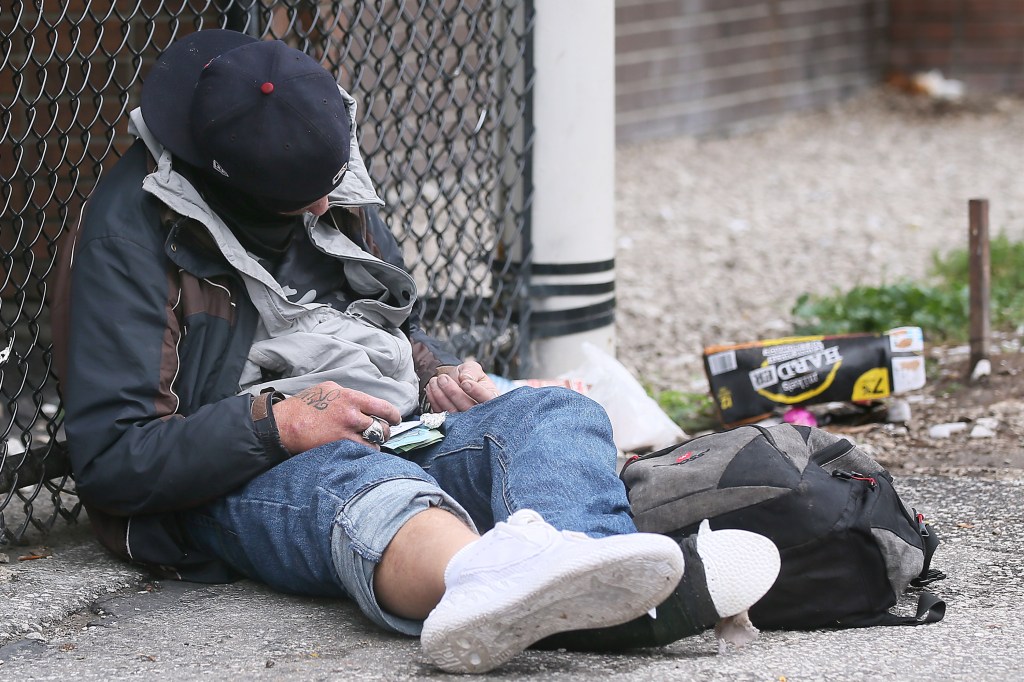
 A man sleeps on Pelissier Street in downtown Windsor on Friday, October 2, 2026. (WINDSOR STAR – DAN JANISSE) Dan Janisse
Currently, a physician can hospitalize a person against their will under the Mental Health Act, but only if they appear to have a mental disorder and pose a risk of serious harm to themselves or others.
The Ontario Big City Mayors group represents municipalities with populations of more than 100,000 and advocates on issues that affect large urban communities.
In 2024, the non-partisan organization launched the “Solve the Crisis” campaign, pushing the province to do more to address the homelessness, mental health and addictions crisis growing across Ontario — challenges municipalities have increasingly been required to respond to, even though social and health-care issues are provincial responsibilities.
This past summer, the big city mayors launched the next phase of its advocacy efforts with the “Solve the Crisis: Reaction to Recovery” campaign. It calls for the provincial government to adopt a recovery-focused approach that improves through better access to treatment, supportive housing and rehabilitation services.
As part of the initiative, the Ontario Big City Mayors group is seeking support from municipal and regional councils to strengthen its advocacy efforts.
Editor’s Picks
“This is really what we’ve been looking forward to seeing for quite a long time,” said incumbent Ward 8 Coun. Gary Kaschak, who is also seeking re-election. “It’s a well-crafted document that outlines that municipalities are really hamstrung in dealing with some of these important issues. There’s no doubt that we’re partners in this, but it really puts the onus and the authority on the province to move this forward.”
The campaign by the Ontario Big City Mayors also asks the province to declare a provincial state of emergency around the homelessness, mental health and addictions crisis. It also urges the province to significantly increase investment in voluntary treatment programs, to expand addiction treatment programs within jails and prisons, and to establish a dedicated Ministry of Mental Health and Addictions.
Dilkens acknowledged the Government of Ontario is spending more than $500 million to implement Homelessness and Addiction Recovery Treatment (HART) Hubs in communities across Ontario — hubs he said “are making a difference.”
“Even with that amount of money being spent, the problem still is prevalent on every street in every city across our country,” he said. “I think it speaks to the difficulty everyone is having trying to get to the root cause of these issues and find a pathway that actually makes a difference.”
Ward 6 Coun. Jo-Anne Gignac, who retires this fall after 23 years on council, said municipalities cannot “financially support” homelessness, mental health and addictions issues.
“It’s not sustainable. The funding sources are simply not stretching far enough to keep up with all of the services that municipalities are mandated to do under the Municipal Act,” she said.
“People have to start putting pressure on their federal and provincial representatives.”
At Gignac’s request, city council will send a letter encouraging the Ontario Big City Mayors to push for discretionary funding for municipalities to implement programs that address “immediate needs” around social issues.
Ward 3 incumbent Coun. Renaldo Agostino, also seeking re-election, asked that the letter include a push for housing supply.
Ward 9 incumbent Coun. Kieran McKenzie asked that notice of council’s support for the “Solve the Crisis: Reaction to Recovery” campaign be sent to senior levels of government and all local members of parliament and members of provincial parliament.