
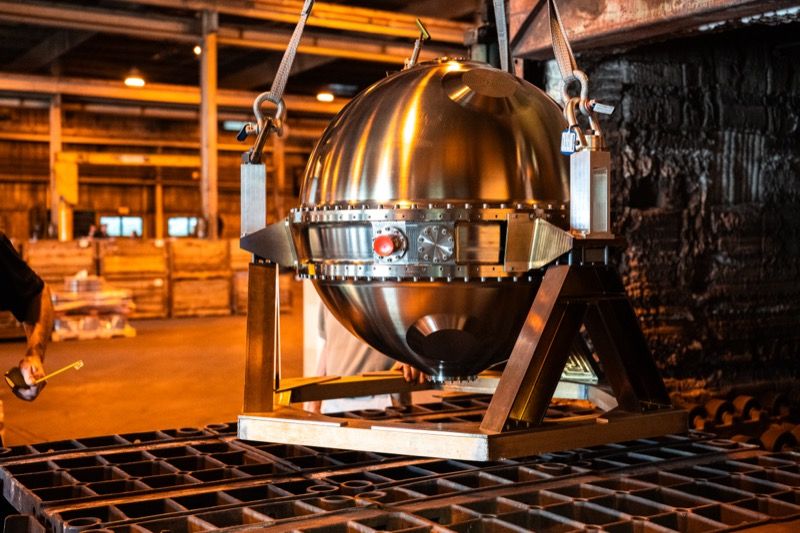
An engineering model of a NASA descent probe designed to explore Venus has passed a thermal test simulating the extreme temperatures of the planet’s surface.
The test, which ran from Aug. 28 to Sept. 10, was conducted for the Deep Atmosphere Venus Investigation of Noble gases, Chemistry, and Imaging (DAVINCI) mission at Rex Heat Treat in Bedford, Pennsylvania, one of few facilities able to heat hardware to Venus-like temperatures as rapidly as the probe will experience. DAVINCI is intended to study the origin, evolution and present state of Venus, including whether it once had oceans and was habitable like Earth.
Engineers heated the probe in a ceramic-lined furnace to 869°F (465°C) over about an hour, matching the heating rate expected during its descent, then repeated the thermal cycle five more times. The model completed every cycle unscathed, with more than 100 thermal sensors monitoring hardware simulating the probe’s instruments.
Jim Garvin, principal investigator for DAVINCI at the NASA Goddard Space Flight Center in Greenbelt, Maryland, said, “The experiment was a rousing success, with six runs to Venus’ surface temperature on our descent timeline of 55–60 minutes with full internal instrumentation. There hasn’t been such a complete assessment of spacecraft-scale hardware at Venus temperatures in the U.S. since the mid-1970s.”
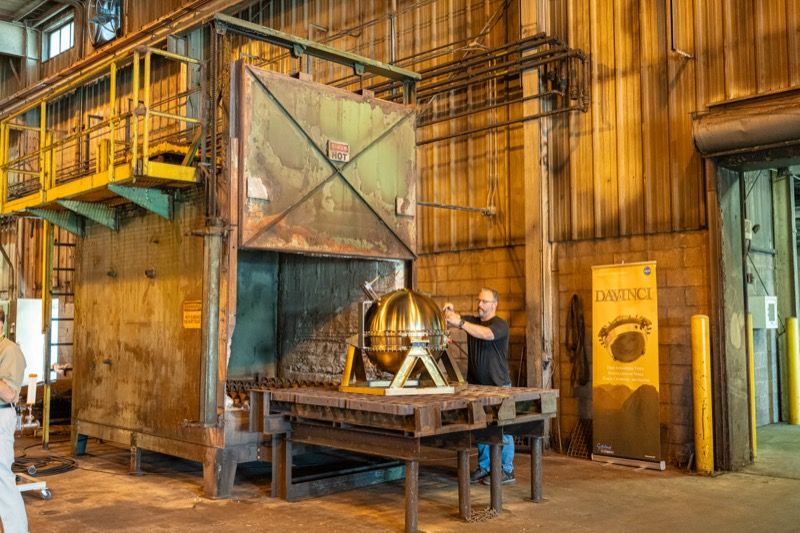
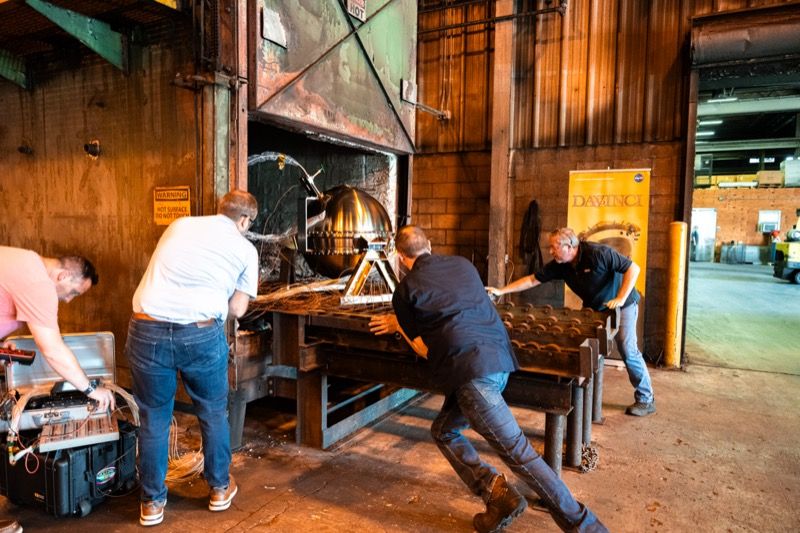 When NASA’s DAVINCI (Deep Atmosphere Venus Investigation of Noble gases, Chemistry, and Imaging) probe descends through Venus’ atmosphere, it will heat up to 869 degrees Fahrenheit (465 Celsius) in under an hour. To ensure the probe will beat this heat, engineers simulated the mission six times in a furnace at Rex Heat Treat in Bedford, Pennsylvania
(Image: NASA/Mike Guinto)
The probe will descend through the Venusian atmosphere for nearly an hour inside a corrosion-resistant titanium shell, carrying instruments to sample the composition of atmospheric gases and determine the atmosphere’s structure. It will also carry cameras that NASA said will capture the highest-resolution images of the Venusian surface ever taken, which scientists will use to build a 3D map, and a radio system to send data to the spacecraft flying 5,600 miles (9,000km) overhead.
Kristen Brown, DAVINCI probe manager at Goddard, said, “It’s a huge engineering challenge given how harsh the Venus environment is. We had to create a system that can protect the instruments from the planet’s overwhelming heat while strategically letting in its high-temperature gases to study through special inlet ports.”
The heat testing follows a campaign earlier this summer to demonstrate the probe’s imaging system. The mission is working toward approval to move into the final design and fabrication phase.
This article was originally published at https://science.nasa.gov/blogs/davinci/2026/09/24/nasas-davinci-beats-heat-in-preparation-for-blistering-venus-descent/.