
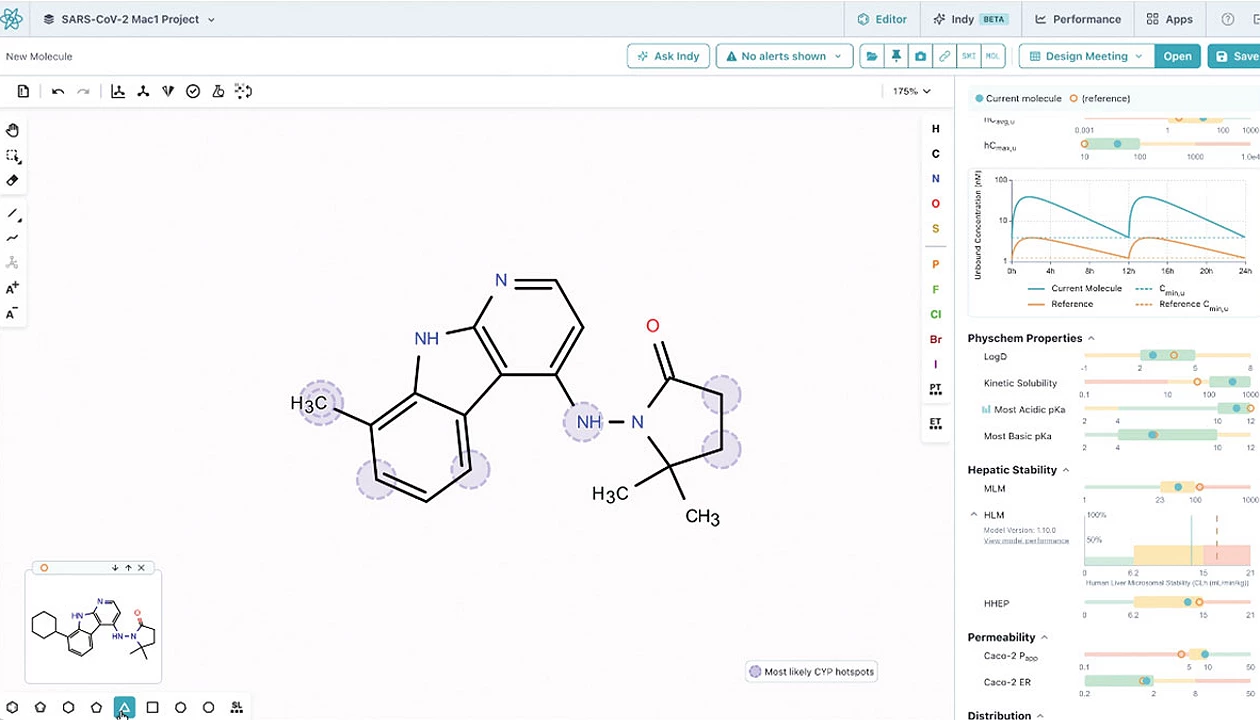
Artificial intelligence is moving into the work that can eat up a medicinal chemist’s day.
The pharmaceutical services company Inductive Bio has launched Indy, an AI assistant that it says can check assay data, analyze structure-activity relationships, and handle other recurring medicinal chemistry tasks. The company also introduced Beacon-2, which uses predictive models to help design compounds that would require lower estimated human doses.
The launches reflect a broader effort to move AI beyond generating molecules and predicting their properties and into the routine work of medicinal chemists. Instead of serving only as a modeling tool, AI is increasingly being built to help researchers interpret experimental results and make decisions as drug discovery projects unfold.
One such task is checking experimental assay data for results that may be unreliable. “Indy will go through every assay curve and look at it and say, ‘Yes, we’re seeing the kind of dose response that we would expect from a well-behaved compound,’ or ‘No, there’s some sort of anomaly here that you might want to double-check,’ ” says Alex Taylor, vice president and head of medicinal chemistry at Inductive.
Developed first for Inductive scientists working on partner programs, Indy can analyze experimental results, check compound characterization data, prepare visualizations, and reason through possible synthesis routes, Taylor says.
At one partner, scientists had been drawing new structures in ChemDraw, checking them against data systems and rebuilding presentation slides as new results came in. Taylor says Indy now updates those slides in minutes, saving about 45 min to 1 h each time.
Much of what Indy does can already be accomplished with existing software, but bringing disparate functions together could still save chemists time, says Jun Wang, a professor of medicinal chemistry at Rutgers University who has not used Indy or Beacon-2.
“The potential value of Indy is therefore less about any single capability being fundamentally new and more about integrating these activities into a unified workflow that can operate across a medicinal chemistry program,” Wang says.
Inductive got its start by developing predictive models for absorption, distribution, metabolism, and excretion (ADME) using data contributed by partner companies, Taylor says. It emerged from stealth in 2023 with a $4.3 million seed round and raised $25 million in series A financing last year.
The firm’s business now includes predictive software, AI tools, and scientific services for drug discovery programs. Partner teams can include medicinal and computational chemists, and drug metabolism and pharmacokinetics specialists. Inductive works in some of the same areas as computational chemistry companies such as Schrödinger and XtalPi, though their products and services differ from Inductive’s.
Inductive operates a small wet lab in Woburn, Massachusetts, where it tests new AI-enabled synthesis workflows, the company says in an email. Most support work for biopharma partners is done through contract research organizations, it says. For example, for ADME-One, a product developed with Tangible Scientific and Ginkgo Datapoints, Tangible coordinates compound management, Ginkgo runs a first-tier panel of ADME tests, and Inductive uses the data to generate an initial human pharmacokinetic projection.
According to Inductive Bio, Beacon-2 considers factors such as potency, solubility, and metabolic stability to estimate how much of a drug a patient might need.
Wang says he would want to see Beacon-2 prospectively validated across diverse chemical series before relying on it in a drug discovery program. Such a test would make predictions before experimental data are available and compare them with measured pharmacokinetics, drug exposure and, eventually, clinical doses.
“At this stage, predicting an efficacious human dose directly from chemical structure may sound almost too good to be true,” Wang says.
Getting the predictions right is only part of the problem. Taylor says generative AI can produce molecules with features that experienced chemists would question. “I think that is still a challenge for AI: to generate molecules that resonate with chemists in the real world,” he says.