
LIV Golf has secured a potential investment that could propel the league into a new era. But there are some conspiracy theories circling…
LIV Golf’s potential financial savour has denied suggestions that tax benefits are the “driving force” behind a proposed $300 million investment into the league.
The London-based credit firm BC Partners announced the conditional windfall on Monday that could prop up LIV 2.0 – a reimagined and streamlined league that would exist without the lavish backing of Saudi Arabia’s Public Investment Fund.
As LIV’s Chapter 11 bankruptcy goes through the courts, BC Partners have declared they plan to provide the financing to “to facilitate LIV Golf’s emergence from the restructuring process on sound financial footing”.
The deal is still subject to court approval, and a deadline for players to sign up to LIV’s new era has been delayed by 12 days. But LIV insiders are stressing this is a “significant step forward”.
There have been claims that BC Partners, which typically finances middle-market companies, wants to use LIV for the sole purposes of a tax-write off rather than backing the vision of the league.
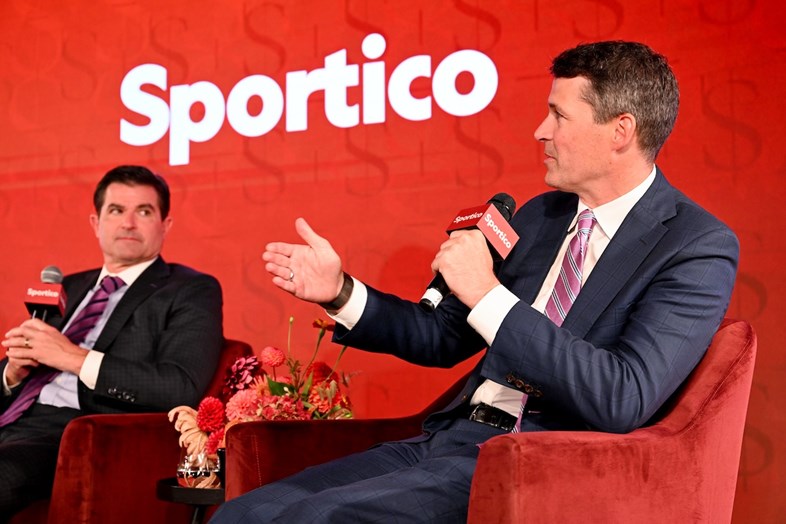
But speaking at a Sportico conference alongside LIV chief executive Scott O’Neil on Tuesday, BC Partners head Ted Goldthorpe said his reasons for investing in the league have been “misconstrued”.
“There’s a big NOL (Net Operating Loss) in the US and in the UK but that’s not the driving force behind investment,” he said. “I think some of this has been misconstrued. We’re all in on the LIV, and we’re very committed to it. And the tax stuff is just an added benefit. Yes, there are tax advantages when you have a bunch of losses, but that’s not the driving force behind the investment.”
While LIV outlined a vision for all 13 of its teams being built into $1 billion franchises in January, Goldthorpe believes the teams can still reach nine-figure values in a post-Saudi era.
“I think you can easily see a path in very short order to over $100 million valuation per team,” he said. “I think that’s a real number.”
Goldthorpe also explained where his confidence in LIV comes from.
“The disconnect between myth and fact is massive,” he claimed. “Myth one: no one cares about the LIV. If you look at our tournaments in Adelaide, or South Africa, or some other places, we get over a hundred thousand fans. Number two: people don’t watch it.
“If you actually look at the statistics, people do watch it. And so because of some of the history and antagonism, there’s a lot of what I would call ‘misreporting’ on what the LIV really is. And the more you dig into it, the more I think there’s a huge opportunity here.”
O’Neil, meanwhile, was similarly bullish about LIV’s next steps. He was asked if he “feels the weight” of the PGA Tour as direct competition moving into a new era.
“I don’t,” he replied. “If you think about it, does Formula One look at look at NASCAR as a competitor? They’re both racing cars – one is in the US and one is globally – and so, from our perspective, we think about the different competition globally. We have events in the US, of course, and we’ve had a good level of success in the US, but primarily if you’re a television network or a digital platform, or if you’re a global sponsor, there aren’t many places to go.”
Goldthorpe added: “I would just add that we’re really complementary to the PGA [Tour]. We’re global, they’re mostly folks in the US. Do they view it that way? I don’t know. Do they view it that way? Does it matter? Well, let me keep going. If you go to our events, the demographic of our fan is different than their fan, and I think our fans are attractive to the PGA of the future.
“Some of the things we can do with media, we can experiment some things media-wise that they can’t do, and so there’s a lot of things. We have a team golf concept [and] they have been struggling with that, so there’s a lot of things that make us very, very good partners and complementary to the PGA [Tour] versus being antagonistic. It makes no sense. We’re so different than them. To Scott’s point, we should be working with them versus against them.”
O’Neil explained how LIV has had to pivot so quickly towards a more sustainable model after being told that the Saudis would be withdrawing funding at the end of the 2026 season.
“I almost couldn’t believe how fast the business was coming together, selling out our premium wherever we went,” he said. “And then the world changed, and none of us here in this room have to be reminded about the intersection between politics and sports, it’s as old as time.
“Then a war happened, and the funding dried up, and we had to get creative, and we had to find discipline, and we had to come together as a team and rewrite the business plan, moving from a Saudi-type business plan to, you could say, a ‘business-business’ plan.”