
Hello, welcome to Politics Insider. Let’s look at what happened today.
Justice Minister Sean Fraser says the government will table legislation this fall that will indefinitely bar medical assistance in dying for patients whose sole underlying condition is mental illness.
As Stephanie Levitz and Kristy Kirkup report, Fraser also announced that the government’s bill will include measures on advance requests for patients who will lose cognitive capacity to be able to consent to the procedure later.
He said that future legislation will look to amend the Criminal Code of Canada, which currently criminalizes medical practitioners who perform MAID when there is an advance request.
The minister said he expects this to spur a conversation at the provincial level on whether they will extend services with “the full knowledge that the doctors who provide the services will not be treated as criminals for doing so.”
Fraser, who did not specify a date for tabling the legislation, said Ottawa believes this is the correct approach to take at this particular time. Regarding MAID for patients with mental illness, he cited continuing concerns about inadequate access to mental-health services.
Meanwhile, the Liberals (save two MPs) voted against a Conservative bill today that would have amended the Criminal Code section covering MAID to read that “a mental disorder is not a grievous and irremediable medical condition.” The Liberals had said the term mental disorder was too broad.
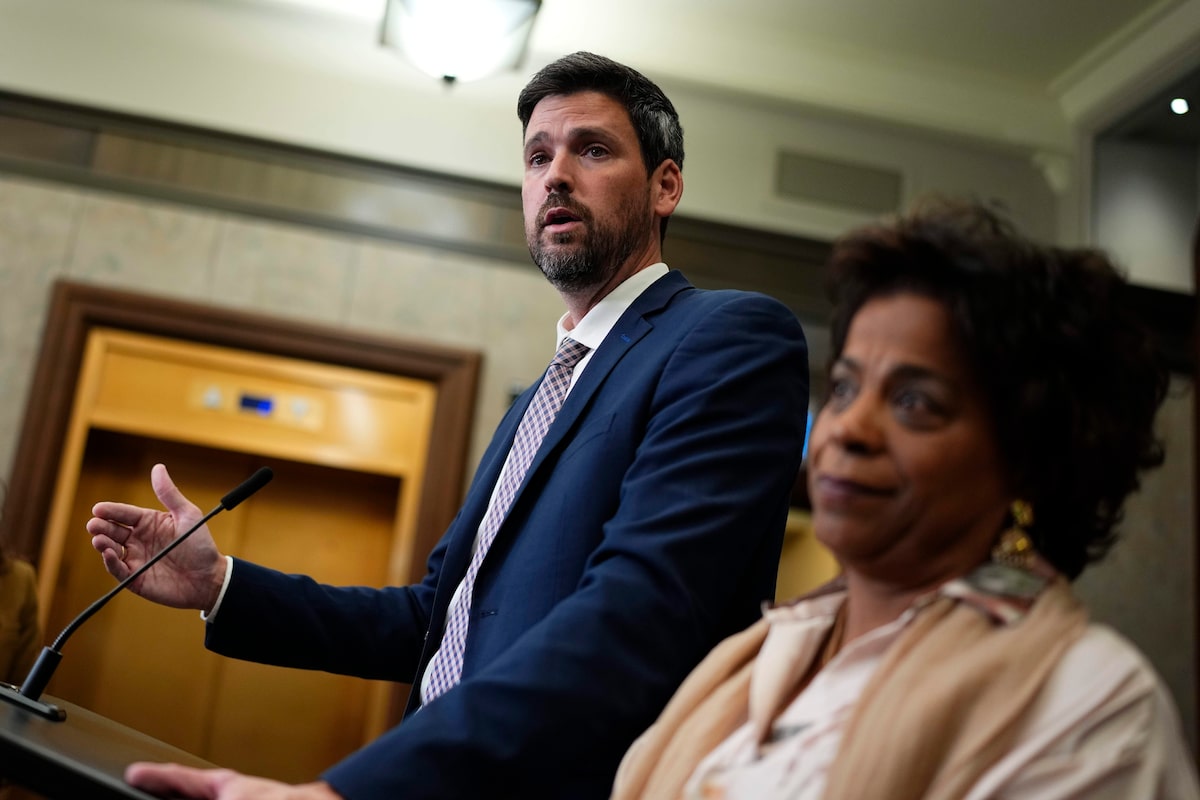
Minister of Justice Sean Fraser speaks as Minister of Health Marjorie Michel looks on during a media availability on Wednesday.Justin Tang/The Canadian Press
This is the daily Politics Insider newsletter, curated by Ian Bailey. It is available exclusively to our digital subscribers. You can sign up for more than 20 other newsletters on our signup page.What else is going on
Canada drops sponsorship of conference that talks of U.S. as foreign interference actor
Ottawa has withdrawn its sponsorship of an anti-disinformation conference in Lithuania that feature panels talking about the United States as a foreign interference threat.
Cleveland-Cliffs boss dismisses idea of nationalizing steel company Stelco
The U.S. steelmaker said last week it was planning to lay off as many as 500 steel workers at Stelco in Hamilton and Nanticoke, Ont., in large part because it can’t compete any more in galvanized steel as a result of the trade war.
Messaging service Signal says changes to lawful access bill will not keep it in Canada
The secure messaging service Signal says government amendments to the lawful access bill are insufficient to persuade it not to withdraw from Canada.
On our radar
Prime Minister’s Day: Mark Carney attended the Liberals’ weekly caucus meeting as well as Question Period, where he defended his record after 18 months in office.Party Leaders: Conservative Leader Pierre Poilievre was in the Commons, taking on the Prime Minister over cost-of-living concerns and trying to pass his party’s motion to extend federal relief on diesel fuel (which didn’t pass.) NDP Leader Avi Lewis will be in Parliament Thursday, speaking out against the government’s new economic legislation, Bill C-39, alongside labour, environmental and Indigenous representatives. Green Party Leader Elizabeth May is also set to speak Thursday about the bill, which intends to fast-track major projects and infrastructure development.Foreign influence watchdog reaches out to Alberta separatists: Canada’s new foreign influence watchdog has reached out to the Alberta Prosperity Project, one of the separatist groups that previously met with the U.S. State Department in its quest to steer the province to independence.Quote(s) of the Day
“I have to keep reminding the Leader of the Opposition that I just got here.” – Prime Minister Mark Carney, countering Pierre Poilievre’s criticisms of his time in office.
“The guy who said he was going to build at unimaginable speeds says he just got here after 18 months.” – Poilievre countering Carney’s contention that he’s just arrived after coming to power in March, 2025.
Question period
When did MAID (medical assistance in dying) first become legal in Canada?
Scroll to the bottom of this newsletter for the answer.
Perspectives
There’s nothing to praise about the Oct. 7 attacks. A Canadian literary journal disagrees
I found this hard to read. But not nearly as difficult as other reading I’ve done about that day.
— Marsha Lederman
The weakness of its mandate will not deter the PQ from the chaos and division of its project
That the PQ did not win a majority will not stop it from using the powers to which it now has access, in any way it can, to promote the separation of the province.
— Andrew Coyne
Is Steven Galloway finally getting justice?
A witch-hunt was underway.
— Gary MasonGo deeper
Got a news tip that you’d like us to look into? E-mail us at tips@globeandmail.com. Need to share documents securely? Reach out via SecureDrop.
The answer to today’s question: MAID first became legal in Canada in June, 2016, for Canadians whose deaths were deemed “reasonably foreseeable.” In 2021, the law was updated after a Quebec court decision allowed patients with incurable conditions to seek to end their lives.