
Sept. 28, NHK Japan TV interviewed Dr. Dieter K. Buse as part of a five-episode series examining the long-term effects of meteorite impacts around the globe. It is to be shown in Japan in January 2027, with a possible international release later.
Their overview stated: “Dr. Buse’s interview will be featured in a section exploring the relationship between celestial impacts and human history. For many viewers, asteroid and comet impacts may seem like events that happened in the distant past, with little connection to human history or our lives today.
“However, the purpose of this section is to use Sudbury’s nickel deposits to show that humanity is, in fact, still being affected by the consequences of an impact that occurred in the ancient past. Before the segment begins, an interview with an astrophysicist will explain that the formation of Sudbury, home to one of the world’s major nickel deposits, is connected to a massive asteroid/comet impact approximately 1.85 billion years ago.
“From Dr. Buse, we would then like to hear the history of how the nickel deposits formed by that impact were later discovered and used by humans. We are particularly interested in the role Sudbury played during the First and Second world wars. We hope Dr. Buse can help convey that an event in the distant past has continued to influence human history.”
Below are the questions and Dr. Buse’s comments on those questions.
Q. Please tell us your name, title and your area of expertise.
A. I am Dr. Dieter K. Buse, Professor Emeritus, Laurentian University, Sudbury. Canada. My expertise is shown in my publications, which include co-editing a two-volume encyclopedia of modern Germany, recognized as Best Reference 1998, and a guide, The Regions of Germany (2005). In the last 20 years, I have turned to Canadian regional studies, including a guide to Northeastern Ontario, Come on Over, and a two-volume work, Untold: Northeastern Ontario’s Military Past, demonstrating the important contributions of northeastern Ontario people to the military history of Canada. Untold won the prize for best regional study of the Ontario Historical Society in 2020.
Q. Please tell us about Sudbury, where we are now. We would appreciate it if you could explain that it is one of the world’s major nickel-producing regions and, if possible, mention its connection to the massive meteorite impact approximately 1.85 billion years ago.
A. Sudbury is a city of 160,000 people living in a widely spread area. It is located just south of the Sudbury basin, an oval impact crater resulting from a meteorite that struck about 8.5 million years ago. I pointed out that until the 1970s, the predominant theory believed by scientists was that the ores here came from an internal eruption of the Earth, but now the meteorite theory dominates.
Then I returned to Sudbury as a city that has changed since the 1970s from a predominantly mining and smelting centre to a regional centre for health, education, with colleges and a university, as well as mining supply. I emphasized that the population remained constant over the past 50 years despite the city losing its dominant position in mining and smelting nickel.
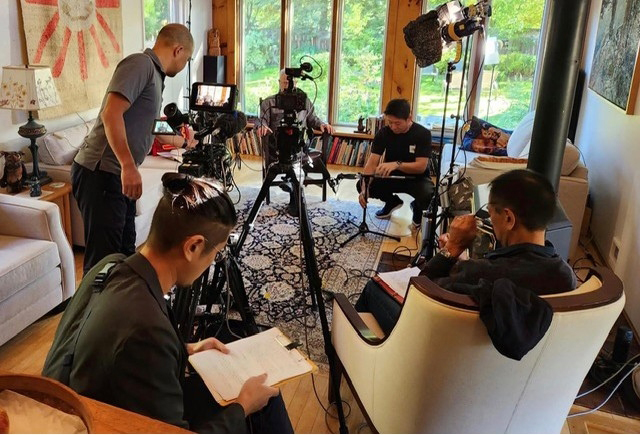 A Japanese TV crew sets up in Prof. Dieter Buse’s living room. Supplied photo
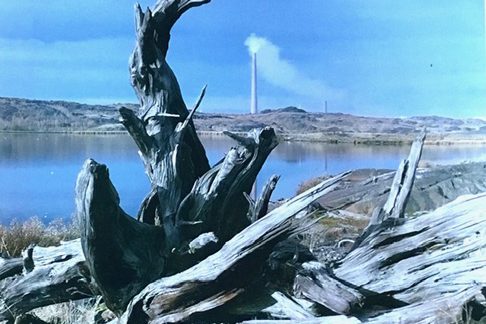
Though I underlined that the city looked very different 50 years ago, with a mainly barren landscape due to timber cutting, mining and smelting emissions, it now looked like much of the green area that has always surrounded it. I held up one photo from the 1970s illustrating the barrenness, but they showed little knowledge of the regreening transformation. I pointed out that a local community team effort was involved in the regreening, but that did not seem of great interest, as they wanted to know the long-term impact of the meteorite.
Hence, I explained that the amalgamated city of the 21st century includes all the basin on the edge of which the mines existed (and showed a map of the crater and surrounding mines/communities). That was because the ores determined where small villages emerged: from Falconbridge and Garson toward the east, Creighton and Copper Cliff and Lively to the west or Levack and Onaping to the north. They seemed to appreciate this long-term geopolitical impact of a meteorite.
Q. Could you tell us when and how the nickel deposits in Sudbury were discovered? From our research, we understand that in 1883, during construction of the Canadian Pacific Railway, a local blacksmith named Tom Flanagan was the first to discover the ore. Is that correct?
A. The story about Flanagan has been repeated very often but is only partly accurate regarding the importance of his seeing rusty colouring on a blasted rock as the CPR tracks were being laid north of what would become Sudbury Junction in 1883. Already in 1856, the surveyor of the baseline from Sault Ste. Marie to what would become North Bay had noted large compass deviations indicating high mineral content.
Flanagan filed no claim as far as is known, but within a year, four others who were associated with the railway had. Flanagan’s rediscovery would become the Murray Mine, and I tried to underscore that the prospectors at first generally sought copper or gold, as nickel was not yet used (an unwanted byproduct).
At this point in the interview, I started to emphasize the speed with which mining developments moved in the next five years and detailed what I thought the TV crew had asked for. I listed the numerous mines that appeared within five years on what would later be seen as the edge of a crater. But they stopped me and indicated that they wanted a shorter version. So, I noted some of the main developments, such as about 20 mines within three years, a blast furnace at Copper Cliff in 1888 and at Murray Mine in 1890.
I wanted to point out that until 1888, it was not known how to separate copper from nickel, and the uses for nickel were not known. But I did get in that in 1888 tests were conducted on a nickel steel alloy proven to deflect or limit damage from artillery shells. Suddenly, a military market existed for nickel as well as copper. By 1902, the main mining companies were down to two, International Nickel and Mond, that had the financial leverage to mine and to smelt the ores.
Q. What role has the nickel mined here in Sudbury played in modern history? Could you give us an overview of its impact on human history?
A. Before I tried to answer this very big and difficult question, I pointed out the special aspects of nickel. Alloyed with steel, it is hard but not brittle; it is exceedingly strong, it is non-corrosive, and it can withstand the stress of heat and cold.
I explained that it avoids what is known as “creep,” namely changing form under extreme pressure. I gave examples of its use in armaments as plating, in consumer goods such as sinks, knives, cleaning equipment, automobile motors, holding chemicals … among its thousands of applications in nearly every instrument that needs to remain as manufactured, such as in heart stents, bombs, jet engines, rockets.
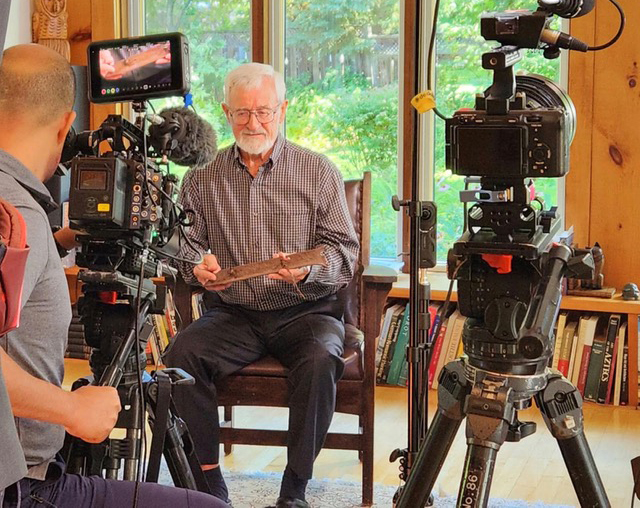 Prof. Dieter Buse holds a First World War picket with barbed wire, rusted without the benefit of nickel alloy. Supplied photo
(I forgot that at present, nickel, even if in minute quantities, appears in more than 300,000 items).
I concluded that nickel has had much influence on human history, and since most of it for over 80 years came from Sudbury until the 1970s, this place helped shape human history.
I asked the interviewers if I could tell some stories, and they agreed.
I suggested that I am very happy when I think that a little bit of what came out of the ground near me serves as a stent to help someone’s blood flow in many places on Earth; I am also happy that a little bit of what comes out of the ground near me is combined with steel to make wonderful knives, sinks, even refrigerators that remain clean and look good (pointing to mine).
But I am not so happy when I think of bomb tips that can penetrate concrete and kill many civilians, though I am happy as a traveller to think that the jet engines will not ‘creep’ and their exhaust will not ruin the back deflecting fans …
I concluded that yes, the nickel mined here has affected human history, even if mostly as a means of giving advantages in warfare. But it also led to the development of the many communities that form what is now Greater Sudbury.
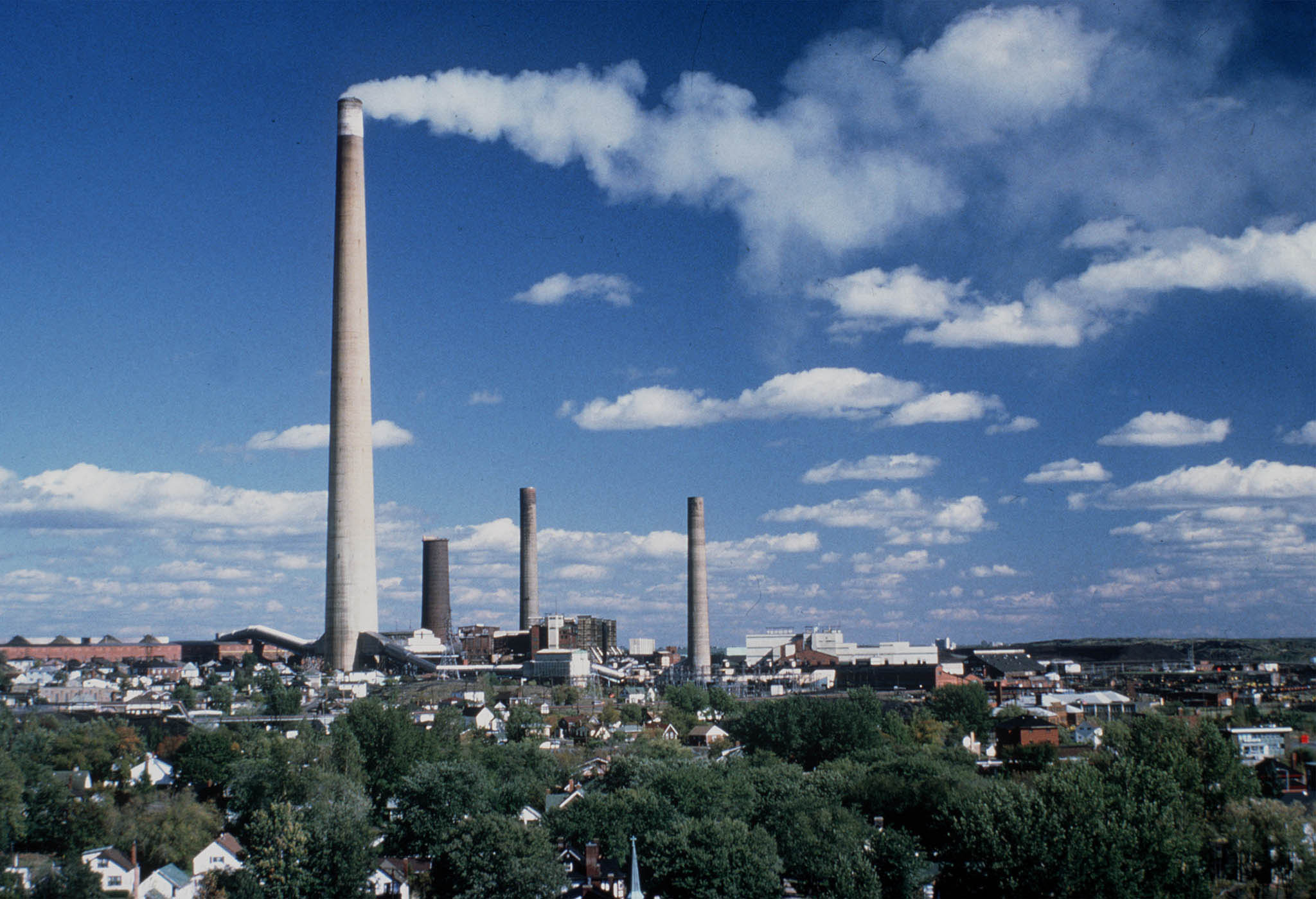 Inco Limited, now Vale, has been producing nickel, copper and other metals from the Sudbury Basin of Ontario for more than a century. The Basin is a unique geological formation some 60 kilometres long and 26 kilometres across at its widest point. (Canada NewsWire) HANDOUT / CNW
Q. In particular, what role did Sudbury’s nickel production play during the First and Second world wars? Why was nickel such an important resource during wartime? (We are particularly interested in its role during the Second World War.)
A. To illustrate the importance of nickel during warfare, I used production figures to demonstrate the increased demand. In 1914, Sudbury produced 45 million pounds of nickel (plus many other metals); in 1918 it produced 92 million pounds. Nickel was not only used for plating on warships (though the big ones were all built prewar), but in huge artillery pieces, their recoil systems, and as an alloy in most shooting equipment.
I reminded the interviewers that the First World War was a war of men, less than machines, and most deaths were by artillery fire. I showed them a rusted iron picket and brittle barbed wire from a First World War battlefield to illustrate what a lack of ferro-nickel meant (corrosion).
The use of nickel in warfare greatly affected Sudbury, and I noted the ups and downs of nickel production in the 1920s and 30s. However, in the Second World War, it was decisive, and Sudbury’s output was crucial to the Allies’ war machines. In 1940, nickel production increased to 245 million pounds from the less than 180 million average in the 1930s. At government request, Inco (now Vale) increased its production by high grading, which I explained, and by modernizing plants. By 1943, more than 288 million pounds were produced. Inco later claimed that in six years of war, it produced more nickel than did all the Canadian producers in the previous 54 years.
Those figures were secret during wartime, as production levels were under censorship, but after the war they were published by Canada’s statistical office. I provided them with a graph from the Canada Year Book.
Why was this increased output significant? In warfare, it is not only what you have but what your opponents do not have. We had an exchange of why Germany, which had stockpiled nickel and had some from Finland, ran short by 1945, why Italy lacked nickel; and why Japan had to resort to lower-grade alloys.
Q. If possible, could you also mention specific military uses of Sudbury nickel, such as its use in aircraft, tanks, or other equipment? If you are aware of any sources or data that illustrate its importance, for example, approximately what percentage of the nickel used in Allied weapons production came from Sudbury.
A: I cited an important statistic for which they wanted the source, namely that around 95 per cent of the Allies’ nickel during the Second World War came from Sudbury. In other words, nearly all of this metal came from here. (The statistic is from an article in the Canadian Mining Journal, while other sources suggest 92 to 95 per cent.)
During the war, nickel alloyed steel was crucial for many items, from jeep motors, to landing craft that had to withstand sea water, bombs, and to enable aircraft cooling systems. They asked about the B-29 bomber, and I should have cited more of the parts of the plane that needed heat-resistant and creep-resistant steel. Undoubtedly, they were interested in the most high-tech plane of the time because, with its 5,000-mile range, it was decisive in ending the Pacific War. I pointed to armoured tanks, machine guns and jet aircraft that required pressure-resistant alloys.
I told the story of the British Meteor jet planes for which nickel alloys were necessary to retain shape under heat and pressure. The planes flew at 480 miles an hour and could catch V rockets sent by Germany to bomb Britain. The pilots flipped the rocket’s mini wings with their own plane wings and disoriented the rocket’s instrumentation.
Q. As a hypothetical thought experiment: if that massive meteorite had struck somewhere other than Sudbury 1.85 billion years ago, do you think modern human history might have unfolded somewhat differently?
A. Certainly, the history of Sudbury would have been different without the basin on the edge of which endless ores were found. However, probably the riches would have been discovered elsewhere and their uses and riches explored. My daughter, who observed the interview, thought they were leading me toward committing myself to stating that if the meteorites’ riches had been in the Axis-controlled areas, they might have won the war. But I focused on the general issue of hypothetical outcomes.
Q. I find it both surprising and fascinating that a celestial impact that occurred as long as 1.85 billion years ago is connected to modern human history and to our lives today. What do you think about this? Could you describe this remarkable connection in your own words?
A. Yes, the long-term impact is surprising but normal in that all the ores taken out of the Earth everywhere were created billions of years ago and influence what is occurring now. I noted that Sudbury’s crater was different, oval from an angular impact, rather than round like the huge ones in South Africa and Mexico, which had not produced metals.
But Sudbury’s influence has diminished since it lost its predominance in the production of nickel (now at 13 per cent of world production compared to Indonesia’s 60 per cent), so that the long-term economic impact of the meteorite is decreasing, but social impact remains in the form of a thriving city.
Bluesky: @sudburystar.bsky.social
X: @SudburyStar