
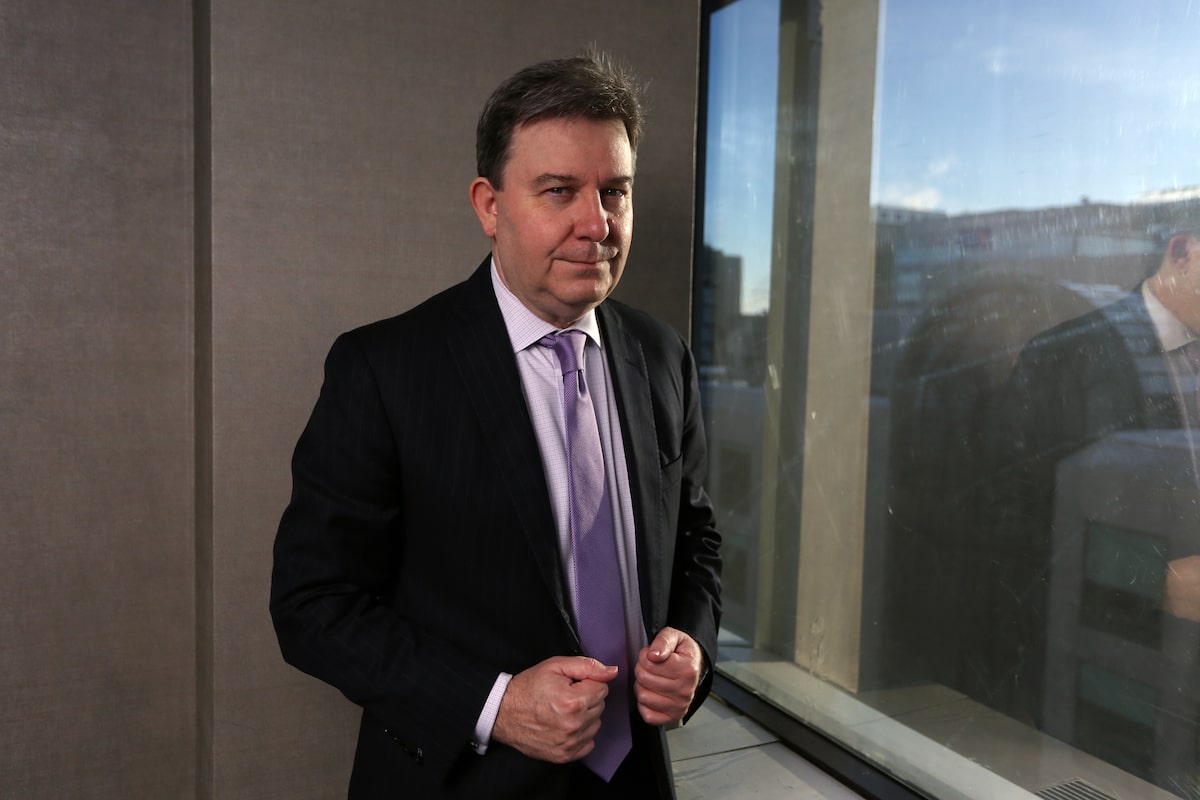
Office of the Superintendent of Financial Institutions superintendent Peter Routledge says he is generally satisfied with the level of preparedness of Canada’s banks, but some are further ahead than others.Dave Chan/The Globe and Mail
Canada’s banking regulator is planning to implement tighter guidelines on artificial intelligence as threats from AI agents and Anthropic’s powerful Claude Mythos model escalate risks among the country’s lenders.
As the pace of AI development surges, banks have been accelerating their use of the technology aimed at cutting costs and generating financial returns. Office of the Superintendent of Financial Institutions superintendent Peter Routledge has tasked his team to work on creating a “safety code” to improve cybersecurity and mitigate risks, he said during a conference Wednesday held by the Global Risk Institute.
The regulator is still working on the details, but Mr. Routledge said the safety code could consist of broad, high-level standards that provide a basic level of safety and protection for the financial system, while also establishing a “wide perimeter for innovation.”
Rather than implement a regulatory framework prior to now, OSFI has guided banks to “do no harm,” Mr. Routledge said. In 2023, the regulator and the GRI published a report on the implications of AI on financial services institutions. OSFI has also previously listed AI in its annual risk outlook.
Bell, Cohere release AI model designed to aid cybersecurity investigations
The introduction of Mythos, which Anthropic has restricted the use of because it is capable of finding and exploiting weak spots in software that could open companies to cyberattacks, was the catalyst that spurred OSFI to consider firmer guardrails on the banking industry’s use of the technology.
“That was an event that signifies the advancing capabilities of frontier AI models, which could be turned for illicit purposes and attack the financial institutions. That constituted a major increase in cyber risk,” Mr. Routledge told reporters during a media scrum on Wednesday.
“And then the more recent stories we’re reading about how agents are interpreting their task authorizations liberally and potentially posing dangers to institutions – that’s frightening, and that is a risk that is front and centre for us.”
Canadian banks have been accelerating AI research and implementation. On Tuesday, AI benchmarking platform Evident ranked all of Canada’s five biggest banks in the top 30 of a list of 50 global financial institutions on AI adoption.
Mr. Routledge said he is generally satisfied with the level of preparedness of Canada’s banks, but “not all institutions across the system are equal on AI” as some are further ahead than others.
If an issue arose at one financial institution, it could spread through Canada’s banking system.
“What if one of your counterparties does something wrong?” Mr. Routledge said. “You’re connected to your counterparties, and if there’s poison at the counterparties, it’s flowing through to you as an institution. Our highest utility is to try and lessen the risk that some poison gets into one institution and scatters throughout the system.”
Canada’s plan to counter the U.S. and China in AI is taking shape. Will it work?
The federal government has been courting investment to build data centres that power the boom in AI demand. While Ottawa says it is attempting to secure Canada’s data sovereignty, the technology also poses significant risks, GRI chief executive officer Sonia Baxendale said.
“We know the very technology required to strengthen our resilience also creates new threats to our institutions, to our national security, and to democracy itself,” she said.
“With trust in traditional institutions at historic lows, a small number of global technology firms now control the platforms that increasingly shape how we communicate, consume information and make decisions.”
Mr. Routledge also cited private credit and private equity as mounting risks, and said OSFI will highlight the issue in its risk outlook, set to be published Thursday.
“We are not seeing sizable risk concentrations that give us heartburn in this sector, but the aggregate concentration is growing,” he said.
As Ottawa has urged institutions to help drive its nation-building efforts, OSFI has introduced measures aimed at making more bank lending available. In June, the regulator lowered the size of the capital cushion the country’s biggest banks must hold, freeing up billions of dollars.
The regulator is also examining ways to even the playing field for smaller banks, Mr. Routledge said, with the intention of helping those institutions increase lending. Over the next six months, OSFI will be examining how its capital framework may disadvantage small- and medium-sized lenders.
He referred to this as a “competitive imbalance” between the smaller banks that follow a standardized approach and the larger banks that use internal ratings to manage capital.
Earlier in the day, federal Natural Resources Minister Tim Hodgson urged the room of financial institution leaders to help finance Ottawa’s nation-building projects – initiatives that banks have often been considered too risky for lending.
“When someone walks into a bank or an asset manager with a $10-billion project, you don’t hand them the money without asking about the risks,” Mr. Hodgson said.
“We understand the government cannot eliminate risk for opponents, and we understand these should not insulate investors with bad investment decisions. However, there are cases where governments can use its suite of tools to change the balance between expected risks and returns of strategically important investments.”
Opinion: There’s a self-serving reason AI companies are calling attention to existential-risk claims
Ottawa is using a variety of measures to help make it easier for banks to lend to riskier businesses and projects, including loan guarantees and potential co-investments, Mr. Hodgson said.
As the U.S. wages its trade war with Canada, President Donald Trump has taken fresh aim at the Canadian banking sector. In September, he repeated his incorrect claim the U.S. banks are unable to operate in Canada.
But when mid-sized banks have been put on the auction block in recent years, there were no U.S. buyers, Mr. Routledge said.
“All the acquirers were Canadian, and they weren’t Canadian because we had any bias geographically,” he said.
“They were who stood up with a bid, and any foreign bank could have stood up with a bid, and we would have looked at it exactly the same way as a Canadian bidder. We are geographically agnostic.”