
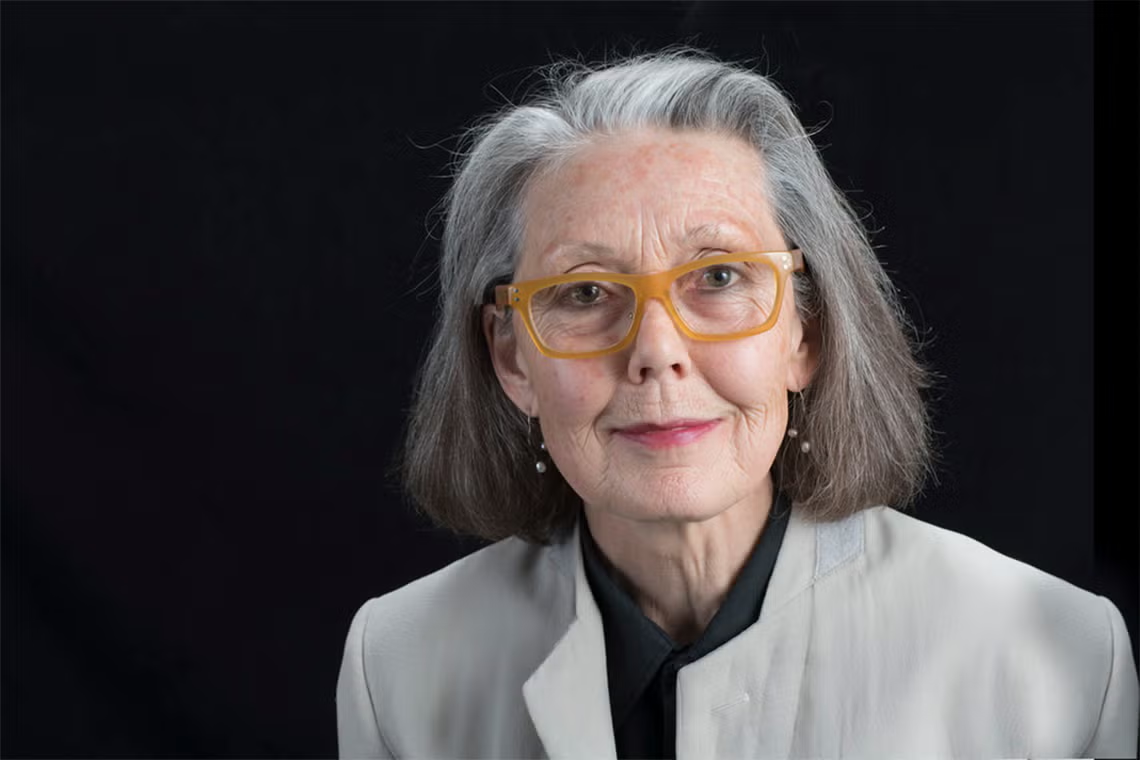
Anne Carson, who honed her mastery of the classics at the University of Toronto before giving them new life in the modern age, has won the Nobel Prize in Literature.
A Canadian poet and essayist who earned three U of T degrees, Carson is the second Canadian woman – and first U of T alumna – to win the prestigious international prize, widely regarded as the world’s highest literary honour. She was honoured for “her bold and inventive oeuvre that, in playful dialogue with the classical tradition, has created new forms for contemporary literature,” according to the Nobel committee.
“On behalf of the University of Toronto, I am absolutely delighted to congratulate alumna Anne Carson on winning the 2026 Nobel Prize in Literature,” said U of T President Melanie Woodin. “This is a very proud moment for our global alumni community and for the entire university.”
Known for writing that resists categorization, Carson draws on the classical training she began at U of T to bring ancient Greek and Latin literature into conversation with the contemporary world, moving fluidly between verse and prose, translation and reimagination.
She learned of the win in Reykjavík, Iceland, where, according to Ingrid Carlberg, permanent secretary of the Swedish Academy, “she was listening to the wind.”
“It seems a little insane,” Carson told organizers in reaction to the announcement. She added that she had been sweeping her kitchen when the phone started ringing, and only called back at the insistence of her husband, Robert Currie. Her plans to celebrate? Leaving her phone behind for a walk in the woods, where she and her spouse can “hear the quiet.”
Just in! New Nobel Prize laureate in literature Anne Carson stands surprised in her kitchen in Reykjavík, Iceland. Stay tuned for our exclusive interview with her coming soon. Join us in congratulating our 2026 literature laureate – send your greetings in the comments.
— Nobel Prize (@nobelprize.org) October 8, 2026 at 9:11 AM
The 19th woman among 123 literature laureates, Carson joins the ranks of Ernest Hemingway, Toni Morrison and Gabriel García Márquez – and fellow Canadian-born writers Alice Munro and Saul Bellow.
Prime Minister Mark Carney was among those congratulating Carson on Thursday, lauding her win as “an extraordinary achievement and a proud moment for Canada.”
Carson has a long and circuitous history at U of T. She first enrolled at St. Michael’s College in 1968, but briefly dropped out to try her hand at graphic design. She later returned to the university to study Greek poetry, earning a bachelor’s degree in 1974. She went on to receive two graduate degrees in the classics – a master’s in 1975 and a PhD in 1981.
She also received an honorary degree from U of T in 2012 and, in 2020, served as the Northrop Frye Professor in Literary Theory at U of T’s Centre for Comparative Literature, delivering a public lecture titled “Stillness.”
In a 2001 profile in U of T Magazine, Carson recalled spending nights studying at St. Michael’s library as she was initiated into the “cult” of the classics.
“Classics gives you complexity: the Greeks and Romans are so exemplary and so screwed up,” she said. “I struggle in the dark with my Greeks. It’s a wrestling match.”
That struggle would play out across a career of more than 20 books of translation, poetry, essay, scholarship and fiction, often blurring the lines between them.
Her 1986 debut, Eros the Bittersweet, announced her as a rigorous, if irreverent, interpreter of the ancients. The lyrical exploration of the Greeks’ tormented tradition of desire captivated classicists, critics and poets alike.
Carson cemented herself as a writer at home in each camp – but beholden to none – with her 1998 novel in verse Autobiography of Red, which transforms a Greek myth about Herakles and a red, winged monster into a coming-of-age love story. The sequel, Red Doc>, made her the first two-time winner of the Griffin Poetry Prize’s Canadian category in 2014. She had won the inaugural prize in 2001 for the hybrid poetry and prose collection Men in the Off Hours. She also became the first woman to win Britain’s T.S. Eliot Prize in 2001 for The Beauty of the Husband, “a fictional essay in 29 tangos.”
Other honours include MacArthur and Guggenheim Fellowships, the Governor General’s Award for English-language poetry and Spain’s Princess of Asturias Award for Literature. In 2005, she was appointed a Member of the Order of Canada.
Alongside her original work, Carson never stopped translating. In her 2002 translation If Not, Winter: Fragments of Sappho, she digs into the gaps in the ancient poet’s surviving works, treating what was lost as part of the text.
Carson has also kept a foot in the classroom, teaching at universities in the United States and Canada.
Wherever her career has taken her, Carson’s alma mater has never felt far. Walking around campus in 2001, she told U of T Magazine: “There are so many footprints on these streets, I’m surprised they’re not really there.”
Carson will be awarded the Nobel at a ceremony in Stockholm on Dec. 10. The prize comes with 12 million Swedish kronor, a gold medal and a diploma.
She told prize organizers she’s thinking of ways to give the money away, noting that she’s a supporter of Doctors Without Borders. Asked if she had any advice for writers, Carson was characteristically cryptic, refusing to provide easy answers. “Start in the middle. It’s the only rule I have,” she said. “Whatever you take that to mean.”
Carson joins several members of the U of T community who have won the award over the years.
Geoffrey Hinton, a U of T University Professor emeritus, was one of two researchers awarded the 2024 Nobel Prize in Physics for foundational discoveries and inventions in the field of artificial intelligence that enable machine learning with artificial neural networks.
John Polanyi, also a University Professor emeritus, was one of three winners of the 1986 Nobel Prize in Chemistry for the development of the new field of reaction dynamics. In 1923, Sir Frederick Banting and J.J.R. Macleod won a Nobel Prize in Physiology or Medicine for their work with Charles Best to isolate insulin.
Other members of the U of T community, including several alumni, have received or been associated with the international honour over the years.
Oliver Smithies, a past professor at U of T, was a joint winner of the 2007 Nobel Prize in Physiology or Medicine for discovering the “principles for introducing specific gene modifications in mice by the use of embryonic stem cells.”
Also in 2007, Professor Robert Jefferies shared in the Nobel Peace Prize awarded to the Intergovernmental Panel on Climate Change (IPCC), in which he was a key Canadian representative as an international leader in Arctic science and global change biology.
In 1999, U of T Professor James Orbinski accepted the Nobel Peace Prize on behalf of Doctors Without Borders, recognized for its humanitarian work.
Similarly, anti-nuclear activist and U of T alumna Setsuko Thurlow accepted the 2017 Nobel Peace Prize in Norway on behalf of the International Campaign to Abolish Nuclear Weapons (ICAN).
In 2001, Michael Spence, an alumnus of the University of Toronto Schools, was one of three winners of the Sveriges Riksbank Prize in Economic Sciences in Memory of Alfred Nobel for his contributions to analyses of markets with asymmetric information.
Bertram Brockhouse, who completed two degrees at U of T, was a co-winner of the Nobel Prize in Physics in 1994 for the development of neutron scattering techniques for studies of condensed matter.
Arthur Schawlow, an alumnus, was one of three winners of the 1981 Nobel Prize in Physics for his contribution to the development of laser spectroscopy.
In 1998, U of T alumnus Walter Kohn was a co-winner of the Nobel Prize in Chemistry for the development of density-functional theory.
Former Prime Minister Lester B. Pearson, who received a bachelor’s degree from U of T, won the Nobel Peace Prize in 1957.
With files from U of T News staff