
Ask a simmer who flies in VR why there’s still a DisplayPort cable running from their PC to their face, and what you’ll hear is either “it’s how they made it” or the savvier “because of better image quality.” And the savvy ones have a point. Wireless PC VR has come a long way, but it still depends on video encoding to squeeze the image through the air, and in a cockpit full of small labels, MFD text and instrument markings, any loss of sharpness gets noticed quickly.
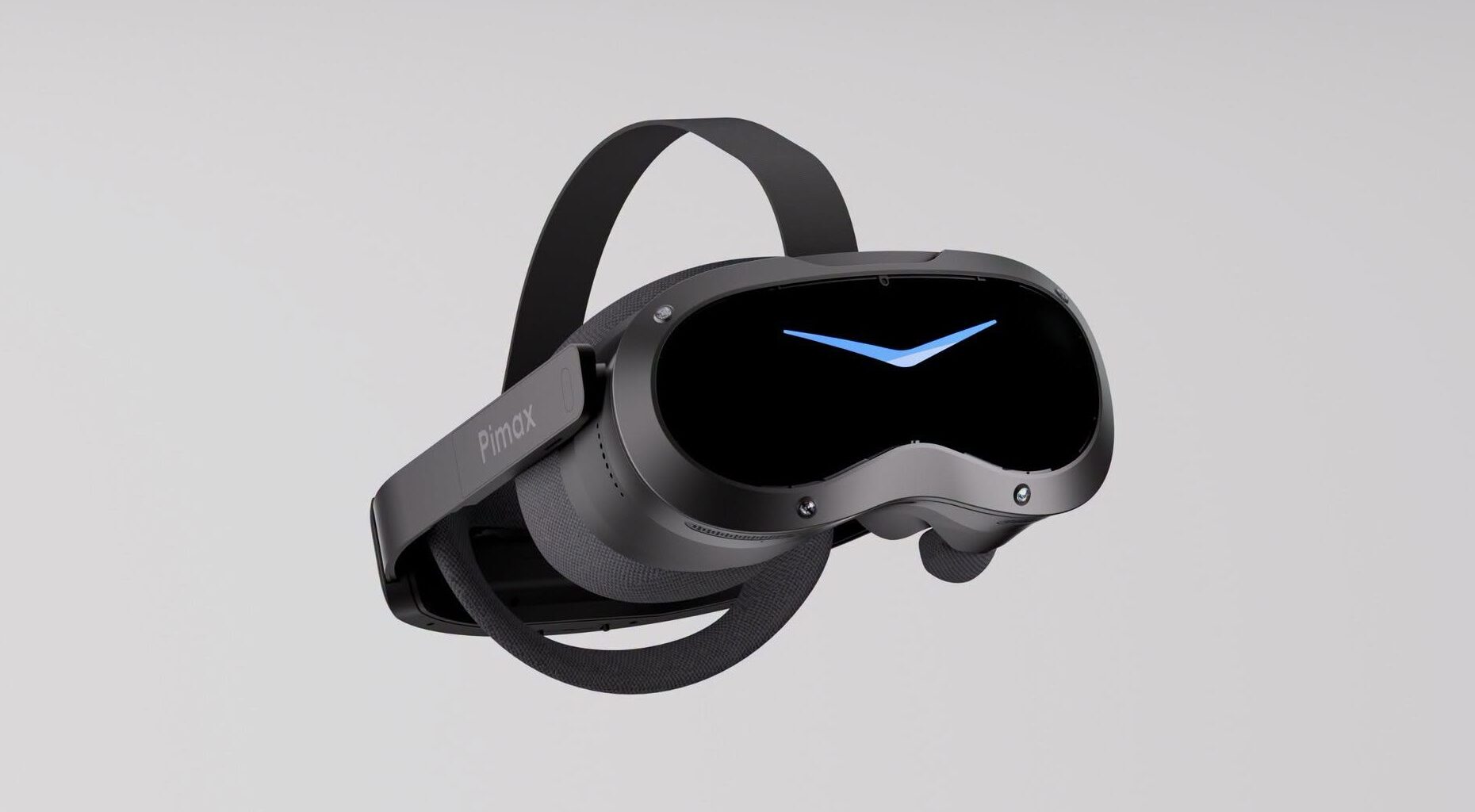
Pimax thinks it has found a way around that. At its Frontier event, held this week at Museum de Fundatie in Zwolle, the Netherlands, the company unveiled the Crystal Pro, a wireless PC VR headset built around a technology it calls Native Foveated Streaming. The idea is simple: track where your eyes are pointing and send that part of the image to the headset exactly as your GPU rendered it, with no video encoding in between. Pimax says the Crystal Pro is the result of five years of R&D.
There are actually two ways to go wireless with the Crystal Pro. Out of the box, the headset includes built-in Wi-Fi streaming and a dedicated Wi-Fi 6E adapter. That route works the conventional way, with video encoding.
The more interesting option is the third-generation 60G AirLink kit, available bundled with the headset or sold separately. It includes two headset antennas and two Room Antennas running in a 2×2 MIMO configuration, which Pimax states is the first 60GHz 2×2 MIMO link on a VR headset. According to the company, the two antennas back each other up when one is briefly blocked, and they split the data stream for more bandwidth than a single-antenna setup. Pimax quotes up to 6 Gbps of combined throughput and under 2 milliseconds of added latency.
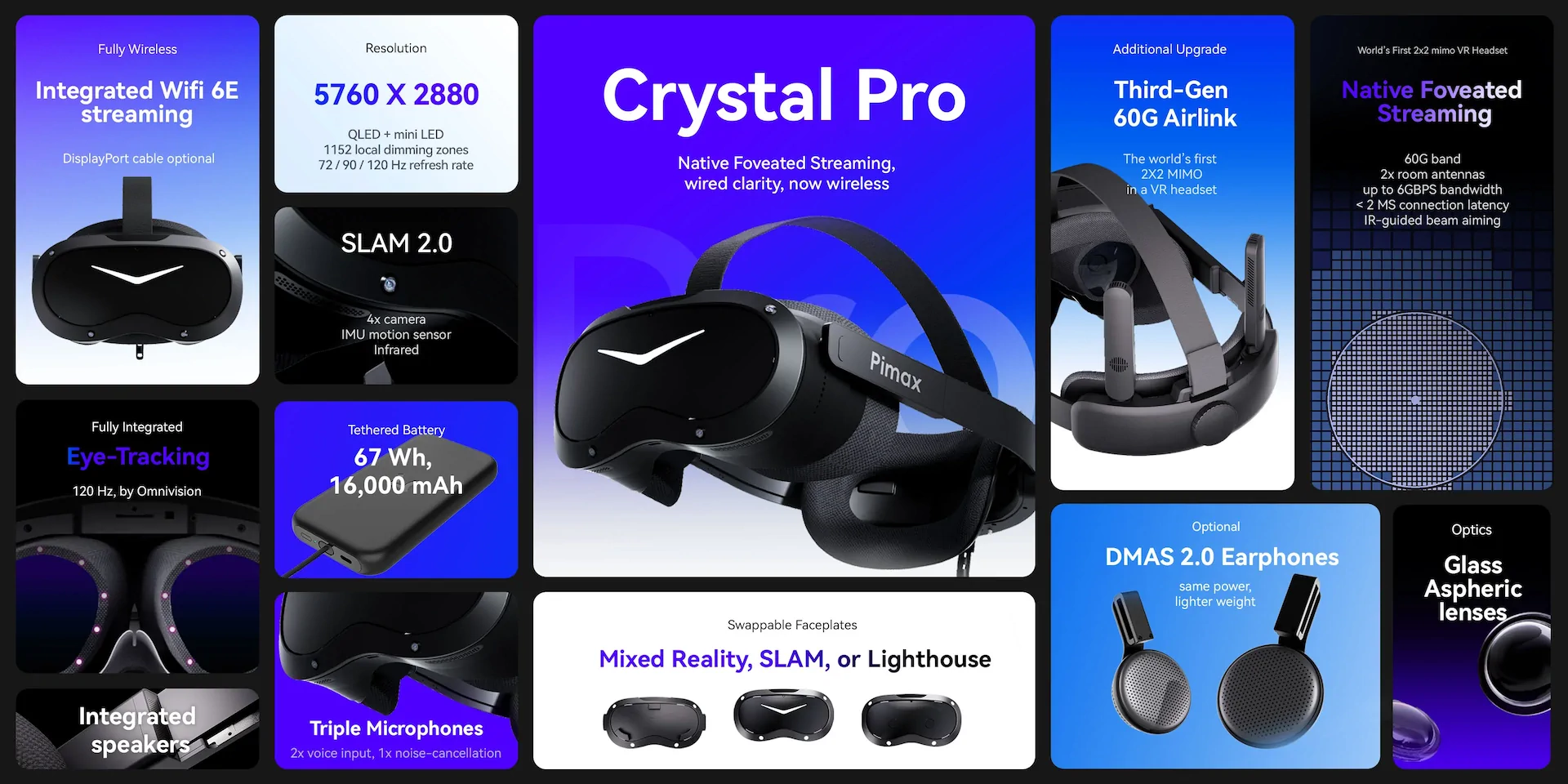
Working together with the eye tracking, the kit delivers an image equivalent to 2880 x 2880 pixels per eye at up to 90Hz in your focus area, without video encoding. Pimax’s description centers on that focus area and doesn’t go into detail about how the rest of the frame is handled. And as with any 60GHz system, the signal doesn’t pass through walls, so this is a same-room setup.
Note that foveated streaming is about how the image travels to the headset, not how it’s rendered. Your GPU still draws the full frame, so on its own this won’t make MSFS 2024 any easier on your hardware. Pimax says the eye tracking is also used for dynamic foveated rendering, the technique that can reduce GPU load.
If “foveated streaming” sounds familiar, that’s because Valve used the same term when it revealed the Steam Frame. Valve’s headset uses on a dedicated 6GHz wireless adapter and low-latency eye tracking to push the highest-resolution pixels toward wherever you’re looking. In Valve’s case, the technique concentrates compression quality on the area you’re focusing on.
Pimax’s claim goes a step further: with the 60G kit, there’s no encoding in the focus area at all. On paper, that’s the key difference between the two approaches.
It’s also the continuation of something Pimax started a while ago. When it unveiled the Crystal Light and Crystal Super in 2024, Pimax said the original Crystal had been conceived from day one as a high-end wireless PC VR headset, and that same year it announced the first 60G Airlink. That $299 module only supported the original Crystal and Crystal Sim headsets, leaving out the Crystal Super and Crystal Light. Meanwhile, the Crystal Light we reviewed in 2024 reached its lower price partly because it dropped the battery and Tobii eye tracking found on the original Crystal.
The Crystal Pro brings eye tracking back, takes the battery off your head and into a 16,000mAh pack you carry in your pocket, and treats wireless as the default rather than an add-on.
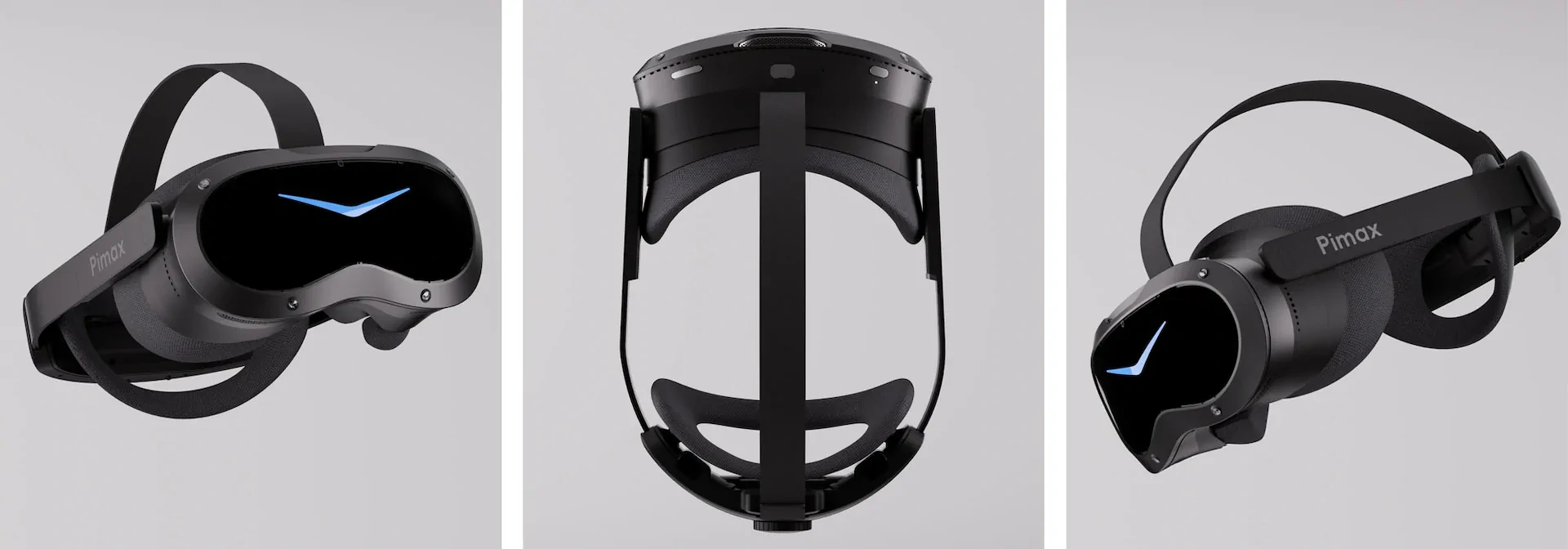 The headset itself
On the display side, the Crystal Pro uses aspheric glass lenses with QLED panels at 2880 x 2880 pixels per eye, around 17 million pixels in total. Pimax lists a 110-degree horizontal field of view, 35 pixels per degree, Mini-LED local dimming with 576 zones per eye, 200 nits of brightness, and refresh rates of 72, 90 and 120Hz. The 120Hz mode is for wired use, over an optional DisplayPort 1.4a cable that isn’t included in the box.
That resolution puts it in Crystal Light territory. It doesn’t try to compete with the Crystal Super, which pushes 3840 x 3840 pixels per eye, and the field of view matches the Dream Air, which Pimax rates at 110 degrees horizontal, compared with 116 on the Crystal Super micro-OLED.
Eye tracking comes from an integrated Omnivision system with ten infrared emitters per eye, sampling at 120Hz. Tracking is handled by Pimax SLAM 2.0, with four cameras, a motion sensor and infrared illumination for low-light conditions, which is handy for those of us who fly in a dark room. A swappable faceplate adds Lighthouse base station support, and an optional MR faceplate adds full-color passthrough with LiDAR depth sensing.
Comfort features include a rigid backstrap, a magnetically attached facemask and foam interface, adjustable eye relief, off-ear speakers and three microphones, with Pimax’s DMAS 2.0 earphones as an option. The faceplate, backstrap, audio components and lens inserts are all swappable.
What Pimax hasn’t published yet is a weight. That’s a number worth watching, because weight is the complaint the Crystal series could never fully shake, as we noted in our Dream Air first impressions. Moving the battery off the headset should help, but we’ll wait for the figure.
 Pricing, reservations and the 2027 window
Pimax lists the following prices:
The headset-only box includes ringed SLAM controllers, the external battery and the Wi-Fi adapter. Reservations are open now for $1, which gets you $20 off the headset at launch or $50 off the AirLink bundle. According to the product page, hands-on demos should be possible soon, with shipping starting in 2027. “2027” is a wide window, so a bit of patience is probably wise.
The rest of the Frontier lineup
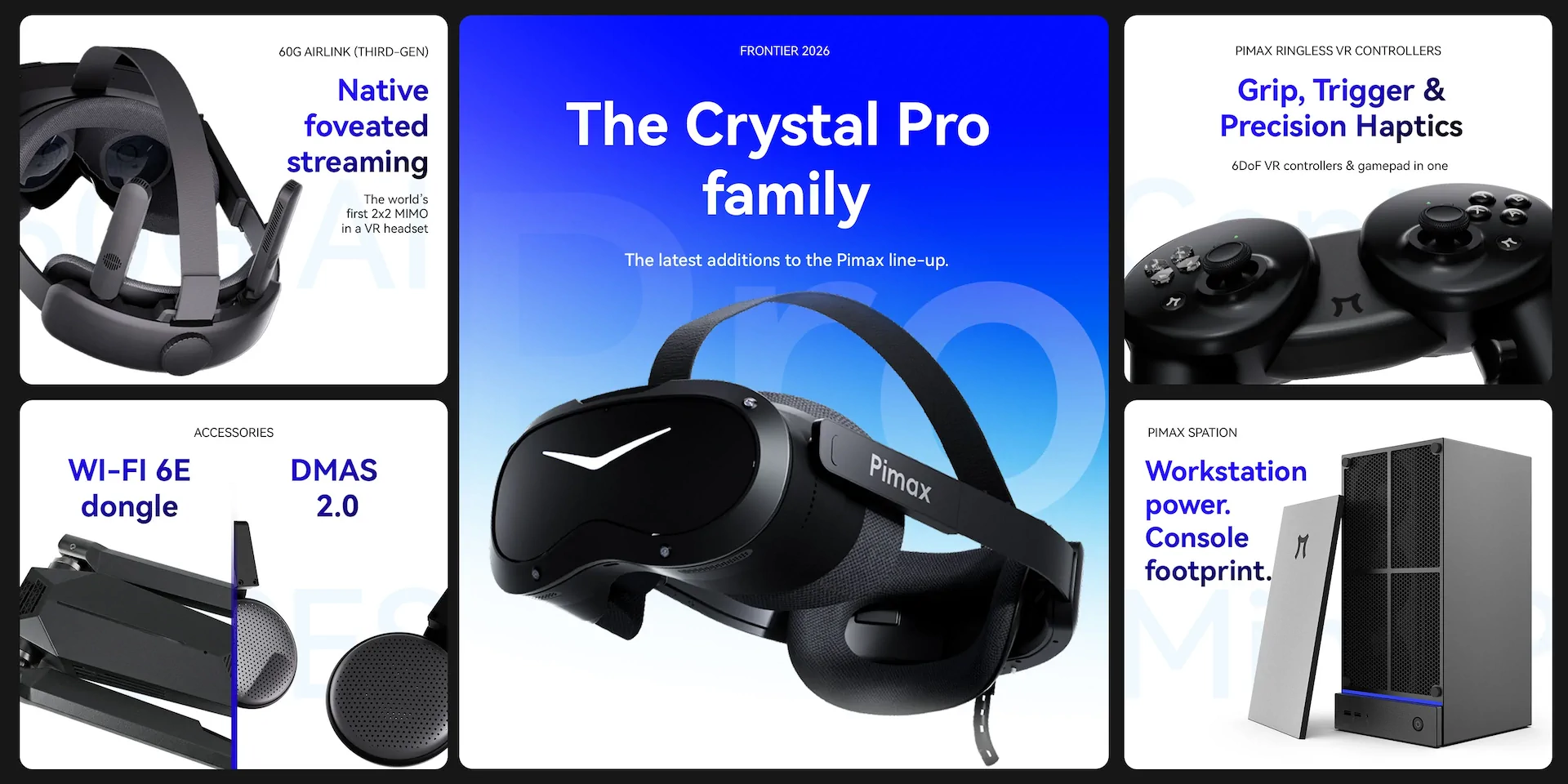
The Crystal Pro was the headline, but Pimax announced a few other things alongside it. The Ringless VR Controllers drop the tracking ring in favor of hand tracking from the headset cameras plus an infrared LED and motion sensor system. Clip the two together with the included pin and they become a regular wireless gamepad for Windows and Steam, usable outside VR. Pimax rates the 710mAh battery at up to 40 hours per charge.
The Spation is a compact mini-PC built with desktop parts. The standard configuration pairs an AMD Ryzen 7 9800X3D (or equivalent) with either an AMD RX 9070 XT or an Nvidia RTX 5070 Ti, 32GB of DDR5-6000 and a 1TB NVMe SSD, powered by a 1000W SFX supply. It supports Windows and SteamOS, and a DIY option lets you bring your own parts. Pimax also confirmed a dedicated Pimax Play client for Linux. Pricing and dates for both the controllers and the Spation will come later.
MSFS Addons is reader-supported. When you buy through links on this page, we may earn an affiliate commission at no additional cost to you. Thank you!