
In what way does watchmaking inform high jewellery and how do these worlds cross? We understand it here in terms of colours. But in what other ways? Maybe technology, techniques?
Christophe Bourrié: Some of the innovations came from our customers. Even now, they challenge us with their concepts which later become innovations. The idea came from a customer, who was a huge watch collector. I don’t know how familiar you are with the Aura watch. It was a very exceptional high-jewellery watch featuring a very large diamond, making it a very spectacular piece. It was also one of the most expensive watches in the world at the time. This loyal customer obviously went for it. At some point, he said, “You know, I really need necklaces to match my watch, because now it is not a watch anymore, but a piece of jewellery.” So he started matching necklaces and other pieces with his watch. It became a tailor-made order and from that, this whole idea was born…
What year was this?
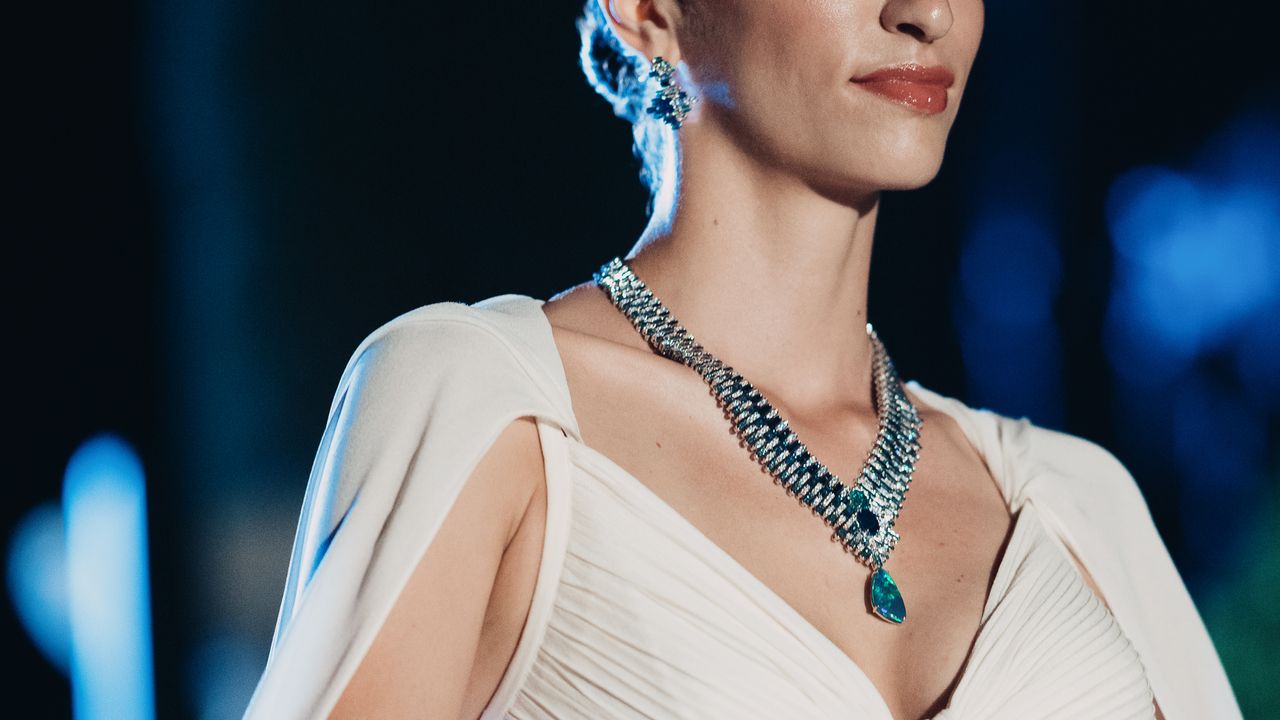
Christophe Bourrié: I think it was sometime in the ’80s or ’90s. At the time, these were mainly tailor-made for a very select group of customers. As we developed more expertise in setting watches with gemstones, we realised that we could also apply the same skills to jewellery, because there are similarities in the setting techniques. Thus, the bridge between watches and jewellery became stronger. We started bringing watches into jewellery as well. Take, for example, the Sautoir watch necklace, which became famous. These two areas of expertise sometimes come together in a single piece. Sometimes we bring watches into jewellery, and sometimes jewellery into watches. The Aura is one such example, but you will discover other designs and wonder whether it is a watch or a piece of jewellery.
The clients have always been at the forefront, giving feedback and helping you develop new products. Does it still happen today, given the brand’s size?
Christophe Bourrié: It still happens because sometimes we don’t push our limits as far as the customers want us to. We receive feedback all the time, especially for special orders. It often happens when we have a product and a client says, “I really love it, but what if we did this?” And we say, “Oh yes, we hadn’t thought about that.” The way customers wear the pieces can also give us new ideas. It happened to me a few weeks ago. Have you seen the Pebble watch sautoir? It’s new and has a beautiful stone. It was originally intended for a film, and then suddenly a very fashionable man bought it. Initially, we didn’t expect it to be bought by a man. He didn’t buy one, but two. We would have never thought of stacking the pieces because they were not designed for that. But now we have the idea of developing it further so that it can be stacked easily. We have to be careful because we don’t want the stones to damage each other when they are worn together. So this is one example, but I have plenty of others where our customers really pushed us. And throughout these discussions, especially with made-to-order items, we are able to innovate. Then there is also a part of innovation that is completely internal, obviously, especially with watches, where everything is confidential. Hence we never share the innovations we are working on. Sometimes it takes many years to develop them. It is a big challenge as there is already a long history of watchmaking and many things have already been done before. So to create something genuinely new, you need engineers and R&D and sometimes the development process can last up to 10 years. It’s easier with high jewellery because we have complete creative freedom. There are no rules. We can explore different ideas, shapes and combinations and aren’t constrained by the pricing as we have customers who can afford such pieces.