
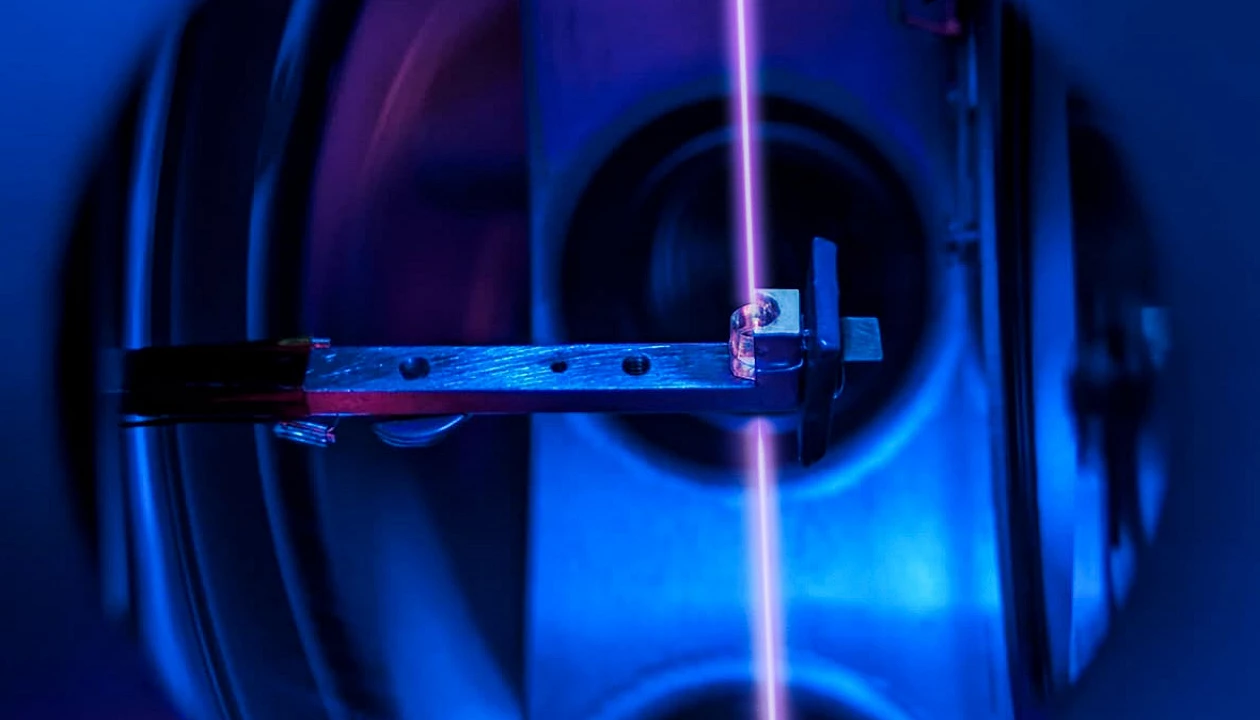
The world’s most precise clocks currently keep time using electrons. A laser excites electrons between two energy levels, and the atoms’ response tells the laser whether its frequency has drifted, akin to a clock gaining or losing time. The laser adjusts accordingly, probes the atoms again, and the loop repeats, setting a stable rhythm for the clock. The best optical atomic clocks are so accurate that they would gain or lose just 1 s in hundreds of billions of years, making their extraordinarily stable frequencies helpful for precision measurements and testing fundamental physics.
Now two independent research teams have built clocks that instead tune themselves to a transition inside the atomic nucleus. The groups, led by researchers at TU Wien and Tsinghua University, shone ultraviolet light on thorium-229 nuclei embedded in calcium fluoride crystals and used the nuclei’s response to continually correct their clock systems’ frequencies. The experiments were reported in separate papers in Nature (2026, DOI: 10.1038/s41586-026-11122-1 and 10.1038/s41586-026-11084-4) and are the first operational nuclear clocks, a concept theorized since 2003.