
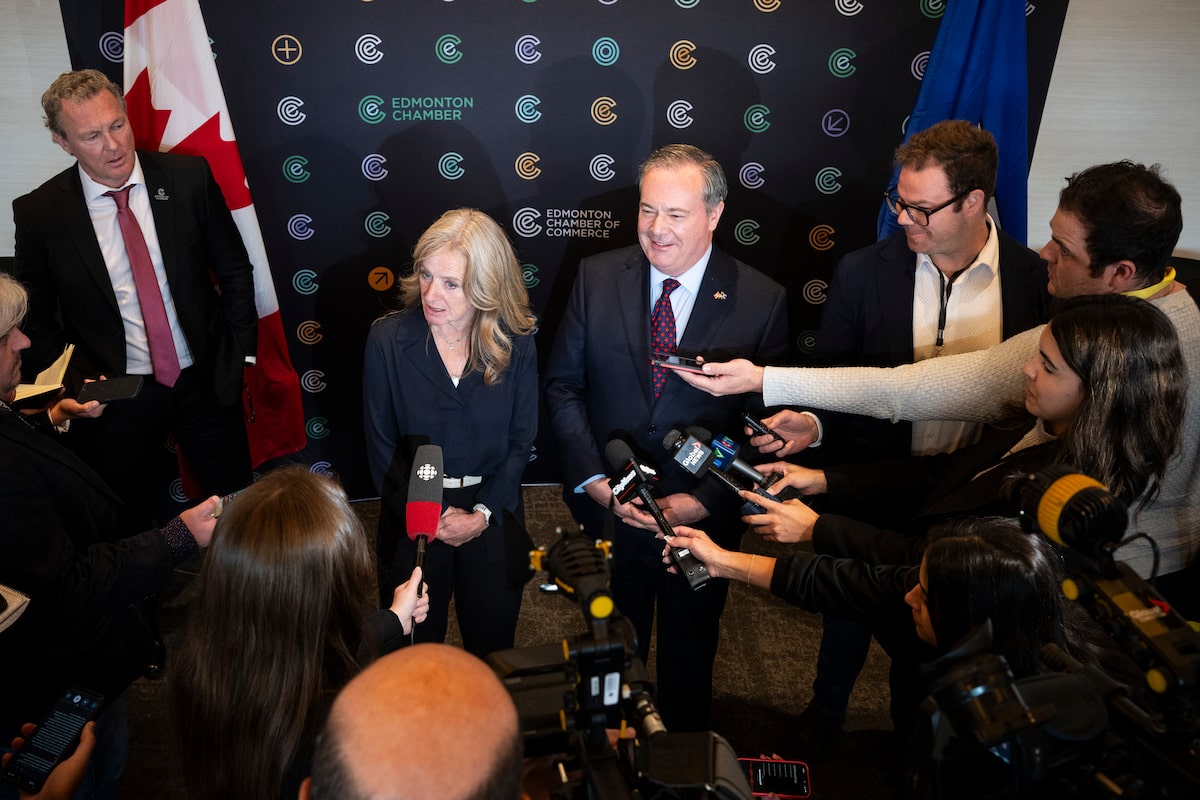
Former Alberta premiers Rachel Notley, left, and Jason Kenney at an Edmonton Chamber luncheon, on Tuesday. The province’s referendum has emerged as one of the greatest stress tests of national unity in decades.John Ulan/The Canadian Press
Four of Alberta’s former premiers are setting aside their partisan differences in the final week leading up to next Monday’s high-stakes provincial referendum.
Former Alberta NDP premier Rachel Notley on Tuesday shared a stage with her long-time political foe, former United Conservative premier Jason Kenney, to form a unified front against the threat of separatism.
“Whatever frustrations we may have, whatever imperfections our country may have, we still have one of the greatest countries in the world,” Mr. Kenney, seated next to Ms. Notley, said at a Canadian Chamber of Commerce event in Edmonton.
Ms. Notley also joined former Progressive Conservative premiers Ed Stelmach and Alison Redford in writing an op-ed, expected to be published this week, imploring Albertans to reject Premier Danielle Smith’s five referendum proposals centred on immigration, which could strip some newcomers of access to public health care and education. The op-ed does not explicitly address the question of separation but calls on Albertans to “choose Canada.”
“When you’re in a position of power – when you’ve been elected to lead a province – you learn that your job is to govern in the best interests of the majority of Albertans,” Ms. Notley said in an interview with The Globe and Mail.
“We know that new Canadians have always contributed to our province. That is part of the formula of our province’s success.”
Alberta NDP Leader Naheed Nenshi is encouraging Albertans to head to the polls as 311 polling stations opened Tuesday for the first of five days of advanced voting for the Oct. 19 referendum.
The Canadian Press
Lines of people snaked out of schools and churches on Tuesday as advance voting began in Alberta’s referendum, with residents weighing in on 10 questions centred on provincial separation, immigration and constitutional issues.
The tenth of those questions, which asks voters to pick between remaining in Canada or working toward a second, binding separation referendum, is what’s drawing the country’s political brass to Alberta this week.
Prime Minister Mark Carney confirmed on Tuesday that he’ll appear at pro-Canada rallies in Calgary and Edmonton on Thursday and Friday, while Conservative Leader Pierre Poilievre plans to give a speech in the province and appear at a gathering of conservatives later this week in Calgary.
Separatist factions, meanwhile, are organizing a Saturday rally at the Alberta legislature while trying to activate hundreds of thousands of supporters they’ve identified at town halls and online over the past several years.
Alberta’s referendum – the first time the province has put a secession question to voters – has emerged as one of the greatest stress tests of national unity in decades. It joins two active threats to Canadian sovereignty: one to the east, with the recent election of a minority separatist government in Quebec, and the other to the south, with U.S. President Donald Trump’s continuing tariff war and musings about annexation.
With Alberta referendum in sight, the nine other ballot questions are capturing attention
The nine other referendum questions, centred on immigration and constitutional issues, have simmered in the background while the separatism debate has hijacked the province’s political arena.
In recent weeks, however, some campaigners have shifted their focus to defeating the remaining nine questions authored by Ms. Smith’s government. Her government has dedicated $4-million in advertising to campaign in favour of those proposals, which Ms. Smith has said she needs approval on to fortify her mandate.
Ms. Notley, Ms. Redford and Mr. Stelmach, in the op-ed expected to be published in the Calgary Herald, wrote that the immigration proposals have already damaged Alberta’s reputation and could inflict generational damage on the province’s ability to attract newcomers.
Ms. Smith’s immigration questions ask voters whether they endorse the provincial government charging some newcomers for their use of the health and education systems, and whether they support making certain non-permanent residents ineligible for provincially funded programs for their first year in Alberta. It also proposes requiring voters to prove their citizenship in provincial elections. (Elections Alberta’s list of electors already confirms voters’ citizenship and, therefore, eligibility.)
Her government has remained ambiguous on key details around how the immigration proposals would be implemented. She unveiled the questions last winter, months after hosting rollicking town halls across Alberta that heavily featured discussion of immigration policy. The town halls were intended to gauge the extent to which residents support changing the province’s relationship with Ottawa.
Alberta’s referendum on a separation vote is approaching. Ask us your questions
Mr. Stelmach, a Progressive Conservative premier from 2006 to 2011, said Alberta should be building its workforce “with the help of new people coming to Canada.”
“Compassion, I don’t think, is measured by which political party you belong to,” he told The Globe in a phone interview.
Ms. Notley, premier from 2015 to 2019, said Albertans’ frustrations with the health care and education systems are justified, but the government’s prescribed solutions are not.
“If our message is that we are xenophobic internal finger-pointers, then people are going to say, ‘Yeah, no thanks. That’s not where I’m raising my family,’ ” she said.
The 10 questions have triggered a broader dialogue about how, and if, Alberta should extract concessions from Ottawa.
Separatists argue the threat of separation is the only way Alberta will get what it wants. Ms. Smith, meanwhile, argued the nine other proposals would give her leverage to change the province’s relationship with the federal government.
Opinion: Don’t buy it when the separatists say the referendum is about leverage
Ms. Notley said she disagrees with the premise that Alberta needs leverage to deal with Ottawa.
“This idea that you have to do this simplistic saber-rattling thing as a means of practicing federal-provincial advocacy is incorrect and, quite frankly, I don’t think that our case has been helped particularly by it.”
Heading into the vote, federalist camps have warned low voter turnout could benefit separatist fortunes on referendum day, but polling has consistently shown support for a second referendum is a minority in the province. Leaders in the separation movement have said they aren’t likely to fade into the political abyss, regardless of the result.
Mr. Kenney, speaking in Edmonton, said after the province’s separation vote Ms. Smith’s United Conservative Party will face a “reckoning.”
The former premier, who helped create the UCP, said party needs to decide whether it still stands on its founding federalist principles, and if so, separatists need to be ejected.
“There’s no doubt that those folks have infiltrated [the party],” he said.
Mr. Stelmach, who is campaigning for Alberta to remain in Canada, said he agrees that separatism won’t disappear after Oct. 19.
“This is just the beginning of the independence movement gaining more attention,” Mr. Stelmach said.
With a file from Canadian Press