
Do the arts matter to the taxpayers of South Surrey?
The board and members of the Semiahmoo Arts Society (SAS) are betting it does – particularly in the context of the rapidly approaching municipal election.
Indeed – as society executive director Amanda Silvers suggests – voters who value the arts as a defining element of Peninsula culture should be asking where candidates stand on what, the society feels, are continuing “inequities” in City of Surrey funding of SAS.
These inequities – according to a July letter to council from the society board, and a petition being circulated in the community – threaten the very existence of SAS beyond the end of next year, when grant funding that has been keeping it afloat is due to expire.
The petition states the case baldly: “SAS is facing bankruptcy at the end of 2027, after more than 53 years of serving the community.
“This is the result of the South receiving almost no arts tax dollar investment into the South Surrey community compared with the rest of Surrey.”
A statement from The City of Surrey disputes this characterization, saying that staff have been “in regular contact with the Semiahmoo Arts Society in regard to a new operating agreement and funding requests.”
“The organization currently receives numerous in-kind services from the City valued in the range of $175,000, as well as a cash grant of $25,000, the maximum amount available through the cultural grants program,” the statement says.
Originally the Community Arts Council of White Rock and District, the organization was founded in 1974. The partnership with the City of Surrey dates back to 2009.
But despite the fact the society contributes support for artists, and arts programming and services for some 111,000 South Surrey residents – including operating the 5000 sq. ft. of arts space at the South Surrey Recreation and Arts Centre, which it has done since 2014 – the City of Surrey’s financial contribution to it remains “negligible”.
The original operating agreement expired in 2014, and despite society and city staff negotiations since the beginning of this year, there has been “no meaningful progress” the society says.
The city statement says, however, that staff have recommended the organization apply to the City’s Community Grants program.
“The City has received Semiahmoo Arts’ application and will review it as part of the grant evaluation process, with recommendations brought forward to Council for consideration through the 2027 budget process,” it says.
The society says, however, that certain facts are incontrovertible.
According to the petition, “the arts in South Surrey receive less than one percent of the City’s annual operating budget for arts and culture despite being home to 16 per cent of Surrey’s population – almost the entire $10.7 million budget is spent north of Highway No. 10.”
“We really need the city to support the arts in South Surrey, in alignment with the way other communities – such as Chilliwack, Port Moody and Coquitlam – support their relevant societies,” said Silvers.
“The community deserves the investment of tax dollars.”
She noted that the city’s $25,000 operating support grant for 2026 amounts to less than five per cent of the $506,400 total available funding to 86 groups – which involve a broad spectrum of other cultural and heritage activities throughout Surrey, in addition to the arts.
And this represents only three per cent of the society’s annual operating costs – while in other communities operating agreements with similar organizations typically fund as much as 40 per cent of such costs, a standard that has been generally established in the region since the 1990s.
The current level of operations support – which works out to some 23 cents per resident – compares poorly, for example, with the $8.66 per resident received by the Port Moody Arts Society, which operates the PoMo Arts Centre on a service model almost identical to that SAS provides for Surrey.
Over the last decade – as the society’s board pointed out in its letter to council – SAS has “significantly grown the services we provide to the community.”
What started as an arts council simply supporting local practising artists and fostering opportunities to share their work with the community, now extends to highly-rated and accessible art education programs open to everybody, it noted.
In 2025, SAS delivered 227 classes, 40 workshops, 89 low-cost or free events and a total of 11 exhibitions. It employed 21 practicing local artists and art educators as instructors.
It also worked in partnership with UNITI, Sources, Brella and the Crescent Housing Society, while providing program subsidies for children, seniors, low-income residents and adults living with developmental disabilities.
During a recent tour of the South Surrey Recreation and Arts Centre, Silvers pointed out two valued programs that may fly under the radar of some, but are an example of SAS’ connection to the Peninsula community.
One is the ‘Messy Babies’ art program conducted by Nina Mudry, which allows mothers a chance to share a first exploration of art with their babes-in-arms and toddlers in a safe, mess-proof environment – a crucial developmental step with recognized advantages for very young children (and Mudry also offers more technique-based sessions for ages three to five and six to 12).
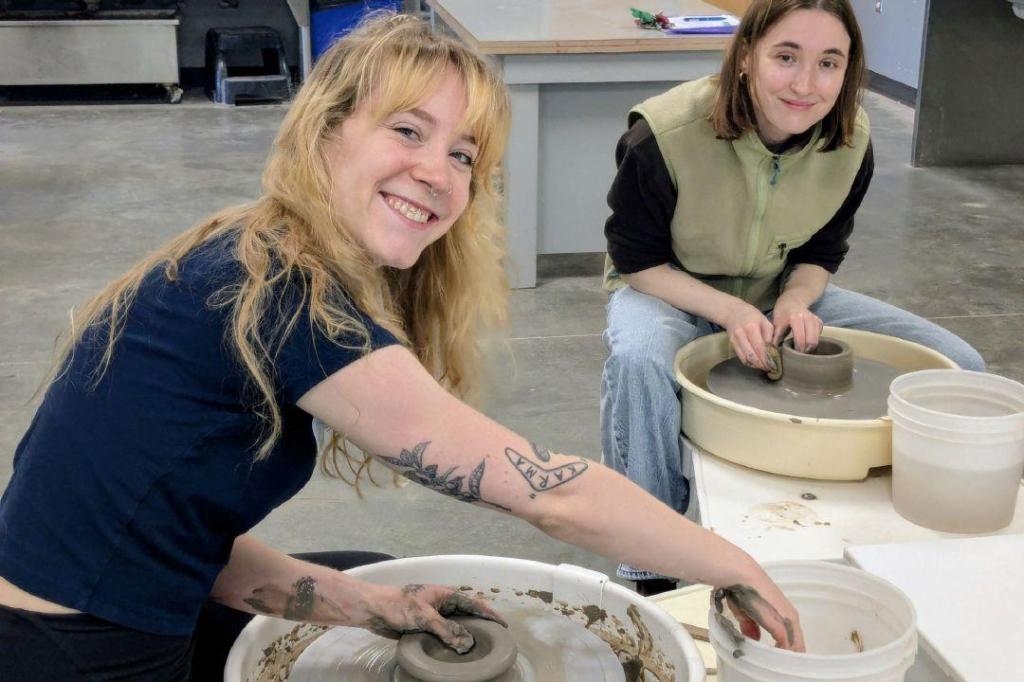
Meanwhile the centre’s highly popular 14 wheel pottery studio offers five five-hour drop-ins per week (more than 860 last year) for children six and up – plus adults and seniors of all skill levels – currently guided by Haley Hebert, with assistance from facility operations coordinator Emmanuelle Culp.
Creating this level of service for the community has not come without a significant cost, the society board notes in its letter.
“We finished several years with large deficits, drained $81K of our investment savings in the first two years of operation, have now had six executive directors, been routinely forced to lay off much-needed staff positions, and struggle to recruit and retain staff because we do not have sustained funding to offer secure employment,” it says.
“Staff routinely get burnt out because the requirements of their jobs are overwhelming. We have never had the funding to build and sustain the staff resources needed to flourish.”
Running a community arts space is stretching the resources of the society to the limit, Silvers said, while it must still struggle to fulfil the basic functions of an area arts council.
The unsung angel for SAS has been a three-year, $100,000 per year seed grant from the Peace Arch Hospital and Community Health Foundation, recognizing the health benefits and community connectedness the arts foster.
This saved SAS from bankruptcy in 2025, but, as Silvers pointed out, it cannot reasonably be expected to continue after the seed grant term expires at the end of 2027.
What would solve the current dilemma – and save the SAS from being dissolved next year?
The answer is straightforward, SAS argues – fair operational funding from the City.
“SAS would finally be able to resource a sustainable operational function to support community programs and services, and build additional funding streams, thereby continuing to deliver arts services to the community at a value exceeding what the City could do on its own.”
Silvers noted the success of the recent auction of paintings from the SAS’ plein-air Paint The Town event – which raised some $6,000 for the cause.
“The opportunity (to raise other funding) is here – but we need fair and equitable funding as well,” she said.