
The United States sought the extradition of Dhaliwal and co-respondent Yadwinder Dhillon in proceedings that included allegations concerning Mexican-sourced marijuana seized in Oklahoma.
The court record describes intercepted telephone communications involving Dhillon and another individual, Donovan Cole, including a conversation about the Oklahoma marijuana seizure.
The prosecution also relied on anticipated evidence from a cooperating witness.
Dhaliwal’s lawyer, Bruce Olmstead, challenged the reliability of that witness and sought disclosure of additional statements, including information about any threats, inducements or promises of leniency.
Justice Wein dismissed the disclosure applications, finding insufficient grounds to compel the additional evidence.
The court also noted that committal was not disputed on sufficiency or identification grounds concerning the Canada-U.S. charges.
The Ontario ruling provides a window into the scope of the cross-border investigation and American extradition proceedings. The reported subsequent federal narcotics conviction in Detroit in 2007 adds another significant dimension to Dhaliwal’s criminal history.
Dhaliwal’s Support for Gill, Police-Funding Critic Idris Orughu and Other Candidates Raises Questions
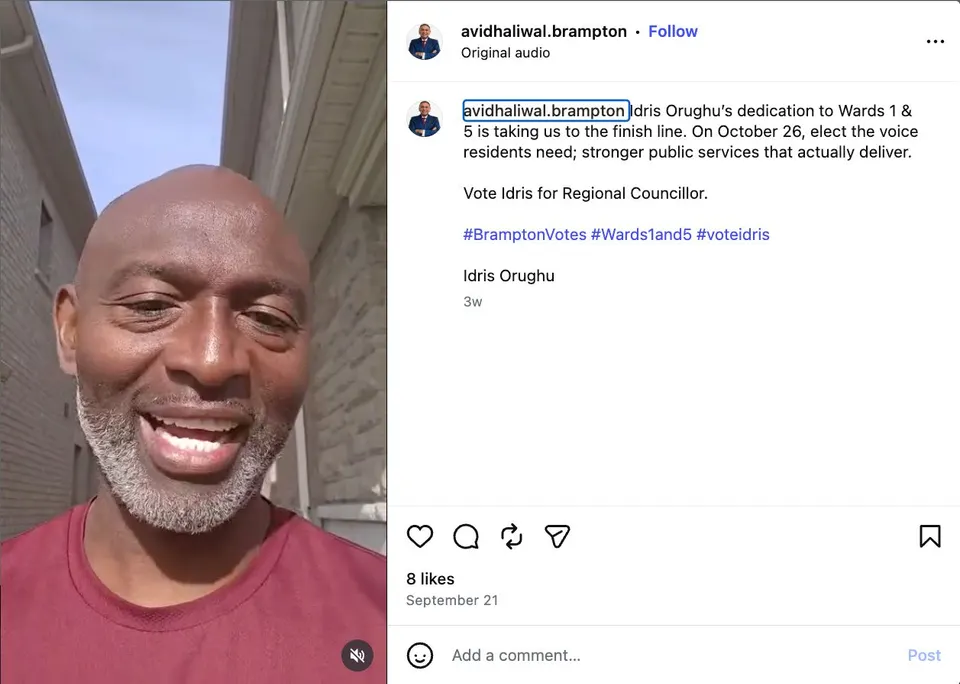
Dhaliwal has also promoted Idris Orughu, a regional council candidate in Wards 1 and 5 who has publicly criticized increased funding for Peel Regional Police.
In November 2024, Orughu called a proposed police budget increase “ludicrous,” questioning the need for hundreds of additional officers while advocating greater attention to social services and other community priorities.
Orughu has also received support from David Bosveld, a prominent police-defunding activist who has advocated redirecting police resources toward alternative services.
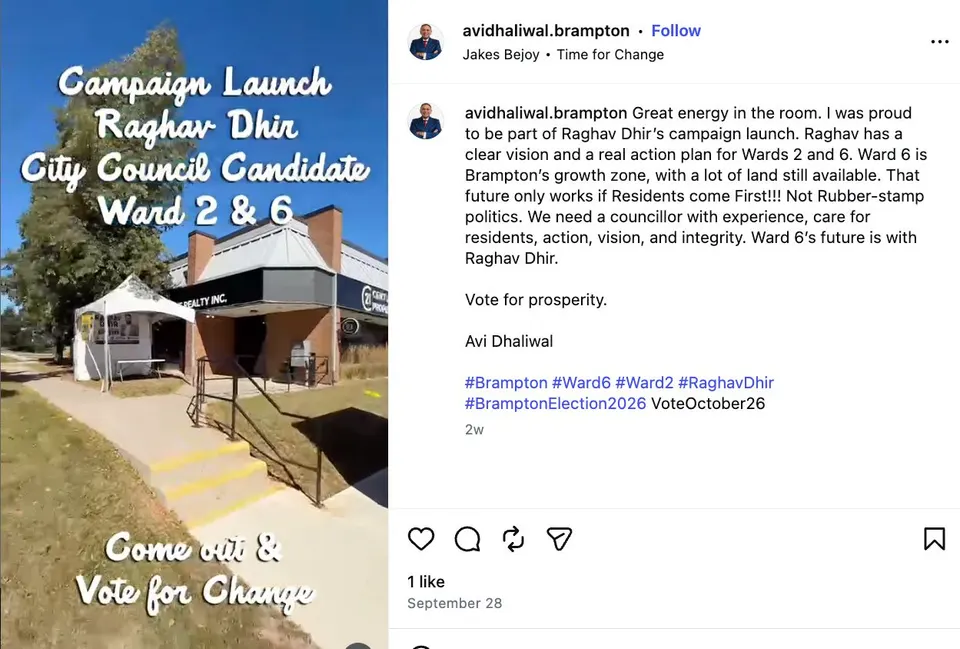
Dhaliwal’s political involvement extends beyond Gill and Orughu. Images reportedly shared on his Instagram account also promote former Brampton councillor Gurpreet Dhillon, Gita Dhakal and Ragiv Dhir.
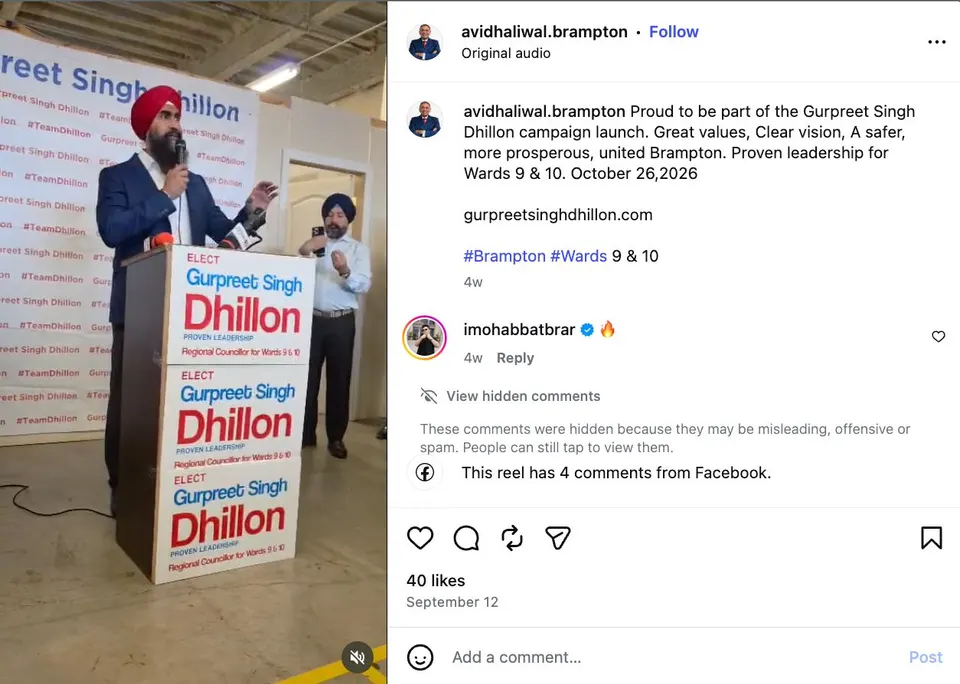
Dhillon was defeated in the 2022 municipal election amid controversy surrounding a 2020 Integrity Commissioner investigation that found he had violated Brampton’s code of conduct in connection with sexual harassment allegations. Dhillon appealed the integrity Commissioner’s report to the Ontario Superior Court and was ruled to pay costs for the frivolous lawsuit while the Integrity Commissioner’s report was upheld.
The reported endorsements raise questions about the extent of Dhaliwal’s involvement across multiple municipal campaigns, including whether his support extends beyond public promotion to fundraising or organizational assistance.
Mayor Patrick Brown has taken a contrasting position on policing, advocating additional frontline officers and enhanced border security to combat organized crime and drug trafficking. On September 29, Mayor Brown released an Instagram video in which Adrian Woolley, President of the Peel Regional Police Association who represents over 3800 Uniform and Civilian members of the Peel Regional Police, endorsed Brown for another term as Mayor.
Brown has previously criticized police-defunding advocates, arguing their policies are “only helping organized crime.”
With Peel Regional Police’s 2026 operating budget reaching $837.3 million, Orughu would have a role in regional police funding decisions if elected.
Does Dhaliwal share Orughu’s criticism of increased police spending? What policing and border-security policies do the candidates he supports intend to pursue? And what financial or organizational assistance, if any, has Dhaliwal provided?
Neither Dhaliwal’s political endorsements nor Orughu’s criticism of police spending establishes an improper motive. However, the candidates’ policy positions and the nature of their political relationships warrant public examination.
More Than $283,000 in Civil Forfeiture Proceedings
Dhaliwal’s name also appears in a 2015 Ontario government notice concerning civil forfeiture proceedings involving individuals, transportation companies, properties, trucks, trailers and financial accounts.
The proceeding resulted in $283,668.62 being deposited into a government special-purpose account.
The notice is a separate legal record from the criminal extradition proceedings and the reported subsequent U.S. federal narcotics conviction.
The existence of the forfeiture proceeding adds to questions surrounding Dhaliwal’s financial history and his present involvement in municipal election campaigns. Civil forfeiture proceedings are distinct from criminal convictions, and the notice alone does not establish that Dhaliwal personally forfeited the entire amount.
Why Is Dhaliwal Opposing Brown?
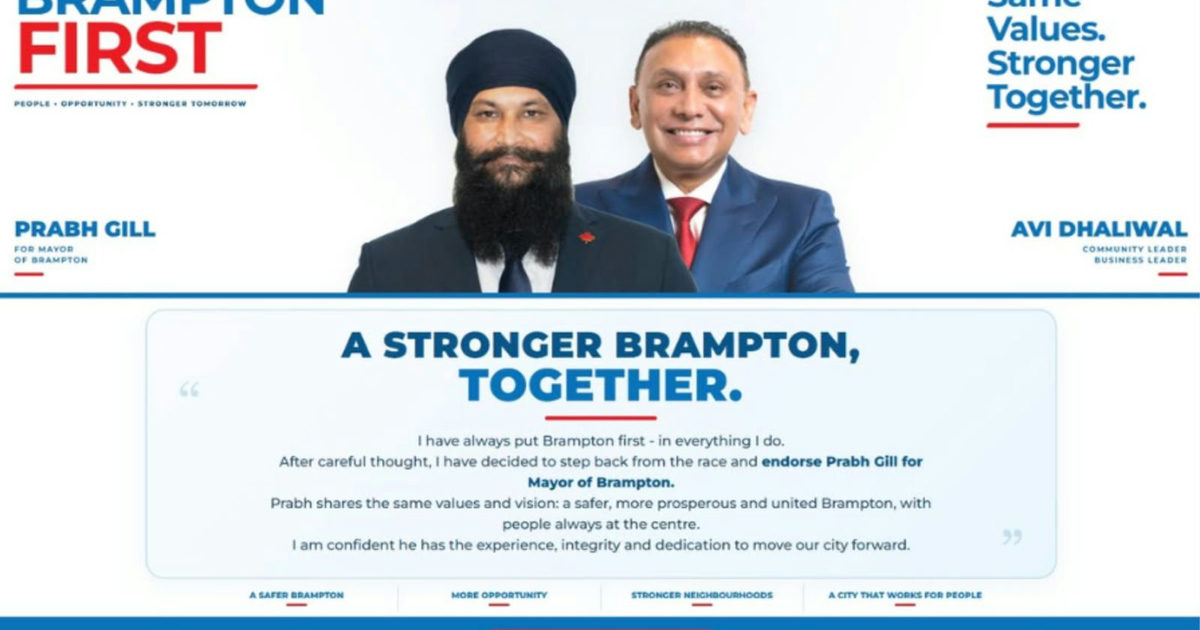
Dhaliwal’s decision to withdraw his own mayoral candidacy and endorse Brown’s challenger raises questions about his political objectives.
Brown has made support for Peel Regional Police, tougher approaches to crime and enhanced border security central features of his public-safety agenda.
Against that backdrop, Dhaliwal’s support for candidates seeking to defeat Brown and his allies invites closer examination of their competing policy priorities.
Does Dhaliwal oppose Brown’s policing policies? What changes does he want from the candidates he supports? What financial or organizational support has he provided to the campaigns he promotes?
What assurances can Gill, Orughu, Dhillon, Dhakal, Dhir and other candidates provide about the sources of any financial or material support they have received? Can they confirm that any contributions comply with election-financing laws?
These questions are particularly relevant to public discussion of commercial trucking and border security, given the role of transportation companies in the historical drug-trafficking investigation involving Dhaliwal.
Brown has been a prominent Canadian municipal voice advocating stronger border security and additional measures to combat organized crime.
Dhaliwal’s current transportation business could clarify its position on those policies, including whether it supports Brown’s border-security initiatives and what alternative measures, if any, the candidates Dhaliwal endorses would pursue.
There is no established evidence that Dhaliwal or his business opposes enhanced border security, that any current campaign contributions involve proceeds of crime, or that his political involvement is connected to his past criminal activity.
Nevertheless, the breadth of his reported endorsements makes campaign transparency, political influence and the candidates’ public-safety platforms relevant matters for examination.
With policing, organized crime, border security and public safety among the issues facing Brampton voters, the nature of Dhaliwal’s political relationships warrants public scrutiny.
The central questions are what role Dhaliwal is seeking through the candidates he supports, what assistance those campaigns have received, and how their policing and border-security proposals differ from the current administration’s.
For Brampton voters, the broader issue is how competing approaches to police funding and border enforcement would affect public safety, organized crime investigations and efforts to combat cross-border drug trafficking.