
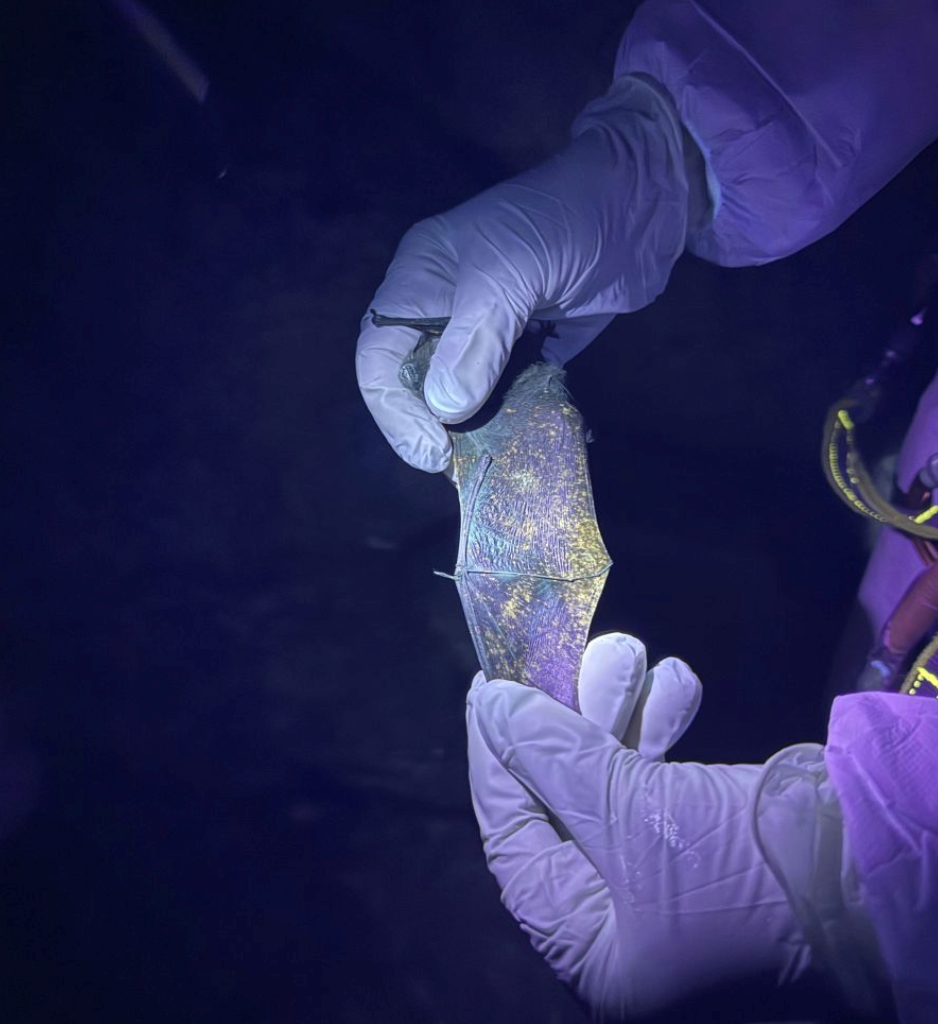
“We’re hopeful we’re getting on the leading edge of preventing big declines in other areas by getting the probiotic out there.”
BOW VALLEY – A probiotic cocktail aimed at slowing the alarming die-off of bats from white-nose syndrome is showing early and promising signs it could be helping, according to researchers.
Last year, the province of Alberta began applying a probiotic cocktail at two sites where bats were roosting in the southeastern part of the province and has since expanded the number of treatment sites to 14.
Jasper National Park is also using the probiotic at known maternity sites after dead bats and white-nose syndrome were found in a hibernating bat colony in March, the only known cave where bats overwinter in the park.
While Parks Canada currently isn’t applying the treatment in Banff National Park, the park’s action plan for at-risk species lists it as a possible future option if partnerships or additional resources become available.
“We’re trying to reduce the negative impact of white-nose syndrome,” said Lisa Wilkinson, species-at-risk biologist at Alberta Fish and Wildlife and the province’s bat specialist during an Oct. 1 online presentation hosted by the Wildlife Conservation Society of Canada.
“We’re hopeful we’re getting on the leading edge of preventing big declines in other areas by getting the probiotic out there.”
Recent research has found that some naturally occurring bacteria – probiotics – can repel the cold-loving fungus that causes white-nose syndrome. As a result, a probiotic cocktail, which is a blend of four bacterial strains that suppress the fungus, was created. These bacteria are naturally found in some bats, but not all.
In addition, researchers say there is also some growing evidence that shows a very small percentage of bats may have some genetic resistance to the fungus, known as Pseudogymnoascus destructans.
Wilkinson said bats will continue to die because there is no cure or easy way to vaccinate bats against this, but there is now hope to reduce those losses.
“There’s no magic bullet,” she said.
“We can’t just eradicate the fungus and it’s going to be here for a long time but there’s a number of ways being explored and there’s a little bit of hope.”
Several options are being considered and tested in other jurisdictions to help combat the deadly disease that first showed up in New York State in 2006. It has since killed millions of bats across the United States and Canada.
Fungicides, which are pesticides used to kill parasitic fungi, and UV light to control fungal growth are being tested with some success in some areas in the United States.
Oral vaccinations are also being tried and seeing some success, though Wilkinson said there are limitations because hundreds of bats need to be caught, not just dozens.
She said Alberta is focusing on the probiotic cocktail, which repels the fungus that causes white-nose syndrome.
“It’s the best fit for the bats in Alberta,” she said.
Alberta’s first confirmation of the fungus was detected in bat poo in 2022 and the first case of the disease was detected in little brown bats in the Badlands along the Red Deer River in spring 2024.
“We had taken steps in Alberta to reduce the likelihood of the accidental transportation of the fungus that caused white-nose syndrome, but we knew, ultimately, it was coming,” said Wilkinson.
During summer 2025, the province began applying the probiotic cocktail at entrances of known maternity roosts when bats were out flying at night. It has now been applied to about 14 sites so far in Alberta.
Ideally, researchers hope the probiotic bacteria will get incorporated into the bat wing microbiome and reduce the risk of fungal infection when bats return to hibernation sites.
The bats pick up the naturally-occurring beneficial bacteria on their wings as they pass through the maternity roosts and spread it to other bats.
“This holds so much promise,” said Wilkinson.
Trials of the probiotic began in British Columbia in 2019 and expanded to Washington State.
In B.C., Wilkinson said researchers had been finding an increase in probiotics at all of the treatment sites.
“This means that treated bats were interacting and spreading the probiotic to other bats after the summer, perhaps in those fall mating swarms,” she said.
Closer to home at Emerson, in southeast Alberta, the probiotic began to be applied in 2025 when researchers noticed the bat colony was declining.
Now, Wilkinson said “there’s a little bit of good news.”
“In 2026, the bats, even though the count was lower, they appeared healthier,” she said.
“Those bats we were catching in 2025 had a lot of wing damage, were clearly coming out of hibernation dehydrated and in rough shape, but they seemed to be in generally better shape.”
Wilkinson said there are a couple of hypotheses, including the probiotic could be helping protect some bats, or more of the bats have a natural resistance.
“We don’t know what percent of bats have these natural resistance … it’s very low but that obviously is going to be coming into play,” she said.
“We can be hopeful. The optimists will look at this and say the probiotic is helping but that really remains to be quantified.”
There are at least nine species of bats in Alberta, but the hibernating bats that don’t migrate south are most susceptible including little brown bat and northern myotis.
“These were listed federally because of their declines in the east, and so we know they’re very vulnerable,” said Wilkinson.
Surprisingly, in Western Canada, Wilkinson said it’s not known where most bats hibernate.
“Probably only a small number are in caves and we know only of a handful of caves,” she said.
“The rest of our bats are probably located in cracks and crevices in rocky outcrops, riparian areas, so there’s still a lot of mysteries that we still need to learn about.”
Despite this lack of knowledge, Wilkinson said they do know how important these areas are.
“Some bats have been recorded to fly over 300 kilometres to get to some of these sites,” she said.
The fungus that causes white-nose syndrome lives in cold, dark places where bats like to hibernate like caves and other cracks and crevices.
It has a range of temperatures that it can grow in from about three degrees Celsius up to just below 20 C, with a peak of around 12 to 15 C.
“It doesn’t survive at over 20 degrees C, so that’s why it’s just found in these cold, wintering environments,” said Wilkinson.
“Bats are not susceptible to it in the summer when they’re in warm places, and their body temperature is warm up at 38, 40 degrees C.”
Once the fungus gets introduced to a bat hibernating area, Wilkinson said it starts to proliferate over a number of years.
Initially, small amounts of the fungus don’t really bother the bats, she said.
“But when it gets to a certain threshold, when there’s enough of the fungus, it starts to grow onto the tissues of the bats, the wings, the nose, the ears, and penetrate those tissues, which triggers the physiological response,” she said.
“They are irritated, they arouse, they’re dehydrated … and if they wake up in the middle of winter, there are no insects, and so they’re using up all their stored fat, and sadly, they die. And so, millions of bets have died across North America from this disease.”
In March of this year, researchers found many dead bats in one of the sentinel hibernation sites where white-nose syndrome had been detected.
“We had picked up the fungus the year before, and, shockingly, we were greeted by dead bats in the snow, and some dead bats in the cave,” she said.
“It’s a really tragic thing to witness and it’s very sad. I was there and it was one of the hardest days of my career.”