
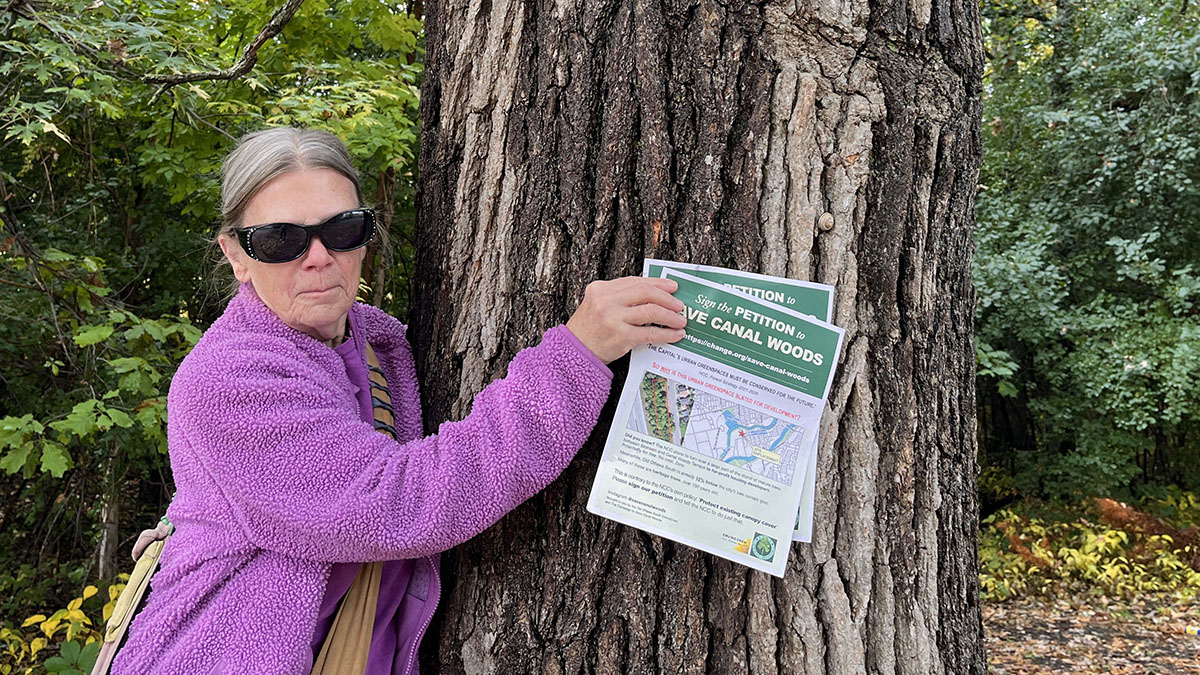
On a recent crisp Monday evening, Kelly Quinn, Sandy Garland and four other residents of Old Ottawa South meandered down to a small urban forest on the corner of Bronson and Sunnyside Avenues to pull invasive Buckthorn roots.
Residents of the community have been taking care of the tiny forest for years. They may not need to soon.
The NCC is selling 1100 Canal Woods Terrace in Old Ottawa South to a developer to build housing, including affordable units. Some neighbours are concerned the loss of the forest could increase pollution and flood risk.
“When we have trees that are over 100 years old, why the hell do we want to chop them down?” said Garland, who chairs the neighbourhood association’s environment committee.
The property was put up for sale by the NCC in January through the Canada Mortgage and Housing Corporation’s (CMHC) Federal Lands Initiative, which stipulates that 12 of the 40 new units must be affordable. Through the program, federal lands are sold or leased at discounted or no cost.
“Following this process, a proponent was identified and the NCC is pursuing negotiations with the goal to reach an agreement,” Valérie Dufour, senior manager of communications at the NCC, told Capital Current in an email. Dufour would not disclose the buyer.
The NCC has 10 properties listed for housing development across the city. It is part of a push to address the “housing crisis that is impacting lives and communities,” says the Crown corporation’s website.
Ottawa is one of the most unaffordable cities in Canada for housing, a 2025 CMHC report found. Despite an increase in construction, the agency says not enough homes are being built to bring prices back to pre-pandemic affordability.
The land up for development on Canal Woods Terrace is 0.28 hectares or the size of 10 tennis courts. It provides ecological benefits to the neighbourhood, said Joe Bennett, a Carleton University biology professor who lives nearby.
The trees help regulate air temperature, offer a spot for birds and animals and filter air and noise pollution from Bronson Avenue. While the NCC can replant trees elsewhere, he said, it will be very hard to replicate what the area provides environmentally, particularly several century-old oak trees.
“If you’re going to gain anything in conservation, you’ve got to protect the places that are under threat or restore the places that are in rough shape. Otherwise, you’re just kind of window dressing,” Bennett said.
The potential loss of the forest prompted Garland to create a petition, which has already garnered more than 1,200 signatures, to save it.
“If there is a buyer and the buyer has a plan, then we’re going to fight it,” she said.
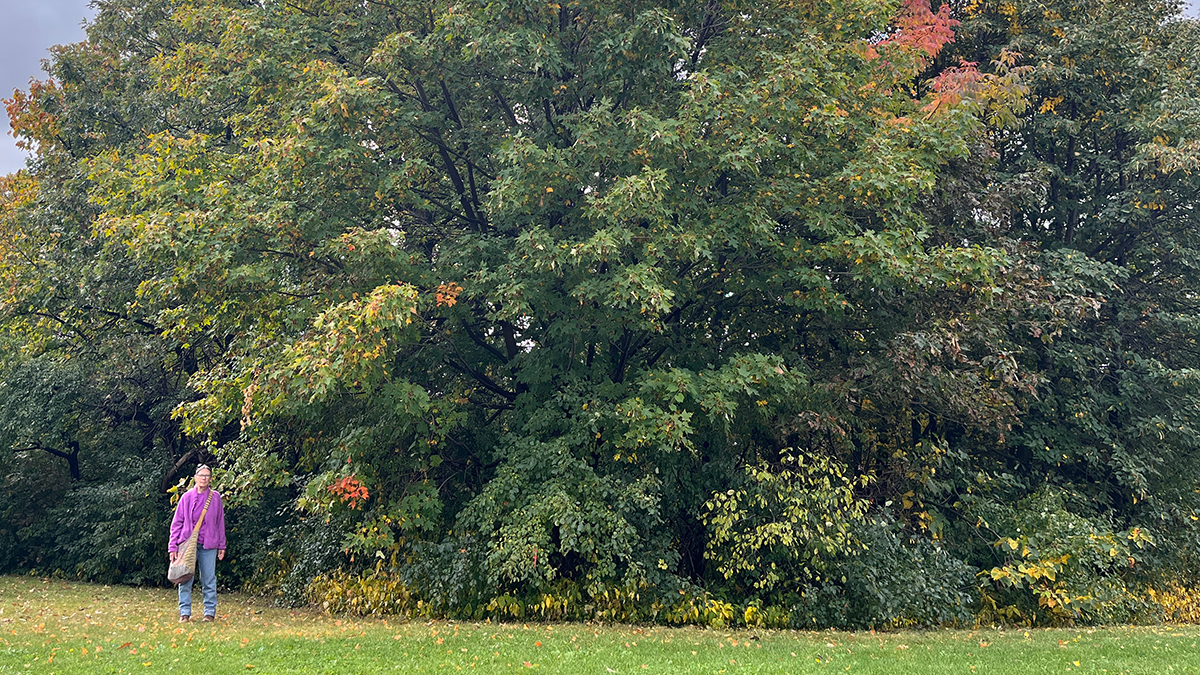 Sandy Garland, shown in front of 1100 Canal Woods Terrace, said the NCC did not consult residents of the neighbourhood. [Photo © Miriam Visser
The site is not zoned for development. However, if the NCC sells the land, there is little the city can do to prevent a buyer from putting the application in and going along with the NCC’s process, says Shawn Menard, who is seeking re-election as Capital Ward councillor.
The city can oppose it, however, based on whether the buyer’s site plan mitigates the flood problems in the area, Menard said.
Part of the forest lies on a flood plain, making it prone to flooding during heavy rains and spring snowmelt. The forest mitigates the risk by absorbing water and stabilizing the soil.
“The current existing site has large flooding on it. It’s like a ravine in the spring,” said Menard. “There is a lot of drainage that goes on so there’s major concerns from that end.”
Quinn, who lives a couple of blocks away, said she has had problems renewing her home insurance over the past two years, in part because of the house’s proximity to the flood plain.
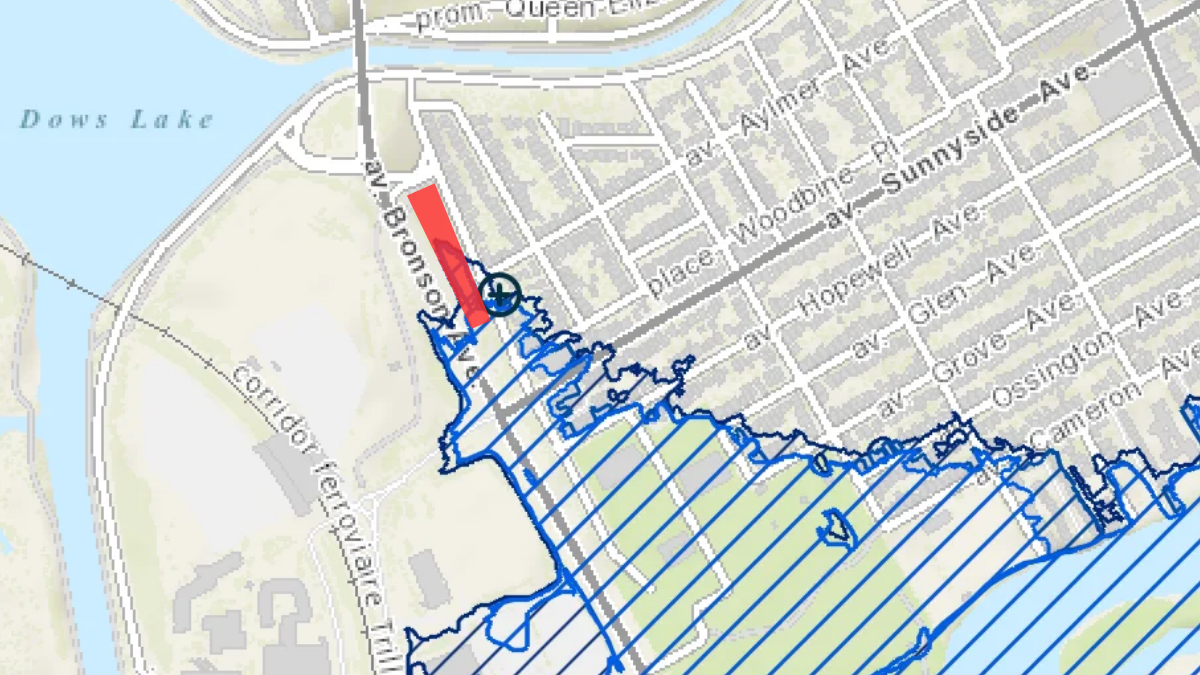 A map showing the portion of 1100 Canal Woods Terrace located on a flood plain, with the proposed development site in red. The south end of the greenspace, past Aylmer Avenue, is not part of the development. [Map © Miriam Visser, City of Ottawa]
“We know that flooding is a risk. We know that green spaces like this are mitigating factors against flooding,” said Quinn. “It just seems so illogical.”
Jaac Doduck, a candidate in Capital Ward, said the site’s proximity to Carleton University and transit stops make the spot ideal for housing development.
“I am understanding of the concerns that people have about losing the green space, but it fits a lot of checkboxes for good diverse housing that is near transit stations and where people need it.”
He said the loss in tree canopy can be offset by planting more trees near houses and sidewalks and in parks.
Irirmgard and Gunther Bauer have lived on the street for 39 years, often walk along the forest to the canal. Gunther Bauer said it would be “such a shame” to see the trees come down.
“We like to walk and when we come back and the sun is shining, we sit and enjoy the beautiful forest that is still there at the moment,” Irirmgard Bauer said.