
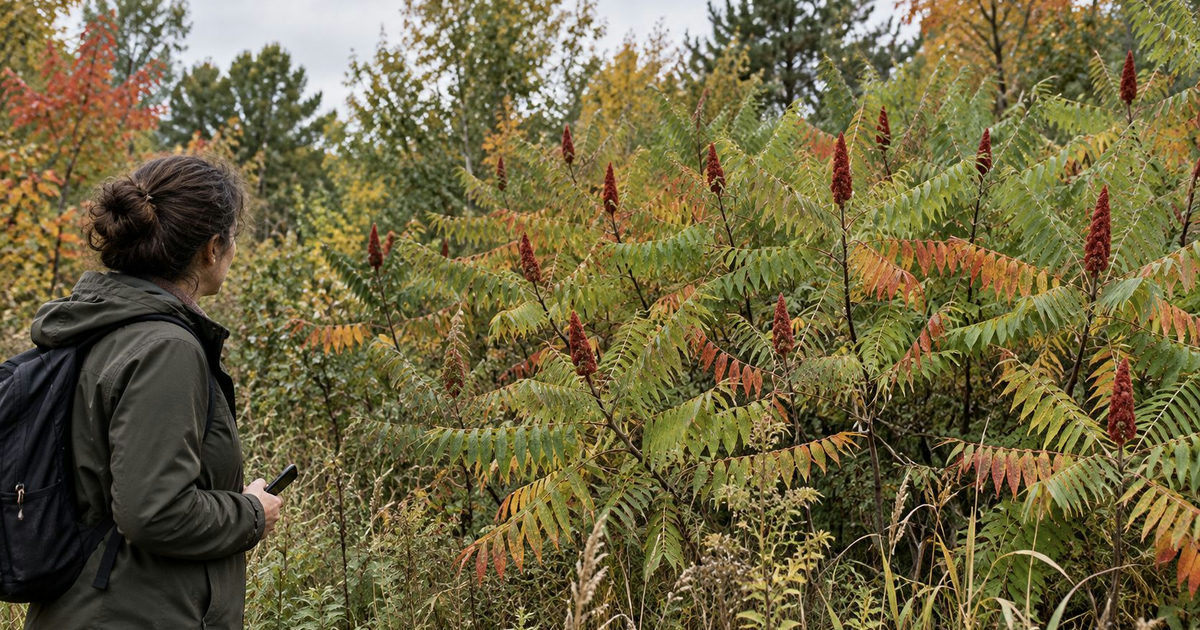
That makes the map useful before leaving home as well as during the walk. Pick a few contrasting species to look for rather than making identification of every tree the measure of a successful outing.
Look for shape, not just colour
The map describes staghorn sumac’s upright red seed clusters and leaves divided into smaller leaflets. For bur oak, it draws attention to rounded leaf lobes and an acorn cup with a fringed edge. These are different clues from the familiar outline of a maple leaf.
Its white elm entry points to toothed leaves with an uneven base, while littleleaf linden has heart-shaped leaves. Comparing those features gives children a concrete observation task even where autumn colours vary between individual trees.
Older trunks offer another comparison. The map explains that the bark of mature white elms can surround hollow spaces used by birds. A tree walk can therefore be about habitat as well as names, without any promise that a particular bird or animal will appear.
Make it an observation walk
Use the photographs and descriptions as an identification aid, not as a reason to pick fruit, remove bark or disturb wildlife. Photographing a leaf or a tree from the path gives everyone a way to compare observations afterwards while leaving the site intact.
Check the map’s location before travelling and follow current entrance and closure notices. The tree-walk page does not establish a signed loop distance, a stroller-accessible route, parking availability or a guided session time. Choose a turnaround point that suits the group rather than relying on an invented route length.