

It’s a challenge that won’t be going away anytime soon, according to Stefanie Ralph of the Yukon Hospital Corporation.
Services at Whitehorse General Hospital are being stretched thin, as the facility deals with more patients than it has capacity for. Last week, officials said the hospital was at 124 per cent capacity and that it wasn’t a temporary blip — occupancy has been going up over the last several years and has averaged 121 per cent so far this year.
It means patients are being told they may be treated in hallways or other “non-conventional spaces.”
Ralph, the executive director of patient care, access and flow for the Yukon Hospital Corporation, spoke to CBC’s Airplay host Dave White about what this means for patients, now and in the years ahead.
This interview has been edited for length and clarity.
What does it look like at the hospital when you’re at 124 per cent capacity?
We have 79 inpatient beds and when we have more patients than that, then we need to provide that care in non-traditional, non-standard spaces.
So what that looks like for someone is, they could be admitted but still in the emergency department receiving care until an inpatient bed becomes available. Or, we have our Thomson Centre pod one — there is a former dining room used for long-term care, we’ve set that up to be a patient care space. While not ideal, it is a bit of a quieter space than the emergency department where people receive care while they wait to be placed in a proper inpatient bed.
On days when we’re really pressurized, it could mean that we’re using meeting room spaces, it could mean that we’re using the beds in our surgical daycare, which disrupts our surgical program.
But what’s important is, regardless of where that care is provided, our team is dedicated to making sure that that care experience is the best possible, we’re advancing a care plan, we’re still moving toward supporting people for discharge. We’re really happy to care for everybody who needs it, even if it means we have to stretch.
Do we know why we’re over capacity? The hospital is not that old, and a lot of work was just done on the emergency room.
There’s a number of factors. We’ve seen significant population growth — the Yukon population has grown 26 per cent since 2014. Our population is also aging, which means they need different types of care, often more care, in order to stay well. Care is also getting more complex, people are coming sicker, with many different issues. We’re also seeing advances in medical science, which is a good thing — people are living longer with more complicated conditions, but that also means that they need care along that journey.
And there are pressures across the health system, which also means if someone can’t access care elsewhere, that they may need to access that care at the hospital.
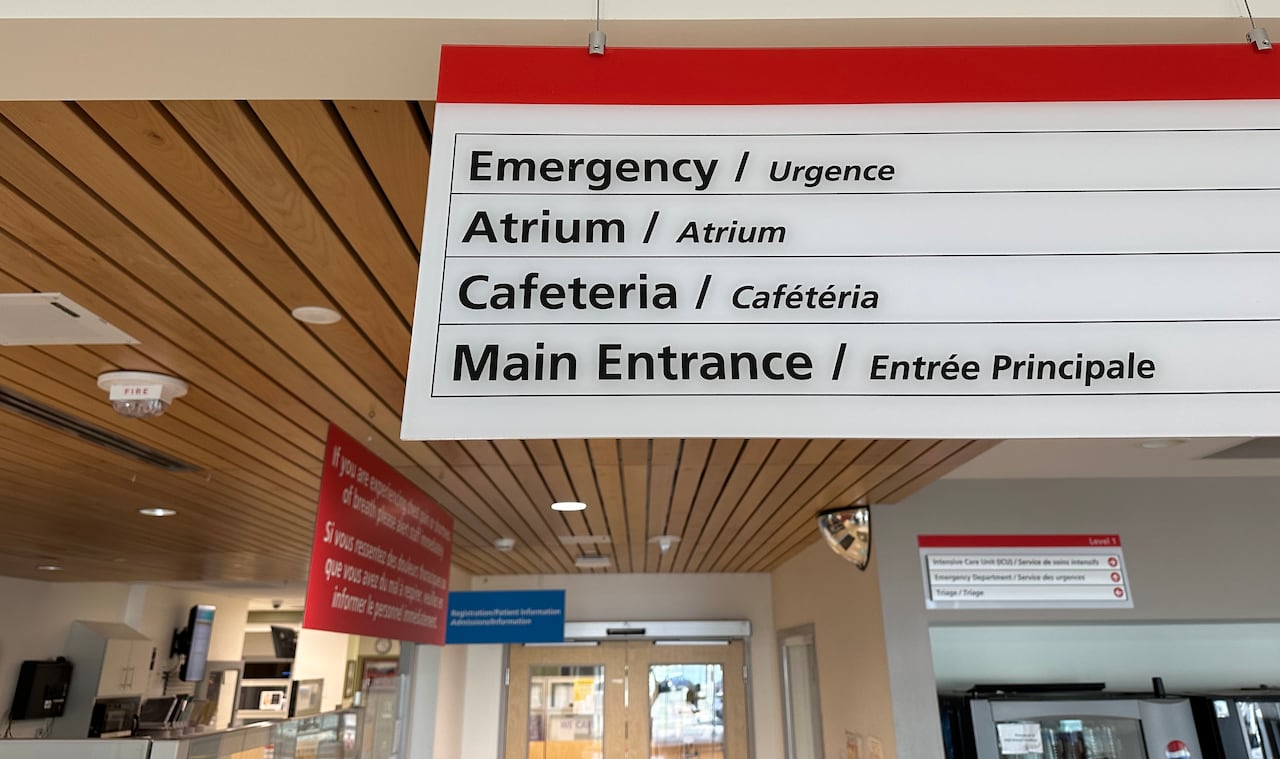
A sign inside the Whitehorse General Hospital’s emergency department directs patients and visitors. (Dana Hatherly/CBC)
Our current projections around hospital demand suggest that today we need 100 beds in order to meet the demand in the Yukon. So there is a shortfall, which explains why we see this pressure on capacity.
In Canada, we have a socialized medical system, and sometimes Canadians have been accused of dashing off to the hospital whenever they stub their toe. Is that an issue? Are we looking at needing more non-emergent care somewhere that can take off that pressure?
What’s important is that people know what choices are available to them. Yes, for some lower-acuity issues, there are options like calling 811, pharmacies can provide some care, there’s a walk-in clinic or access at your physician or primary care provider.
But the hospital is always a choice. And for anyone who decides that they need or choose to get care at the hospital, we’re really happy to care for them, even if it is a lower-acuity presentation.
You mentioned 20 more beds would be a big help. How big a process is that, to expand Whitehorse General Hospital by that number?
The work is underway right now to look at a significant expansion to Whitehorse General. A proposal has been put forward to expand by roughly 56 new beds. Those projections I mentioned, that say we need 100 beds today, tell us that we need between 139 to 159 beds by 2045. That’s a significant infrastructure investment and will take a significant amount of planning to move us toward that.
In the interim, though, we have been supported with growth at Yukon Hospitals. We opened eight new medical inpatient beds in June in what was the former secure medical unit. And in the fall of 2025, we were pleased to open our Fireweed mental health unit, which increased our mental health capacity by an additional three beds. So we appreciate those investments, and there’s still a need today that we’re all working to address.
A hospital is a stressful environment at the best of times. When you have these sort of shortfalls and you’re making do with these temporary measures, what kind of strain does that put on hospital staff?
It pressurizes the system, all the way across. What people most often see are the nurses and physicians who are directly providing their care. But as we’re caring for more people, it pressurizes things like our lab services, imaging, diagnostics, all of our allied health services, and also really importantly, the support services behind the scenes. With more people and more spaces, it means our environmental services folks are stretched to make sure our hospitals stay clean and safe. It’s more people who need nutrition and food services. It just stretches the whole system.
The hospital has been over capacity for some time now. Does it look like it’s going to continue for the foreseeable future?
Yes. I think that’s the simplest answer — I think it will.
We continue to work on making sure that we’re reducing wait times whenever we can, we’re being as efficient wherever we can, but also balancing — we don’t want people to leave the hospital before they’re ready, we want to make sure people have good discharge plans and are supported to return to the community, because we want people to continue to get well, not just get sicker and need to come back.
So we pay attention to all of those factors, and I think we will have to continue to use those overflow spaces. And I would stress that in those cases, we know they’re not ideal, maybe not as private as folks would like, but we really try to provide the best care that we can.