
Re: “They speak French, so why are young anglophones still leaving Quebec?” (The Gazette, Oct. 10)
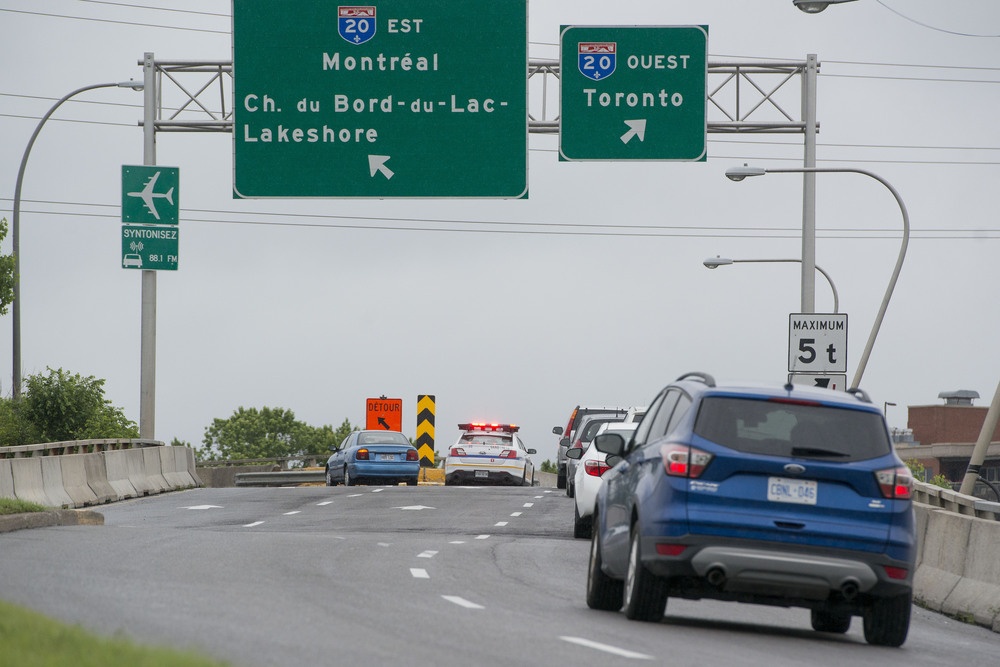
On any weekend, but especially a statutory holiday, there are’ so many Ontario licence plates on Montreal roads you have to wonder what city you’re in.
How many of the visitors are native to Montreal is anyone’s guess, but I put the odds favouring ex-pats.
Out-of-province drivers, to some extent, reflect the exodus from Quebec that took root in the 1970s and continued over the next 50 years.
While the tidal wave of anglos leaving has receded from previous levels, a younger generation is still seeking opportunities elsewhere, according to the study out of Concordia University cited by The Gazette.
However, if past behaviour repeats, as readers here can attest to, an older demographic will follow family that is no longer here.
Maybe not right away, and certainly not everyone can pick up stakes, but retirees or even those still working who want to be near their children and grandchildren will eventually join them, be it in Toronto, Vancouver or south of the border.
Make no mistake: The loss of these older adults will be felt economically, culturally and socially.
Dorothy Lipovenko, Westmount
Alternative schools’ crucial role
Re: “School’s alumni fight to protect a safe space” (The Gazette, Oct. 16)
When will governments and school boards realize that one size does not fit all ?
I am thankful for these types of schools, like Phoenix Alternative High School and others, that give students a chance to learn in a way that meets their needs and move on to productive lives.
Kudos to those who are trying to save the school.
Victoria Jonas, Beaconsfield
More fresh air, less technology
Re: “Kids need our help to be kids again” (Opinion, Oct. 15)
Lisa Filice of AMCAL Family Services has written a timely op-ed about how kids today need help to feel comfortable making friends and connecting with other children.
From what I see, there is way too much technology at their disposal, and children have too many planned activities rather than just going to play with friends, like I did when I was young.
We did not have iPhones, iPads and big-screen TVs with countless channels to watch. We did not have “play dates” where an adult is around. We were allowed to ride our bikes with friends and play outside until we were called in for dinner.
No doubt the pandemic added to the difficulties children are experiencing. But I feel it’s more about how they are being socialized. Bring back playing in fresh air with no elecontronic devices.
Franceen Goodman Finesilver, Côte-St-Luc
Nurture both mind and soul
In her op-ed, Lisa Filice states children need help learning how to be together and make friends.
Schools have put academics at the centre of education for a long time, but children need so much more than just reading, writing and mathematics to thrive.
Play should be high on, if not at the top of the list: It teaches collaboration, conflict resolution, negotiation, empathy and the social skills that shape who they become.
These are not extras; they are essential life skills.
I hope Quebec’s new government listens to educators, parents and community organizations, broadens its vision of education, and gives children the time, support and freedom to learn through play.
Children deserve an education that nurtures both their minds and their hearts.
Lindi Ross, Carignan
Convert abandoned buildings
Re: “Groups press St-Pierre Plamondon to make good on homelessness pledges” (The Gazette, Oct. 8)
Montreal Mayor Soraya Martinez Ferrada and premier-designate Paul St-Pierre Plamondon have both vowed to make a concerted effort to battle homelessness.
Will there be a change of course, where tent encampments will be replaced by converting and maintaining existing abandoned buildings that are still safe to use as housing?
This is an opportunity for tangible results to be achieved.
Harry Wise, Dollard-des-Ormeaux
Editor’s Picks
Submitting a letter to the editor
Letters should be sent by email to letters@montrealgazette.com
We prioritize letters that respond to, or are inspired by, articles published by The Gazette.
If you are responding to a specific article, let us know which one.
Letters should be sent uniquely to us. The shorter they are — ideally, fewer than 200 words — the greater the chance of publication.
Timing, clarity, factual accuracy and tone are all important, as is whether the writer has something new to add to the conversation.
We reserve the right to edit and condense all letters. Care is taken to preserve the core of the writer’s argument.
Our policy is not to publish anonymous letters, those with pseudonyms or “open letters” addressed to third parties.
Letters are published with the author’s full name and city or neighbourhood/borough of residence. Include a phone number and address to help verify identity; these will not be published.
We will not indicate to you whether your letter will be published. If it has not been published within 10 days or so, it is not likely to be.
Please send the letter in the body of an email, not as an attachment.