
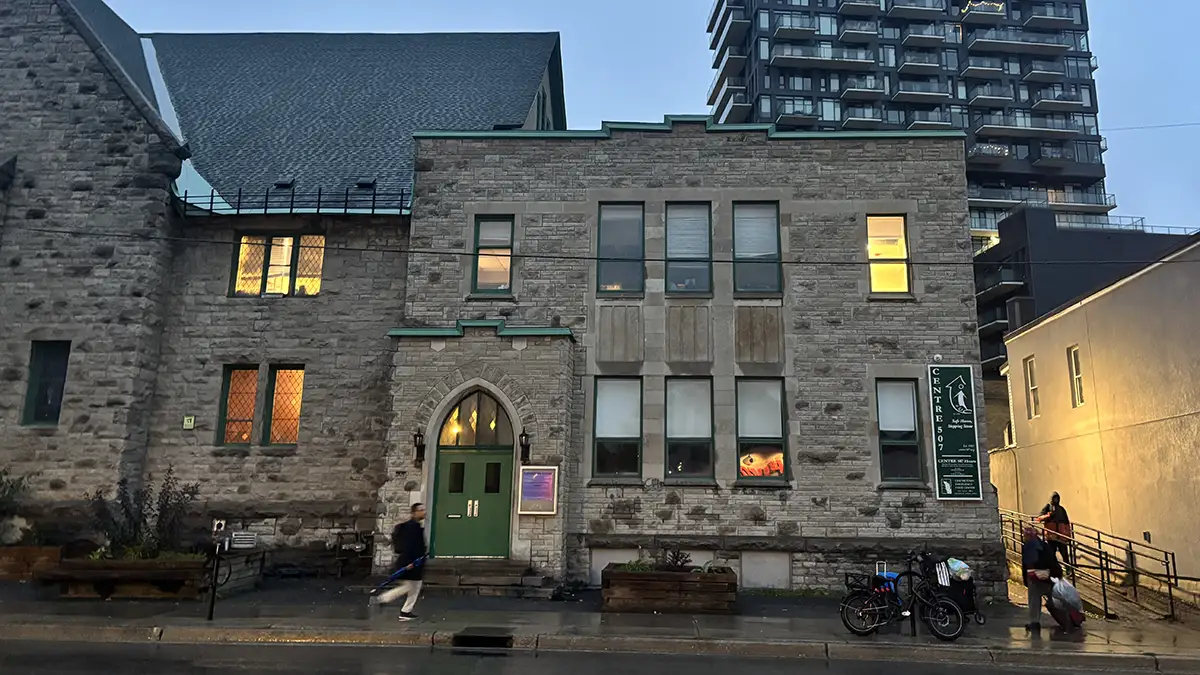
Two weeks ago, Danyel Despaul and her husband spent a night on the steps of a downtown museum. It was out of the wind, somewhat warm and nobody caught them.
But with winter approaching, homeless individuals and community workers say Ottawa is heading into the cold with fewer services and less funding than last year, when there was already a shortage of spaces in warming centres.
“There’s no point,” says Jason Beaupre, who experiences homelessness, describing the challenge of accessing municipal warming centres such as Centre 507. “This place hits capacity almost every night because it’s so cold. If you’re not here at nine o’clock, you’re not getting in.”
Beaupre says he would rather see tiny-home communities or subsidized housing than more shelter beds.
“We get kicked out on the streets or told we have to leave all the time,” he says. “We need outhouses. Access to bathhouses.”
Jason Beaupre describes waiting for a space in warming centres during the winter. [Audio © Micki Lam]
Richard Leblanc, executive director of Centre 507, a 24-hour drop-in, says demand for space has increased dramatically over the last 10 years.
The City of Ottawa’s Point-in-Time count recorded 4,569 people experiencing homelessness in 2025.
Some individuals such as Despaul and Joshua Baxter say they sometimes prefer not to sleep in shelters because of concerns about drug use, pests and personal safety.
“[People are] complaining that there’s more drug use on their property, but there’s more drug use because you’re the ones that voted for not building us proper centres,” Despaul says.
Pressure on frontline workers
Mira Jovanovic helped organize the What’s the Winter Plan? campaign in 2025, urging the city to expand warming spaces and improve shelter conditions. She says centres will remain “packed to the brim” this winter, despite the opening of a small overflow space in Orléans last year.
These are the drop-in centres available this past winter. The centres provided food, shelter, and supports for homeless individuals. [Map © Micki Lam]
Jovanovic also says the city has increased oversight of how shelters are run by using funding as a lever to control services and programs offered.
“The burden keeps going on social services,” she says.
Shauna Young, executive director of Centre 454, says the organization has been told it must relocate from Sandy Hill by January 2027 to maintain city funding. The move is in part because of plans to revitalize the ByWard Market.
Centre 454 provides food, laundry and internet access, with the city covering about 84 per cent of its funding, Young says.
According to Tabitha Morris, supervisor of peer engagement programs at Ottawa Inner City Health, finding a new location that can provide the same access to laundry and other services has made Centre 454’s move difficult.
Although the centre is open to relocating, Young says it needs more time.
“We can’t afford to lose our funding. But we need to be mindful and thoughtful about when and how that move happens,” she says.
“[Homeless] people are moving downtown because they feel safer in big groups and congregations, and with community. But we’re sending them further and further with no way to get there,” says Morris.
Dean Dewar, of the Sandy Hill Community Health Centre, says the closure of the area’s last consumption and treatment services sites in June led to the loss of crucial injury treatment resources and nurses for the winter, making it harder for staff to identify injuries — such as frostbite — among those without shelter.
Dewar says the decision also cut $4.5 million in addiction recovery funding for support organizations in Ottawa.
“There will be more need this winter than we had last winter for us to be planning as a city and as a community,” Dewar says.
Mayoral candidates outline plans
Support for fixing homelessness is the top priority downtown for 48 per cent of Ottawa residents, a study done for CTV News in early October shows.
Mayoral candidate Jeff Leiper says the city needs more 24-hour warming spaces to give unhoused people an alternative to shelters.
“We do need more 24/7 warming spaces, so not necessarily shelter, but places where people are able to get some respite,” he says.
If elected on Oct. 26, Leiper says he would consult city staff and advocates to identify gaps in Ottawa’s winter response.
Mayoral candidate Mark Sutcliffe’s platform proposes a 24-hour Campus of Care hub connecting people with health and social services, along with more supportive housing.
Candidate Neil Saravanamuttoo wants a city-led homelessness plan focused on stable housing, support services and expanded rent assistance. Candidate Alex Lawson proposes regular, unannounced inspections of shelters and hotels, consistent safety standards and public reporting of inspection results.
“I’m hopeful for the election, for new funding, promises, options for people to go,” says Morris.
For Despaul, the immediate challenge remains finding somewhere to stay in the winter.
“Hopefully I’ll be able to pull off the winter in a tent. But again, that comes down to funding.” she says.