
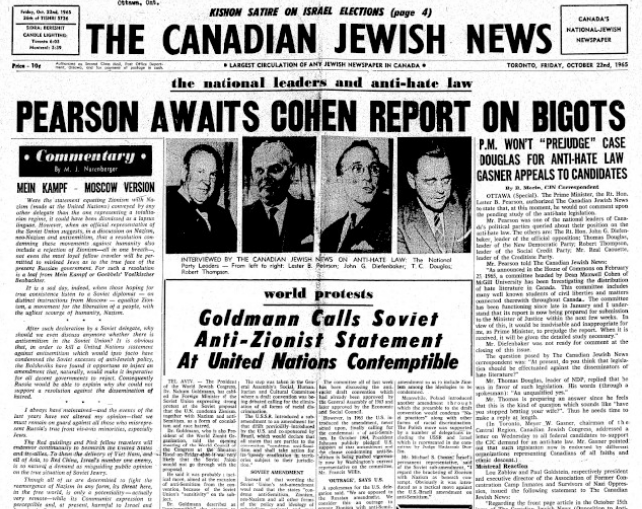
The week of October 22, 1965, laws and motions of great concern to Canadian Jews were being debated both at the United Nations and within the House of Commons.
Just the week before, the Soviet Union brought a proposal to the UN to formally condemn Zionism along with Nazism and antisemitism “as forms of colonialism and race hatred.” This was introduced as “a sub-amendment to an amendment” to a draft convention previously introduced by the United States and co-sponsored by Brazil, which called for “the elimination of all forms of racial discrimination” including antisemitism. World Jewish Congress President Dr. Nahum Goldmann expressed confidence that the Soviet Union “would not go through with the proposal,” interpreting it only as a “tactical move, aimed at the exclusion of antisemitism from the convention, because of the Soviet Union’s ‘sensitivity’ on the subject.” Israel’s representative to the UN, Michael S. Comay, similarly viewed the Soviet sub-amendment as a tactical move against the “U.S.-Brazil amendment on antisemitism.”
Ten years later, in 1975, the UN General Assembly would go on to adopt Resolution 3379, which denigrated Zionism as a form of racism and racial discrimination.
In Canada, the House of Commons formed a Special Committee on Hate Propaganda. Its forthcoming study of anti-hate legislation was highly anticipated. The Canadian Jewish News interviewed prime minister Lester B. Pearson about his position on the matter. The prime minister declined to directly comment: “As announced in the House of Commons on February 22, 1965, a committee headed by Dean Maxwell Cohen of McGill University has been investigating the distribution of hate literature in Canada. The committee has been functioning since late in January and I understand that its report is now being prepared for submission to the Minister of Justice within the next few weeks. In view of this, it would be inadvisable and inappropriate for me, as Prime Minister, to prejudge the report.”
The CJN also spoke with John G. Diefenbaker (then Leader of the Official Opposition), Thomas Douglas (leader of the NDP), Robert Thompson (leader of the Social Credit Party), and Réal Caouette (leader of the Creditiste Party). Diefenbaker similarly skirted The CJN’s questions. Only Douglas gave a clear response, stating he was in favour of such legislation (“an unqualified yes”).
The proposed anti-hate legislation was strongly supported by the Jewish community, with the Canadian Jewish Congress and the Association of Former Concentration Camp Inmates and Survivors of Nazi Oppression actively lobbying for its adoption.
The Special Committee’s eventual report led to the Criminal Code being amended in 1970 to include as criminal offences, under specified conditions, the public promotion of hate against identifiable groups and the advocacy of genocide.