
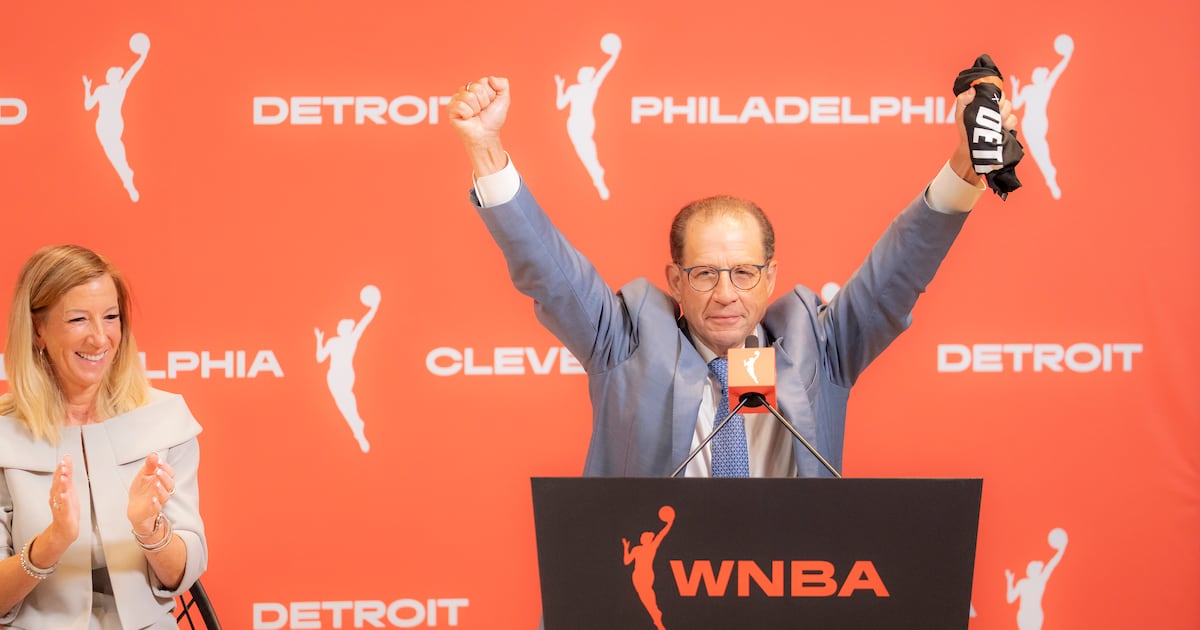
Arn Tellem’s competitors for a WNBA expansion franchise were places such as Austin, Nashville and Miami — “hot, sexy Southern cities,” he called them. So how did sweater weather Detroit beat them out? It started with cold calls.
It was vintage Tellem. He’s big on charts, decks and whiteboards, and in 2024, he and then-Pistons COO Rich Haddad drew up a list of dream investors — power brokers who had connections to the city of Detroit, to NBA Commissioner Adam Silver and to WNBA Commissioner Cathy Engelbert. He figured: Sometimes it’s not just who you are, it’s who you know.
“So we put together this list thinking very strategically: ‘How do we make this the most decorated group that has ever owned a sports team?’” Haddad said.
One of the first calls was to Grant Hill, a former Piston, head of USA Basketball and, aha, on the Duke University board of trustees with Silver.
“I call him, give him my presentation,” said Tellem, the Pistons’ vice chairman. “He says he’s in. And he says, ‘You ought to call Mary Barra.’”
Tellem already had Barra, the chair and CEO of General Motors, on his to-do list. She was also on the Duke board with Silver. She told him she was in, too.
Tellem dialed Lions owner and Chairwoman Sheila Ford Hamp — “There’s no more notable women’s sports owner, I think, in the universe,” he said — and Hamp and her husband, Steve, committed. He called Denise Ilitch, daughter of Mike Ilitch and president of Ilitch Enterprises. She was in. He called the Davidson family, whose patriarch, Bill Davidson, owned Detroit’s original WNBA team, the Shock. Bill’s son, Ethan, and Ethan’s wife, Gretchen, were also good to go.
Add in Lions quarterback Jared Goff and rapper Eminem, and now Tellem was cooking. “These are powerful people, including powerful women that are leaders in the city,” Pistons owner Tom Gores said. “I told Arn he can come work for Platinum [Gores’ private equity and investment firm]. Because he’s great at that as well.”
But Tellem had more up his sleeve, especially this doozy: Steve Greenberg, his close friend and longtime colleague, is managing director of Allen & Company, which was leading the W’s expansion process. “Let’s just say we had a rooting interest for Detroit,” Greenberg said.
All that was left was convincing Silver. Tellem strategically invited the commissioner to Detroit to speak to Pistons employees, and while Silver was there, told him about Gores’ plan to build a WNBA training facility “unlike any other in the United States” — a $50 million, 75,000-square-foot campus that would include an adjacent 100,000-square-foot youth complex. Kids and W players would intermingle. He gave Silver his charts; waited for an answer.
“Well, when Adam was in Detroit, Arn had like 40 or 50 of his front-office staff meet with Adam,” Greenberg said. “And someone said, ‘Commissioner, what are our chances of getting one of the WNBA teams?’ And apparently Adam said, ‘Well, we hired Arn’s best friend as our banker, so I think they’re pretty good.’”
By June 2025, it was official: Detroit would have a WNBA team in 2029. It hadn’t gotten the cold shoulder.
“I can sell a vision,” said Tellem, raising his arms on announcement day.