
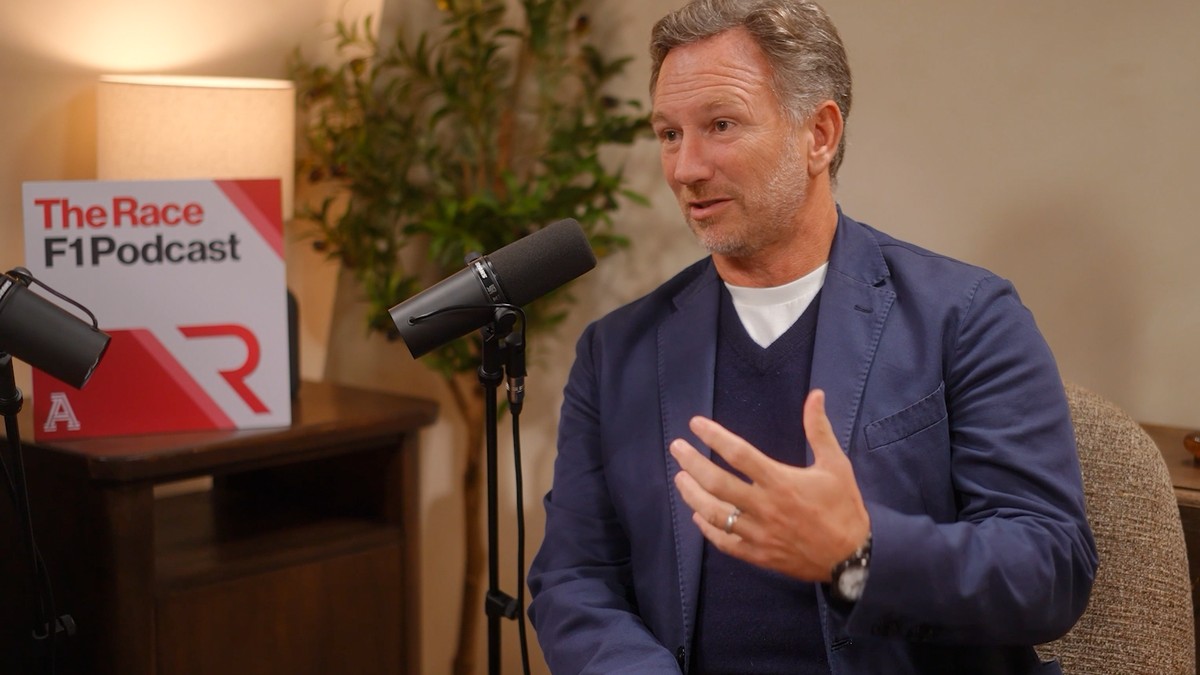
Former Red Bull Racing team principal Christian Horner has revealed that senior figures at the company privately congratulated him after the team’s new in-house power unit delivered early race wins, describing the project as one of his biggest achievements.
Speaking on The Race F1 podcast about his new memoir Drive, Horner said both major shareholders independently thanked him after victories in Singapore and Malaysia, while Red Bull’s Oliver Mintzlaff made a personal call following the Singapore race. “Oliver Mintzlaff very graciously called me after the race in Singapore to thank me for what I’d put together and what they’d gone on to achieve,” Horner said. He added that the shareholders “have independently thanked me and made reference to that fact.”
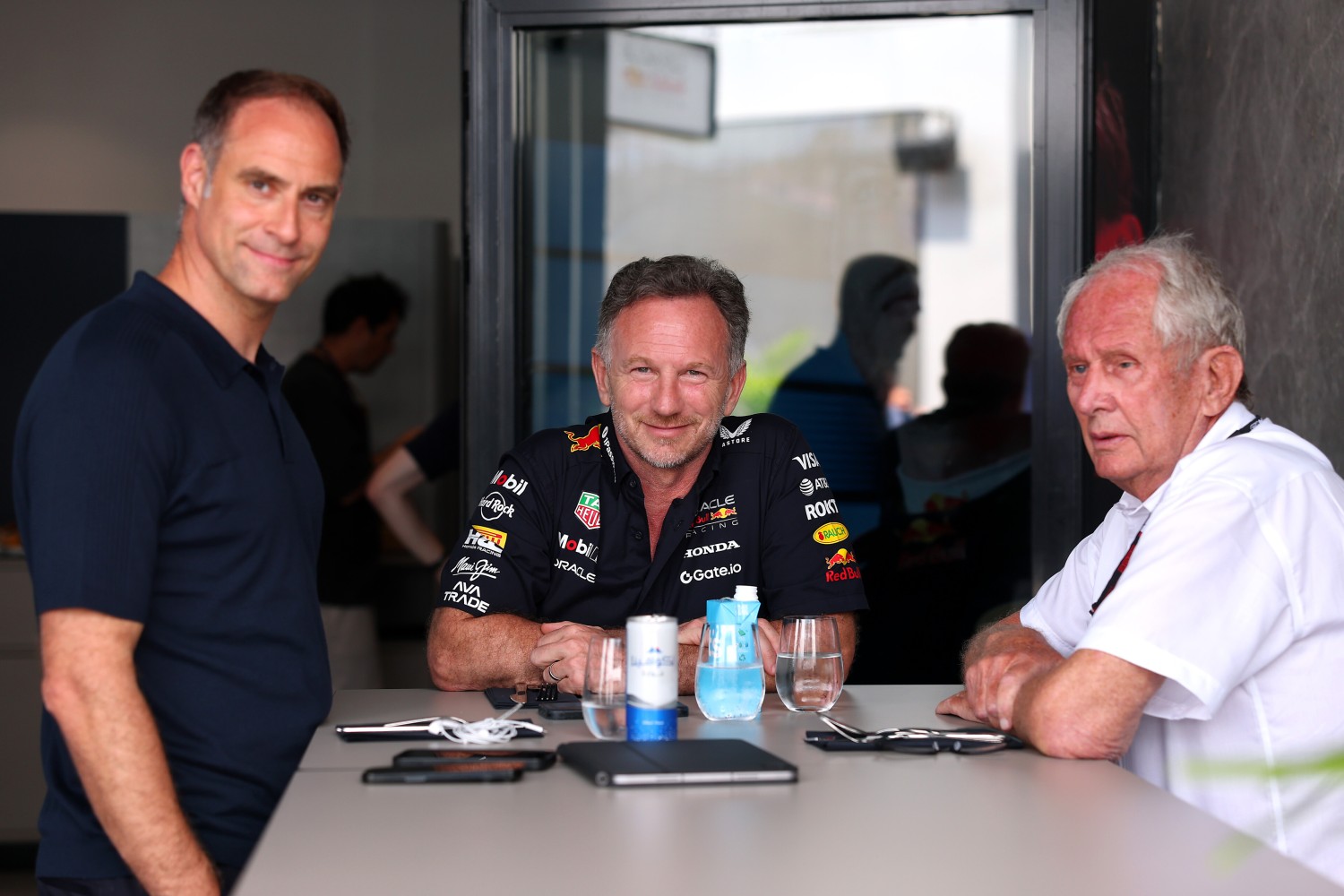 Oliver Mintzlaff, Managing director of Red Bull GmbH, Christian Horner, Team Principal of Oracle Red Bull Racing and Dr Helmut Marko, Team Consultant of Oracle Red Bull Racing talk in the Paddock during practice ahead of the F1 Grand Prix of Saudi Arabia at Jeddah Corniche Circuit on April 18, 2025 in Jeddah, Saudi Arabia. (Photo by Alex Pantling/Getty Images) // Getty Images / Red Bull Content Pool //
The Red Bull Powertrains unit, developed after Honda’s withdrawal and in partnership with Ford, was judged the most performant engine in Formula 1 under the 2026 regulations in its debut year and secured its first win on its 16th grand prix start. Horner called the outcome remarkable given the project’s origins. “For that engine to go out and be judged to be the most performant engine in Formula 1 in its debut year and win on its 16th attempt. Arguably, I see that as one of my biggest achievements,” he said.
He recounted starting the power unit program in February 2021 with what he described as a “harebrained idea.” A bubble-wrap factory was converted into an engine facility in 55 weeks. “It demonstrated to me that again by applying that philosophy of getting a great group of people together, empowering them, giving them clear direction and creating the right culture, giving them the tools… we converted a bubble wrap factory into an engine facility in 55 weeks,” Horner explained. The engine has not received an upgrade since the opening race in Melbourne, yet it has proven reliable and competitive while the chassis has continued to improve.
Horner, who left Red Bull in July 2025 amid a power struggle that followed the death of Dietrich Mateschitz in 2022, said he was disappointed by the manner of his exit but now has a decent relationship with both shareholders. He was told at the time that the organization felt it had become “too much Team Horner and not enough Team Red Bull,” and he declined to give up parts of his role because he believed it would compromise leadership. “I was disappointed in the way and the manner in which it finished,” he said. “I felt that I’d given loyal service to the company… It was just I felt sad that I didn’t have the chance to conclude my time there in maybe a slightly more dignified manner.”
Despite that, Horner expressed pride in the state of the team he left behind. “All I know is that I’ve left that team in a great place. You know, there’s some incredible people there, great facilities, a competitive engine,” he said. He added that Red Bull is “in a different place now” under new structures, but “the business is, from what I understand, flying; they’re doing incredibly growth-wise.”
Throughout the wide-ranging interview, Horner reflected on the autonomy he believes a team principal needs. “You got to have you got to be able to turn the lights on and off. If you can’t, you’re just a puppet,” he said, contrasting the powerful team principals of earlier eras with the more constrained roles he sees today. He credited the same approach—empowering people, clear direction, and a strong culture—for both Red Bull Racing’s earlier success and the power unit project’s rapid progress.
Horner also addressed Max Verstappen’s importance to the team, describing him as “an enormous cog” and a generational talent whose ceiling raised the performance of everyone around him. He noted that Verstappen’s demands for a specific car balance were non-negotiable, and the team responded accordingly.
While open to a return to Formula 1 under the right circumstances—full autonomy and a clear mandate to win—Horner said he would not come back simply for the sake of it. “I wouldn’t come back just for the sake of coming back… I’m proud of what I did in Formula 1,” he said. For now, he is focused on promoting Drive and looking back on nearly 21 years at Red Bull with fondness for the majority of that period.