
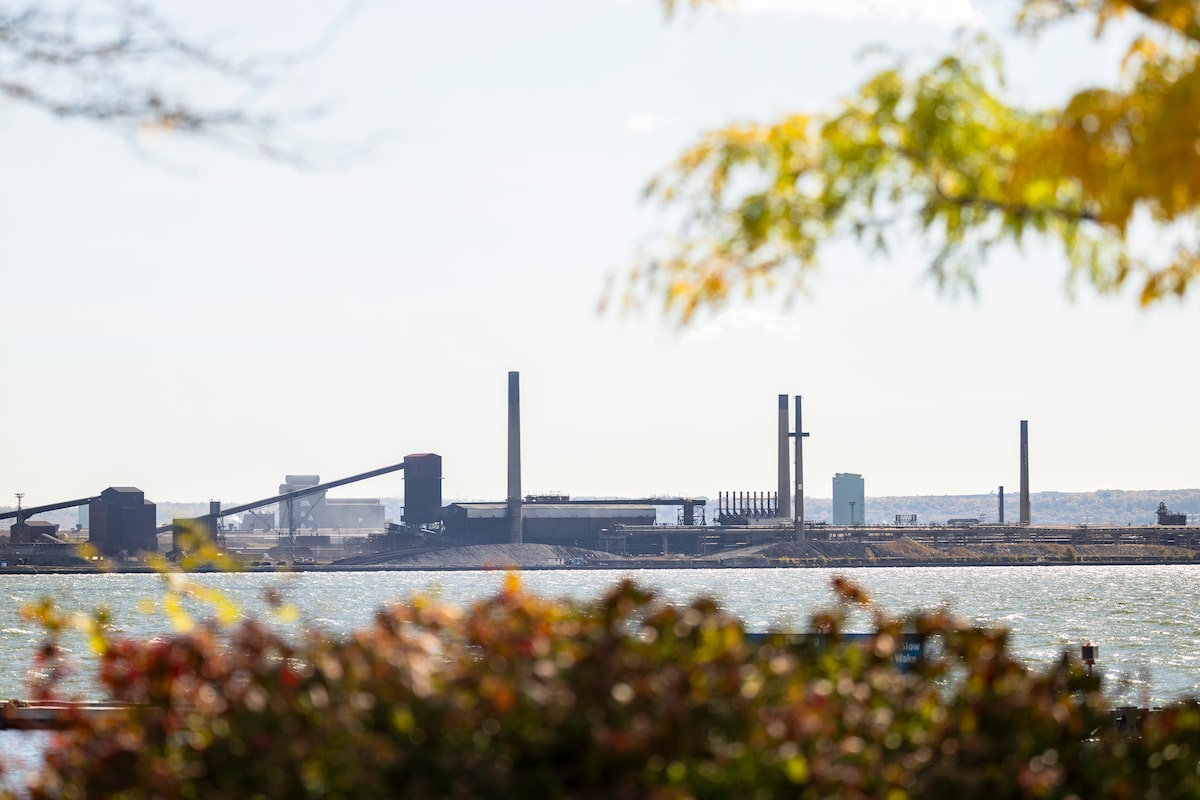
Stelco’s steel production facility in Hamilton is seen from across the harbour in Burlington, Ont. Ottawa has warned the steelmaker’s U.S.-based owner, Cleveland-Cliffs, against laying off workers in Canada.Nick Iwanyshyn/The Canadian Press
Cleveland-Cliffs Inc. CLF-N chief executive Lourenco Goncalves on Monday criticized Prime Minister Mark Carney for “snatching defeat from the jaws of victory” in trade, and he extended “kudos” to U.S. President Donald Trump for a job well done, as the U.S. steelmaker remains locked in conflict with Ottawa over hundreds of job losses in Canada.
On Sept. 28, Stelco Inc. announced that it was laying off up to 500 workers in Hamilton and Nanticoke, Ont.
By proceeding with layoffs, the federal government says Cliffs has breached legally binding job commitments from when it acquired Stelco in 2024, including maintaining at least the same number of unionized employees in Canada for five years.
Opinion: Ottawa has a case for suing Cleveland-Cliffs. But what does it hope to achieve?
Industry Minister Mélanie Joly has repeatedly warned Cliffs that if it doesn’t comply it could be sued, or possibly forced to divest its Canadian operations.
Cliffs says it can no longer compete in galvanized steel in Canada owing to both the trade war with the U.S. and Ottawa not doing enough to prevent a flood of cheap imports into the country.
In a conference call on Monday, following the release of Cliffs’ third-quarter earnings, Mr. Goncalves said that while a crackdown by Ottawa last year on foreign steel imports have helped Stelco considerably in hot-rolled steel, it hasn’t been nearly enough in the galvanized sector. The Canadian galvanized market is too small to accommodate two domestic producers, Stelco and ArcelorMittal Dofasco, as well as a flood of cheap imports, he said.
“The domestic market in Canada simply cannot accommodate,” he said. “And when the prime minister goes on a world trip and says, ‘Come to Canada, we’re open for business,’ they’re basically inviting new imports into the market.”
Rita Trichur: Stelco owner Cleveland-Cliffs is playing a classic game of chicken with Ottawa
Mr. Goncalves drew a direct line between Mr. Carney’s efforts to diversify Canada’s auto sector internationally and the loss of steel jobs. With the Prime Minister earlier this year permitting China to sell a limited number of electric vehicles in Canada, “he was basically snatching defeat out of the jaws of victory,” Mr. Goncalves said.
“And the punishment was not on companies like Stelco or even Cleveland-Cliffs, the punishment was on Canadian workers.”
Mr. Goncalves, meanwhile, praised the actions of President Trump, saying his imposition last year of up to 50-per-cent tariffs on most U.S. imports of steel has helped boost profits at Cliffs, allowed it to invest with confidence, and is bringing back manufacturing to the U.S.
“Kudos to President Trump, Secretary Howard Lutnick, and others, USTR Ambassador Jamieson Greer,” Mr. Goncalves said.
“Now the United States is the third-largest producer of steel in the world, ahead of Japan. Rightfully so,” he said.
After the Stelco layoffs were announced, Mr. Carney said that Cliffs had “betrayed” its Canadian work force.
The Prime Minister also made it clear that Mr. Goncalves’s earlier public backing of Mr. Trump’s trade policies irked him. On Sept. 29, Mr. Carney pointed out the Cliffs CEO had previously “applauded President Trump for putting those tariffs on.”
Mr. Goncalves on Monday renewed his call for Ottawa to stamp out cheap imports of galvanized steel, a measure he says should allow the company to bring back laid-off Ontario workers.
The Canadian government took aggressive action last year to reduce foreign imports of steel into the market.
Countries without a trade agreement with Canada are only allowed to sell 20 per cent of their 2024 volumes tariff-free, with anything above that facing a levy of 50 per cent. Countries that have a free trade agreement with Canada can send 75 per cent of 2024 levels tariff-free. A 50-per-cent tariff will apply for anything above that. The United States and Mexico are excluded from these restrictions.
But Mr. Goncalves said more needs to be done to protect the galvanized steel industry.
“The last piece of the puzzle to be addressed by the Canadian government is galvanized steel,” he said. “And then we would be able to bring the workers back and restart production.”
In an Oct. 9 letter to the federal industry minister, Stelco argued it was in compliance with its Investment Canada Act undertakings, saying that employment commitments did not apply to every single day of the five-year period.