
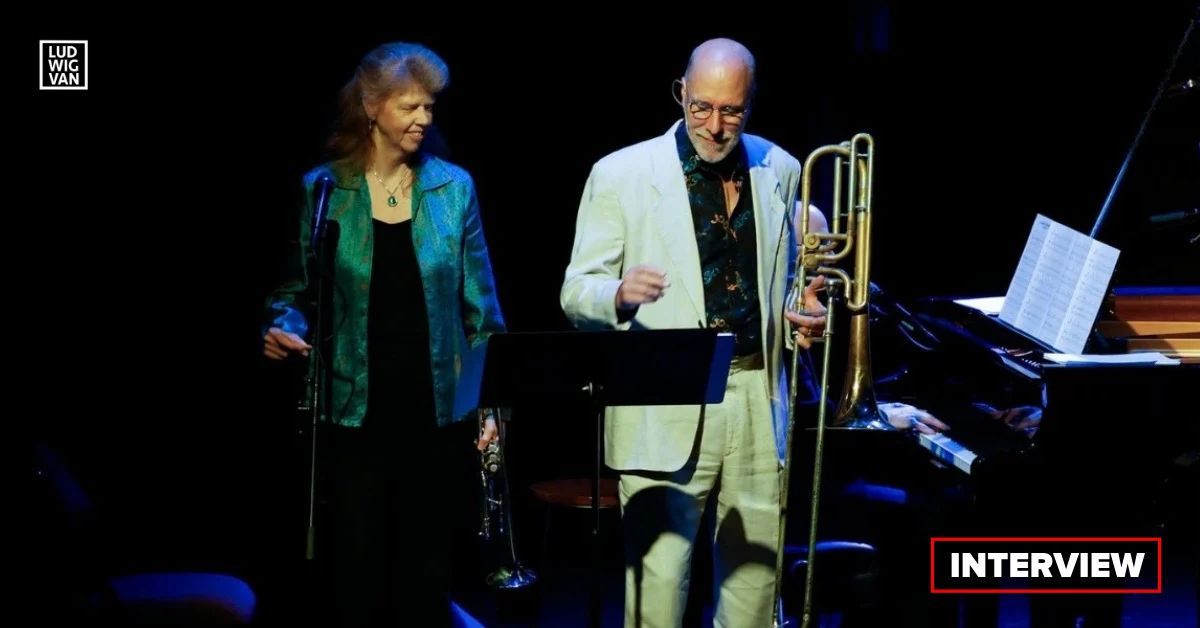
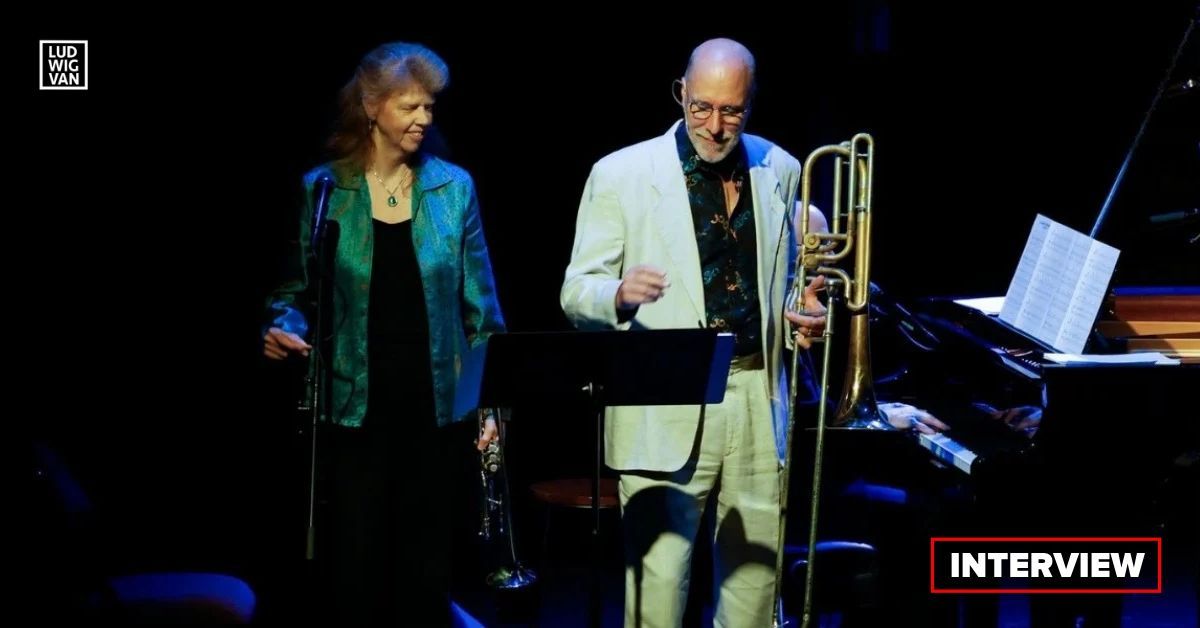
 Harpist Lori Gemmell (L) and broadcaster/writer/storyteller/musician Tom Allen (R) (Photo courtesy of Tom Allen)
With its new piano and excellent acoustics, the new Broadway Avenue space that has become a permanent home to Hugh’s Room Live is an ideal venue for music of all kinds. More and more often, that has included classical music.
Writer and broadcaster Tom Allen is launching a new series that will add to that trend. His new residency will include three concerts that incorporate his signature brand of storytelling, research based information, and of course, beautiful music.
LV caught up with Allen to talk about the series.
Tom Allen Residency at Hugh’s Room
A Poe Cabaret (October 29, 2026)
Just in time for Halloween, four talented Toronto string players — Marie Bérard, COC Concertmaster, Annalee Patipatanakoon, violinist with the Gryphon Trio, COC Assistant Principal violist Joshua Greenlaw and COC Associate Principal Cellist Leana Rutt — perform this show that explores the spooky works of Edgar Allan Poe. The music includes the work of brilliant and tragic French impressionist composers who were inspired by his works: Claude Debussy and André Caplet, along with a setting by Canadian master composer Alexina Louie of Poe’s best-known work, The Raven.
Brahms In New York (January 31, 2027)
This story explores what might have happened back in 1842, if the family of Johannes Brahms, then nine years old, had immigrated to New York City with his family. How would his career, his life’s trajectory, been radically different in North America as opposed to Europe, where he lived under the shadow of its history and culture? Allen frames the story around Brahms at the end of his life, ruminating on who he is and who he might have become. What if he had grown up in an environment shaped instead by the Civil War and the Reconstruction, the Gilded Age and its money-driven society? Violinist Yolanda Bruno, accordionist Michael Bridge, and singer Patricia O’Callaghan bring the music to life.
The Music of Talk (May 9, 2027)
There’s a deep and subconscious relationship between speech and music, and this event explores those intrinsic ties, which reach into our ancient evolutionary history. The music includes pieces for strings and harp by Marjan Mozetich, Josef Haydn, Gustav Mahler, and Jessie Montgomery, along with the premiere of a composition by JUNO-winning Canadian Nicole Lizée. The Music of Talk is based on the pre-verbal infant research of psychologist Beatrice Beebe, and delves into the deepest levels of communication between humans.
Tom Allen: The Interview
Allen has toured Canada with his classical music/storytelling shows.
“We have been building up a library of shows over the years, and we have a lot now,” Allen explains. “It’s been a gradual transformation.”
He was struck by the acoustics in Hugh’s Room, a converted former church building, when he first presented an event there in 2024. “I was profoundly impressed by the natural sound of the room,” he says. He was also impressed by the way the venue had adapted to a wide spectrum of genres — including classical music.
“The audience essentially told them, when you have a room this nice you can offer acoustic music,” he says. He and wife (and harpist) Lori Gemmell were both drawn to the venue. “We live in the neighbourhood, and the idea of having a local home for our shows was always pretty attractive to Lori and me.”
The Shows
As he explains, his first pitch was for two shows, but then a cancellation opened up the October date, ideal for the Poe show. Allen’s many years of broadcasting, writing, and hosting shows has given him a wealth of material to draw from in creating his shows. “I’m looking for moments in the past that either predict or reversely echo the current political situation,” he explains.
He researched the mysterious circumstances of Edgar Allan Poe’s death in 1849. Poe was found in the street semi-conscious, dressed shabbily, and unable to move, and died not long after.
Tom points out that mid-term elections were taking place at the time, along with frequent kidnappings and other skulduggery. “Baltimore, where Poe died, was known to be closely connected to mob activity,” he says. “The party that won the day was known to practice brutal tactics in trying to get more votes for their candidates. It’s very possible that Poe died in the course of that.”
Mid-terms, vote rigging… it all sounds very familiar to contemporary audiences.
“It’s what happened on any given day or week in 19th century politics, and I’m sorry to say that it doesn’t speak well for our progress as a species,” he says. It’s a time where so many people lack historical literacy, he notes. “At the same time, we have the access to information. We have the choice of real information and real narrative at our fingertips, and to find it we have to endure mind numbing spam.”
Those ideas are augmented by music. “It also goes along with some spectacular music, Poe’s poetry and his awareness of the dark side of the human soul.”
That music includes pieces by Claude Debussy and André Caplet, a student and friend of Debussy’s. Caplet was inspired by Poe’s poems, as was contemporary composer Alexina Louie in writing her piece The Raven. “Alexina Louie wrote for Lori and I many years ago,” he says.
Allen himself is inspired by Poe’s work. “The more time I spend with it the more it reveals to me. It’s quite amazing how enduring his pieces are. Debussy and his whole circle, there was a great admiration for his work.”
He enjoys the ambiguity of The Raven. “We don’t know who Lenore is, or what his guilt is about,” he says. “It’s an energy that carries him forward.”
Poe’s work was disrespected for much of his career, and even beyond. Allen draws parallels between the literary and musical worlds. “Debussy is still considered a revolutionary and a visionary, and he’s respected for that.” In contrast, he notes that Rachmaninoff was looked down on by his contemporaries as a populist, an artist who was giving the people the kind of romanticism they wanted, rather than “real” art. “Now we revere him,” he says. “It’s the same with Poe. His work stands on its own.”
Tom Allen in The Brahms Effect, another of his shows, with London Symphonia in April 2026:
Brahms In New York
Brahms in New York is a recent addition to his catalogue of storytelling shows.
“It’s built on an intriguing little wrinkle of history,” Allen says.
As he explains, the Brahms family of Hamburg, Germany, was poor. When Johannes was about nine years old, what is now called the Hamburg fire destroyed more than 1,700 homes, many of them in the lower middle class district where he lived. The family decided to help raise money for the many citizen affected by the devastation.
“They put on a benefit concert featuring their genius of a son,” Allen explains. A character Allen calls an “oily impresario” approached and persuaded the family to pick up stakes and leave for America. There were many such traveling impresarios at the time, scouting talent to send to the US. “They bought passage for the whole family, and they were going to move to New York in 1842.” Those plans, however, didn’t materialize.
It led Allen, along with other music scholars, to speculate on how different his career — and music — may have been. He may have escaped the looming shadow of Beethoven’s genius that informed so much of his work.
“He would have not had many of the burdens that affected everything he was,” Tom adds.
Brahms’ new teacher Eduard Marxsen played a role in keeping the Brahms family in Europe. It was felt that his studies would be best served by staying put. “With Marxsen’s teaching for two or three years, he learned a sense of responsibility.”
Johannes was Beethoven’s successor. It was a boost to his growing profile over the years, but also bestowed on him the lifelong burden of carrying German culture on his shoulders. He might also have been spared occurrences such as performing in brothels at the age of 12 and 13. Some researchers believe he suffered sexual abuse on those occasions. As Allen points out, Brahms was never able to form lasting romantic relationships. “Intimate, lasting love was always beyond him.”
He was a great friend of Clara Schumann, it’s true. “It was never possible to form an intimate relationship.”
For Brahms in New York, Allen constructed the character of Johnny Brahma, a successful touring American pianist in the Gilded Age, an era of prosperity without conscience.
“It’s an exploration of who that Brahms would have been,” he says. “We all have those what if moments in our lives,” he points out. “It has a cumulative magnitude on the past.”
The Music of Talk
“It takes a look at the very deep relationship, the preverbal relationship we humans have with music,” he says. As he points out, it’s a relationship that begins even before we are capable of speech.
“It connects with us on a deep level. Music can reach beyond the logic of language.”
Rhythm and sound come before a baby can speak. “Speech becomes so paramount to who we are, and how we are perceived in the world, but it’s the last step in the evolution of our communication.”
The show is based on solid research.
“It’s built around the research of a psychologist by the name of Beatrice Beebe,” Tom says. Beebe, a clinical psychologist, looked into the relationship between mothers and their four month old babies.
“We see this astonishing communication that’s happening. It’s all melodic and gestural.”
It’s a form of communication that can even occur with non-human animals. “They function on this immediate level. That’s how music reaches us,” he notes. “One of the fundamental questions of the show is, why does music give us goosebumps?”
As he points out, goosebumps are a protective gesture that the human body has developed in response, largely, to threats that include fear and extreme cold. How does it happen that they also connect to deeply emotional experiences, such as music?
“The whole thesis of the show is built on that.”
Like his other shows, it’s meant to provoke thought, as well as celebrate timeless music.
See It Live
Tom Allen’s residency at Hugh’s Room includes three shows: October 29, 2026, January 31, 2027, and May 9, 2027.
Find tickets and other show details [HERE].
Are you looking to promote an event? Have a news tip? Send us a note.
#LUDWIGVAN
Get the daily arts news straight to your inbox.
Sign up for the Ludwig Van Toronto e-Blast! — local classical music, culture, and opera news straight to your inbox HERE.