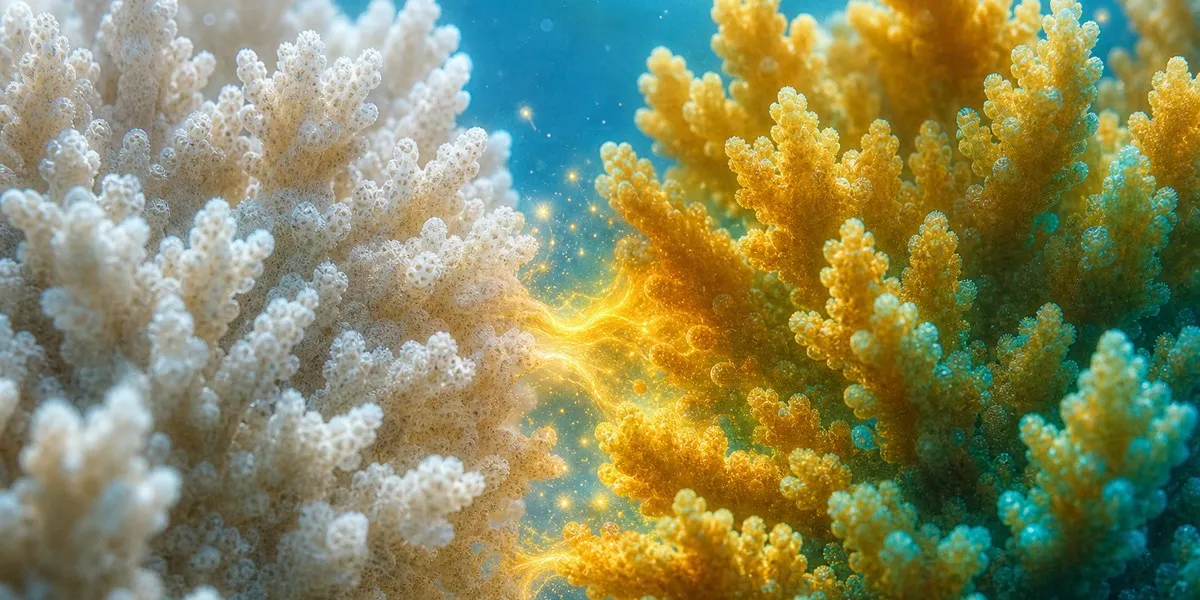
Severely bleached corals that were close to death fully recovered within seven weeks after contact with healthy genetically identical fragments. This was shown by laboratory experiments conducted by scientists, ScienceDaily reports, citing a study in the journal Science Advances.
Bleaching occurs when corals lose the symbiotic algae living in their tissues because of elevated water temperatures. These algae provide a significant share of the energy needed for growth and survival. Without them, corals turn white, have difficulty feeding, and become more vulnerable to harmful algae. Recovery from this condition can usually take months or years.
Contact with a clone
Researchers formed 10 pairs of coral fragments: each consisted of healthy and bleached genetically identical fragments originating from the same coral animal. Five pairs were positioned so that they touched each other, while a gap of several millimeters was left between the fragments in the other five pairs.
All bleached fragments that were in contact with healthy ones fully recovered within seven weeks. The fragments that did not touch their healthy counterparts died. The study’s lead author, Danny Collins, explained that bleached corals may be on the brink of death but are not yet dead.
More current news is available on the UA.News Telegram channel Telegram.
Algae transferred within days
Scientists found that genetically identical corals can fuse their tissues upon contact. Microscopic examination showed that channels in the tissues of the fragments aligned and formed connections for the movement of substances. Symbiotic algae transfer was recorded in the damaged fragments just three days after contact.
One week of contact was sufficient for the corals’ full recovery, and in some cases five days were enough. After the fragments were separated, they still returned to a healthy state within seven weeks: once inside the bleached coral, the algae multiplied rapidly. In the second week, their number doubled approximately every four days — roughly 10 times faster than observed in wild corals.
The authors emphasize that the method is not yet suitable for large-scale reef restoration, because each bleached coral requires a healthy genetically identical counterpart. As a next step, the team plans to study ways of introducing beneficial algae into bleached corals without physically joining them to healthy fragments.
Read us on


Download our app