
Surrey Cats offers free spay/neuter services to help cats and guardians
Published 7:30 pm Monday, October 19, 2026
It is challenging to run a first-response cat rescue facility and have a full-time job. But that’s the daily life of Tamsin Ramsay and Therese McKirdy, who have dedicated time and effort for Surrey Community Cat Foundation (Surrey Cats) for more than a decade.
Surrey Cats was founded in 2014 to address the city’s stray cat overpopulation. The facility offers free spay/neuter services and food and supply assistance to low-income cat guardians, helps feral cats get fixed and provides emergency care for stray kittens and mother cats.
On Oct. 18, Surrey Cats held a bingo night that saw all 100 tickets sold in just six days, to raise funds and awareness about cat welfare in Surrey.
“It’s hard to get the word out there,” said Ramsay, president of Surrey Cats. “The people we need to help us financially don’t know that we exist.”
Most of Surrey Cats’ funding comes from donations, which can be inconsistent. Ramsay said Surrey Cats is struggling to find a sustainable financial channel as well as committed volunteers.
She said the best way to prevent cat overpopulation and homelessness is to get cats fixed, but spay and neuter service can cost around $300, and not everyone can afford it.
Surrey Cats invites low-income cat guardians to apply for the free spay and neuter service on the first of every month, next on Nov. 1.
Demand is high, and Surrey Cats is able to give away only 24 to 25 services monthly.
“We’re not qualified for a lot of grants because we’re not a ‘rescue’,” said McKirdy, communication co-ordinator.
Surrey Cats does not facilitate rehoming and adoption like a typical rescue would. Its first response neonatal care program primarily helps kittens get through the first few stages of their life for about a week or two, and then transfer them to a foster care to get adopted.
Although Surrey Cats receives close to $2,000 a year in grants from the city, the amount is too little to run every program. Ramsay said Surrey Cats is like “a bridge” between the streets and foster care that steps up to fill in the “gaps” left untouched by the animal welfare system.
“So many people think the SPCA takes care of everything, but they don’t,” Ramsay said, indicating that SPCA is operating with a restricted funding that does not equip them with enough resources to deal with stray-cat overpopulation.
“A lot of rescue centres don’t have a place for kittens to come in when they’re sick and infested,” Ramsay said. “They say only 30 per cent of kittens survive on the streets after they’re born.”
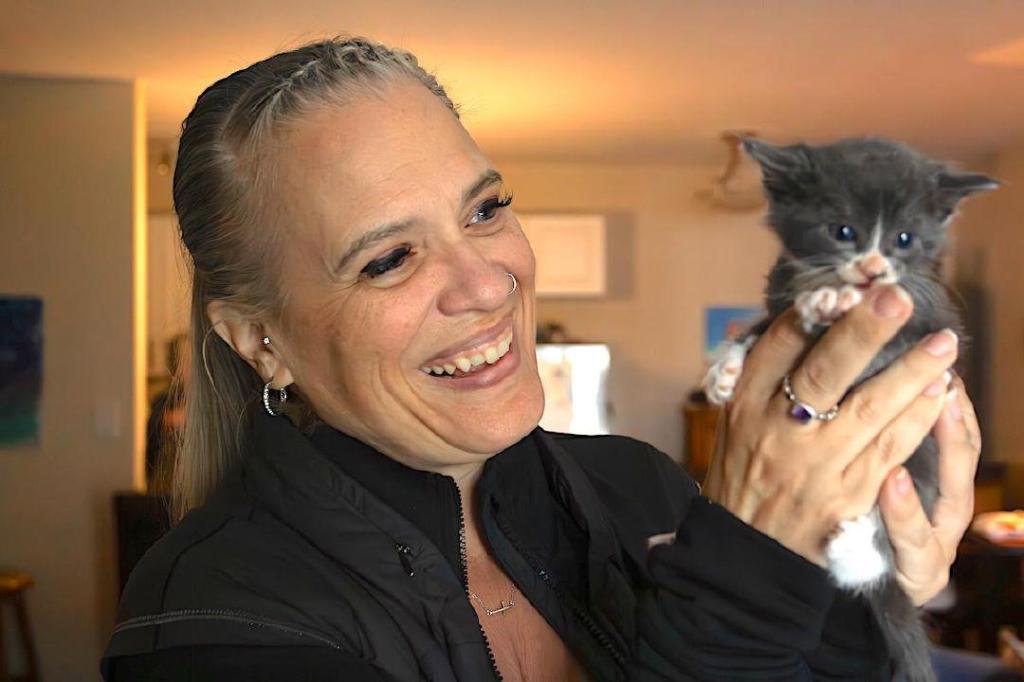
Earlier this month, Surrey Cats took in a litter of seven kittens found in a wet, moldy cardboard box, glue stuck on their fur. As main caretaker, McKirdy helped stabilize the tiny cats by treating medical issues, making sure they’re flea-free and healthy enough to be transferred to foster care.
“We make sure that any cats that go into a (partnered) rescue will be fixed, and that rescue will take care of the fixing costs before the cats get adopted,” Ramsay said.
“I love seeing Therese get the kittens healthy and happy,” she added. “The best part is to get updates from the fosters that they’re now beautiful young cats and have gone into loving homes.”
McKirdy, who was a nurse and a pharmacy technician, has 40 years of experience in husbandry. Her background in animal medical care helps Surrey Cats run its emergency care. “Some days you just want to quit because you see what humans are doing, and the cats don’t ask for it,” McKirdy said.
Surrey has struggled to control the stray-cat population, estimated at close to 30,000 cats in 2014. Updated numbers aren’t available.
“For a lot of people, their pets are their mental health,” Ramsay said. “(We) want to try and help people who have financial barriers keep the pets that they love. (We) don’t want to see a cat that was so loved for five years in a home that has to end up in a rescue because their guardian can’t care for them.”