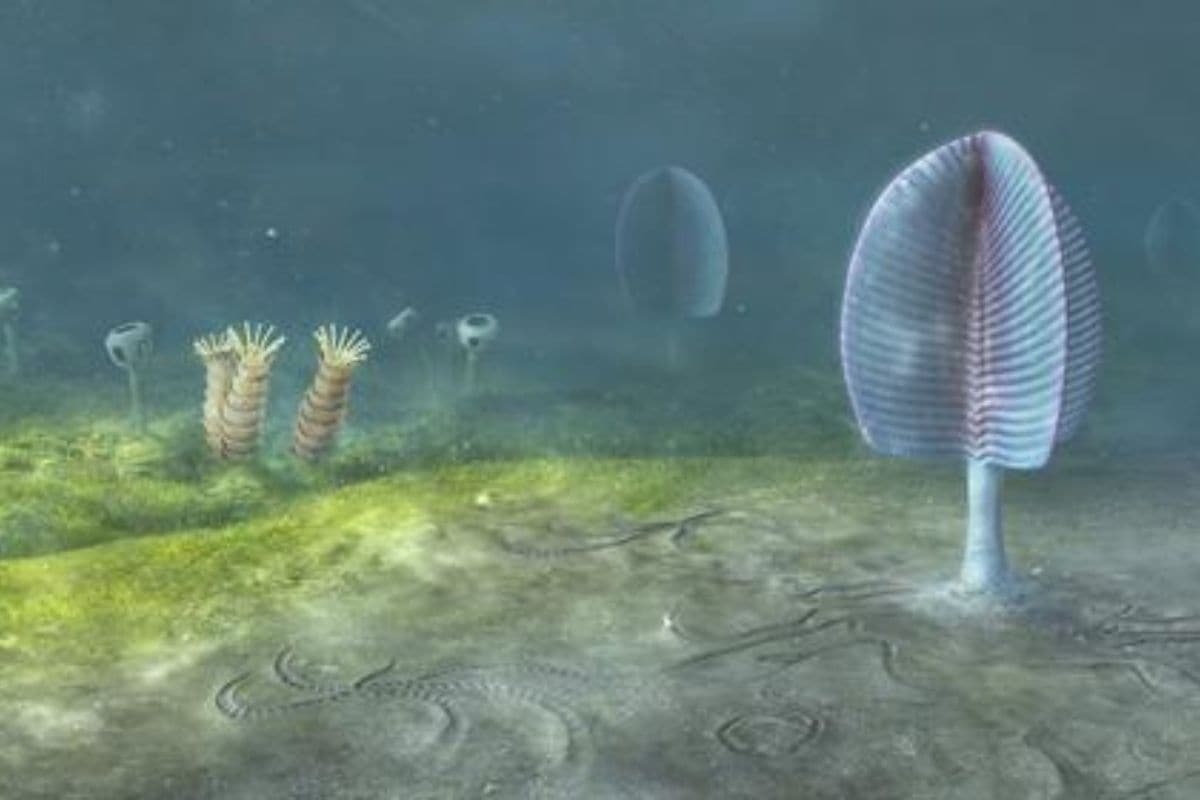
 A diorama of some of the earliest animals on Earth. Image via Wiki Commons.
An ancient fossil bed in Mongolia preserves tiny organisms in remarkable detail. Some even have structures resembling embryos. But there’s something conspicuously missing: animals.
That’s strange because animals were definitely alive when these fossils formed.
Now, that apparent contradiction is helping scientists rethink one of evolution’s biggest mysteries: when did the first animals appear?
A new study published in Science Advances suggests animal life may have originated between 800 million and 700 million years ago, up to 200 million years before the oldest widely accepted animal body fossils. If correct, Earth’s first animals may have lived through some of the most extreme ice ages in planetary history.
The fossils should’ve been there
For years, scientists have debated why animals seem to appear relatively suddenly in the fossil record around 574 million years ago, shortly before the Cambrian explosion.
One important clue came from China’s Weng’an Biota, a roughly 590-million-year-old collection of extraordinarily well-preserved microscopic fossils.
These rocks contain delicate cellular structures, but no definitive animals. Some researchers therefore used the deposit to set an upper age limit on animal evolution. The reasoning was straightforward: If animals had existed, surely such an exceptional fossil deposit would have preserved them. So, since they were not preserved, it meant animals didn’t exist yet.
However, researchers from the University of Oxford and collaborating institutions have now challenged that assumption.
×
Thank you! One more thing…
Please check your inbox and confirm your subscription.
They examined more than 140 samples from Mongolia’s Kheseen Biota, using scanning electron microscopy to investigate microscopic fossils in remarkable detail. In these samples, they found spiny, spherical organisms and intriguing embryo-like structures.
Again, no definitive animals. But here’s the thing: in this context, the fact that there aren’t any animals is the jackpot.
These Mongolian fossils date to roughly 550–526 million years ago, when animals unquestionably existed. Animal fossils from that time have been found in other parts of the world.
So, essentially, an ancient environment can preserve microscopic life beautifully while leaving no recognizable trace of animals living at the same time.
Turning back the evolutionary clock
That distinction matters enormously for a technique called the molecular clock.
Scientists compare genetic differences between living organisms to estimate when their evolutionary lineages split. They then calibrate these estimates using fossils of known ages.
But the dates depend partly on which fossils researchers use to constrain their calculations.
A 2024 molecular-clock study supported an origin for animals around 600 million years ago. The new researchers revisited that approach, questioning whether the absence of animals at Weng’an justified such a restrictive upper age limit.
Instead, they used older fossil-rich deposits from Norway, Australia, and the United States, dating roughly between 850 million and 730 million years ago, to establish alternative constraints.
The resulting estimates shifted animal origins much further back: somewhere between 800 million and 700 million years ago.
Other lines of evidence also hint at an ancient history. Chemical signatures preserved in rocks around 650 million years old have been interpreted as evidence of early sponges, although scientists still debate whether some of these molecules genuinely came from animals.
Did these early animals survive the Snowball Earth?
The revised timeline raises another fascinating possibility.
Around 720 million years ago, Earth entered the Cryogenian Period, when enormous ice sheets spread across the planet during episodes often called Snowball Earth.
If animals evolved closer to 800 million years ago, they would have been around before these immense glaciations. They would have survived the Snowball Earth.
But this is still speculation for now. For now, researchers hope to examine more ancient rocks from different environments, searching for fossils and chemical traces that might fill this missing chapter of evolutionary history.
As lead author Orin Lole Durbin, now at Virginia Tech, cautioned in the University of Oxford’s announcement, the findings do not prove animals existed 800 million years ago.
But they suggest that the earliest history of the animal kingdom may go farther back than its surviving fossils reveal.
The research findings were published in the journal Science Advances.