
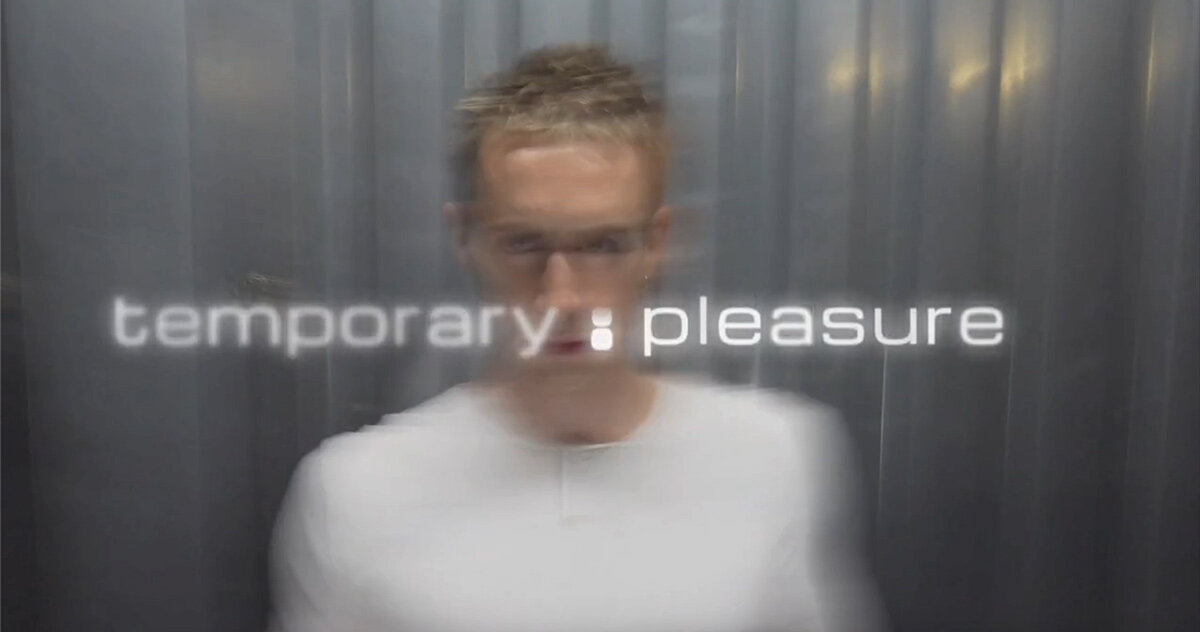
TEMPORARY PLEASURE AND THE EPHEMERAL NIGHTCLUB
For most of its history, the nightclub was built on a simple premise: you had to be there.
John Leo Gillen was born and raised in a nightclub in the west of Ireland, and came of age just as the nightclub began to disappear. Outside the family business he threw illegal raves, then learned architecture to build temporary club spaces. Temporary Pleasure, the practice he founded, combines the two — the architecture of a club with the emotion of a rave — into a single idea: the ephemeral nightclub.
His projects include Choreomania at Horst Arts & Music, Joyride at the Barbican and The Superclub at WeCanDance, and he is the author of Temporary Pleasure: Nightclub Architecture, Design & Culture 1960–Today (Prestel, 2023). designboom speaks with Gillen about time as a design material, the crowd as the show, and why the moments that matter most can’t be captured.
‘The nightclub once offered something radical: a moment suspended in time that could only be experienced by those who were lucky enough to be in the right place at the right time,’ Gillen tells designboom.
IN CONVERSATION WITH JOHN LEO GILLEN
designboom (DB): You grew up inside a nightclub in the west of Ireland. How did that lead you to the idea of a temporary nightclub?
John Leo Gillen (JLG): My family business was a nightclub in the west of Ireland. I was literally sleeping there as a baby while my parents worked, and I worked there all through my teens — collecting glasses, working the bar, eventually managing it. I spent my entire life fantasising about the nightclub I would design. Then I came of age just about exactly when the nightclub as we knew it started to disappear.
I started organising illegal raves, and I had this idea: imagine a nightclub that existed in each place just for a moment. The architecture of a nightclub — with the emotion of a rave. Designed and built, with all the physicality and specificity of a real nightclub, but with the emotional urgency of a rave. So Temporary Pleasure is a nightclub that exists in each place only for a moment, before disappearing and re-appearing somewhere else. A warehouse in Barcelona or Dublin, a car park in London, on a beach in Belgium.
A space known to disappear communicates urgency, heightens behaviour, and produces meaning rooted in impermanence. When architecture carries this message, people act differently: more present, more invested, more alive.
Everything that came after — architecture, show design, performance, even image — was all about presence. Tools for creating, restoring, elevating presence. This is not nostalgia. It is an act of definition: what is club culture when its traditional containers have disappeared, the medium has been forgotten, but its aesthetic and language are still being used?
DB: The clubs you write about from the 1960s and 70s used light, sound and the crowd itself almost as architectural material. What did they understand that’s been lost?
JLG: The nightclub was a distinct spatial invention — a deliberate break from the concert hall, against stages and audiences, performance as something you just watched. Designed to dissolve the central focus, erase stage hierarchy, fracture orientation. No divide between stage and audience. Platforms at different heights, some lit, some dark — every inch was the stage. Everyone was on stage, and no one was. You weren’t watching the show — you were in it.
Nightclub architecture evolved as a total interior world: facades, doors, entrances, thresholds, loops, dancefloors, bars, bathrooms, seating zones. Compression and release. Enclosure and circulation. Darkness, density, intimacy, anonymity, disorientation. Friction and disappearance. Social zones without spectacle.
Spaces to see and be seen, to disappear and re-emerge. Total worlds where the club itself was the headliner. Behaviour emerged from the way space was organised — possibly accidentally. The way bodies moved, gathered, circulated, danced. The nightclub didn’t present culture — it produced it.
The name remains, but the conditions that made a nightclub a nightclub mostly don’t. Stages return. Dancefloors face DJs. Sound becomes frontal. LED screens dominate orientation. The booth becomes the focal point, and the rest of the room becomes infrastructure for servicing it — something to be managed rather than inhabited.
The nightclub has become the very thing it was designed to break: a concert.
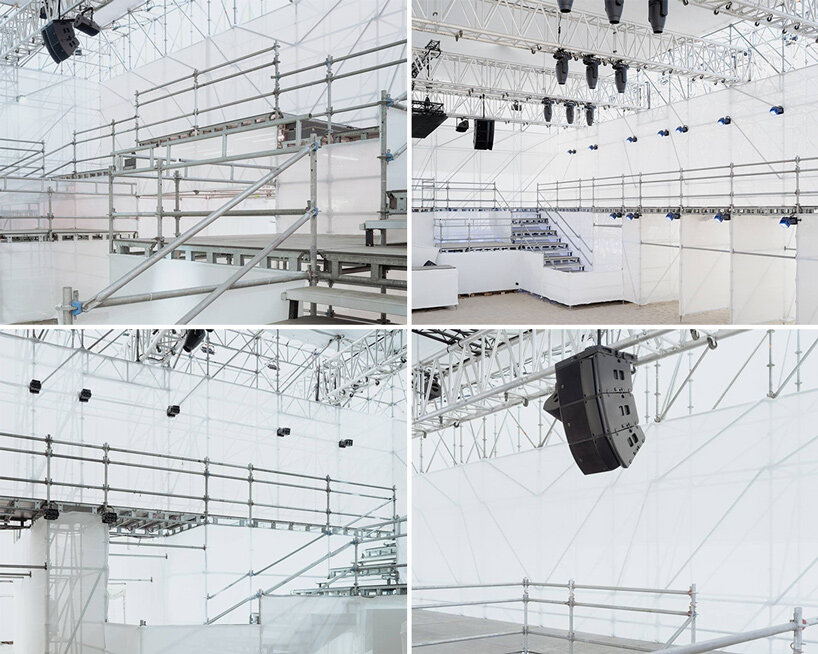 The Superclub at WeCanDance: balconies, speaker, stairs and scaffold detail
DB: You’ve talked about how club culture has become more focused on watching the DJ, while your work tries to put the attention back on the crowd. When do you think that shift happened?
JLG: We’ve forgotten what a nightclub and a dancefloor actually is. It’s not just a space in front of the DJ booth — it is the club. The crowd is the source of the energy, not the recipient of it. Dance is fundamental — physical, risky, collective. Everyone performing for each other, in real time. The moment someone takes the risk, someone else follows. Anything else is a concert. It’s rare to find a dancefloor where people are dancing with each other — it feels like they’re dancing to the DJ.
The DJ was never meant to perform at the crowd, but to service the dancefloor. DJs were mostly residents, obsessing over the energy every night, as much a part of the club as the walls, the speakers and lights. At Paradise Garage, Larry Levan played from a bird’s-eye nest above the crowd — he could see the dancers, but they couldn’t see him. The dancefloor was the instrument, not the decks.
Clubs put the DJ booth on stage and erased the rest of the room. Lineups made DJs the destination. We stopped going to a place and started going to a DJ.
We’ve designed clubs that make people bystanders, then wonder why everyone watches. Perhaps the reason people aren’t dancing is that dancefloors stopped being dancefloors.
DB: When you say ‘the crowd is the show,’ who are people actually performing for? The camera, each other, themselves?
JLG: A real rave isn’t about watching — it’s about being essential to the moment. The space should make people feel like this wouldn’t be happening without them — because it wouldn’t. That they are the energy. That they are the event. The club did not happen to them; it happened because of them.
What happens when everyone is fully protagonised? Exhibitionism, play, competition. Contagious dance energy. Everyone and no one on stage simultaneously. The whole space is the stage, and the crowd is the show.
DB: A lot of your work is about designing spaces that still leave room for spontaneity. How do you choreograph an experience without making people feel their behavior has already been scripted?
JLG: Architecture loaded with potential.
Platforms at different heights, balconies, mezzanines. Sound and light move, eyes follow. Nothing is fixed. Nothing lasts. Platforms shift, stairs loop, sightlines fracture. Architecture that leaves gaps — and rewards risk.
A single moving spotlight. It searches the room, looking for something, and lands on a lone dancer. It jumps to another on the opposite platform, then another, and the whole room’s gaze follows it — a body rolling, a foot stomping, arms jacking. No one knows when it will land on them. Surreal, elevated moments that feel almost cinematic, like you’ve just stepped into a music video or like: what the fuck is this? How is this happening? And then back to chaos.
The architecture creates the dare, but someone still has to take the risk. So it’s scripted but unscripted. You should never know where the energy is going to come from — or where it’s going to go next.
DB: Today almost everyone walks into a club with a camera in their pocket. How has that changed the way people behave in these spaces, or even the way clubs are designed?
JLG: The nightclub was something to be entered, not consumed visually. Its value lay in what could not be fully captured, replayed or verified — what lived on only as fragment: in memory, in myth, in distortion.
Modern image culture has changed not only how clubs are seen, but how they are designed and function. Today, image precedes experience. Presence is replaced by extraction. The moment is no longer lived for itself, but for its afterlife as content — designed to be replayed before it has even happened. That fundamentally changes why people are there and how the experience is lived.
If image is the primary output, if the experience itself has no implicit or sacred value — why gather physically at all?
DB: You’re drawn to spaces that disappear, but your book preserves them through photographs and stories. What can an image actually tell us about a nightclub, and what gets lost once the night is over? John Leo
JLG: An image can tell you what a thing looked like — a fragment, a clue, a trace. But it can’t give you the thing itself.
The club historically produced its record at the edges: flyers, graphics, accidental photographs, hazy recollections, stories that changed slightly every time someone told them. Suggestive, not descriptive. The record was never complete — and that incompleteness was part of its power. What couldn’t be fully seen or verified lived on in memory and myth, and grew through retelling.
Today, memory and myth collapse into instant capture and archive. What was powerful because it could not be fully seen is flattened into documentation. The fragment disappears. The distortion disappears. The story stops changing.
I’m increasingly interested in memory and myth rather than documentation as an absolute record. Can documentation be something produced by the experience rather than imposed upon it? Can the record come from the experience, rather than the experience being designed primarily to produce a record? How do you document without parasitising the moment?
Maybe that moment survives more powerfully in memory and myth than in documentation. Can a moment — not an image — become the record?
DB: With Superclub, you recessed the DJ, wrapped balconies around the dancefloor, and really pushed the idea of people watching each other. Did you manage to recreate the nightclub experience inside a festival?
JLG: Not entirely — and I think that’s important.
A nightclub is a space with its own rules, codes and belief system, shared by the whole crowd even if never explicit. They permeate the music, the programming, the staff, the door, the crowd, the promotion and the way people behave.
With Superclub, we were trying to challenge the assumptions of the festival format from within it. Festival logic is a stage, a frontal view, a crowd facing one direction, a DJ elevated above everyone. We wanted to fight against that from within — decentralising the DJ, breaking the spectacle and the frontality, putting the audience back at the centre.
But we were still working within a festival. We were leading the conceptual and spatial design of the stage, but not the programme, the staffing, the promotion, the messaging or the audience. We could change the physical conditions. We couldn’t completely change the cultural conditions around them.
The bigger challenge isn’t building the structure. It’s fighting for the nightclub as a format — and for the kind of collective experience that the format makes possible.
You can build a room that looks like a nightclub very easily. Creating the conditions that make it behave like one is much harder.
DB: Temporary Pleasure also works with cultural institutions. What happens when ideas that came out of underground club culture move into institutions? Can that energy survive the change of context?
JLG: The issue is not confined to institutions. Most of what we call club culture today is inverted. The language of the club is everywhere, the conditions are nowhere. Contemporary culture borrows the aesthetics and rhetoric of the club while operating under logics that fundamentally betray it.
It comes down to intent — a commitment to the culture, not just its kudos, clout or credentials. Institutions are often drawn to club culture for its optics, energy and audience. To appear as a club is safe. To actually offer it is risky. The question is whether they’re willing to offer the conditions, not just the aesthetic: darkness, duration, risk, a crowd that’s allowed to take over the room.
Are we actually creating a situation where people are participating, taking risks, behaving differently and producing something together? Or are we simply representing a history of participation?
We’re interested in temporary systems, one-night formats and conditional architectures — prototyping with real bodies, in real time, with real risk. Because you can’t fully design a club from the outside. If you’re genuinely trying to create a collective, emergent experience, you can’t completely determine what happens. You have to be willing to give up control.
This interview is part of designboom’s SPECTATOR AND SPECTACLE chapter, asking how wonder gets built, and how it might return some mystery to a world that has measured most of it away. Presented in partnership with SolidNature, the stories in this chapter turn onlookers into participants, alter perception and disrupt the everyday – learn more here!
Each designboom chapter explores one theme in depth through projects, interviews, features and news across architecture, design, art and technology. Discover more chapters here, and get in touch if you’d like to submit a story through our submissions portal or contact form.