
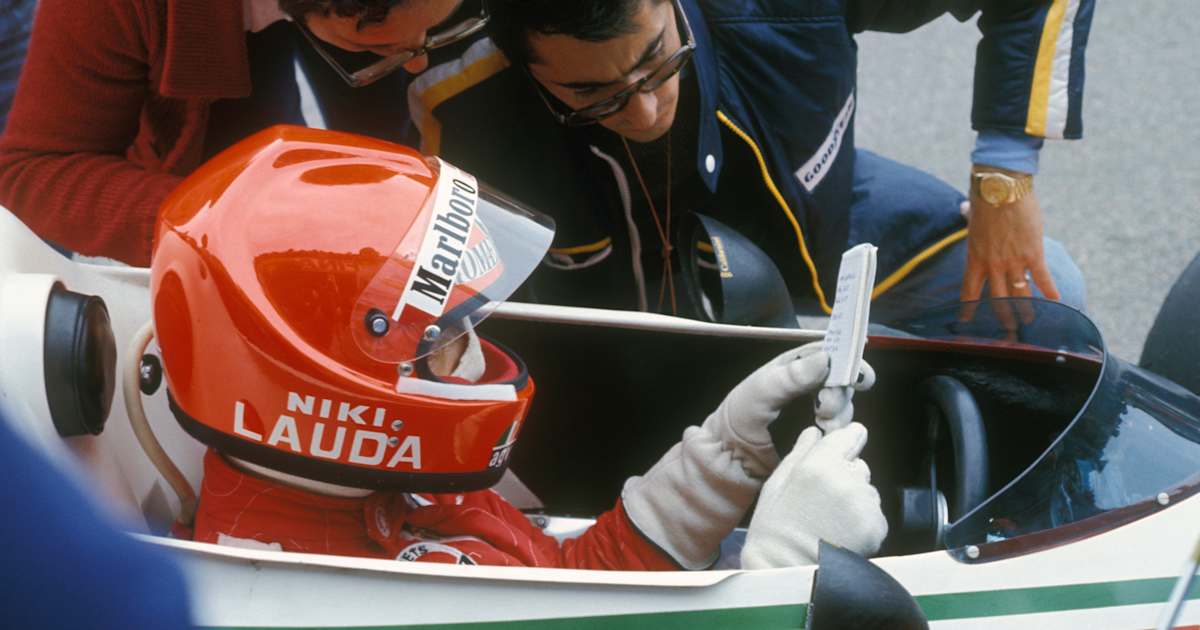
It was a Formula 1 season unlike any before it: The reigning world champion enjoyed a string of early victories, followed by protests and successful appeals; the champion found himself in a life-threatening situation after a crash, only to make a miraculous comeback; the team had to resort to a stand-in driver; and the season finale on 24 October felt as though the world was coming to an end.
In 1976, 50 years ago, Niki Lauda and his Ferrari team took centre stage. At the start of the year, the former rally co-driver and marketing executive Daniele Audetto became the Scuderia’s new racing director. Now aged 83, he describes in an interview with speedweek.com what was happening behind the scenes at the time.
Audetto on the start of the 1976 season: “When Luca di Montezemolo, who had been Ferrari’s racing director since 1974, was appointed director of public relations at Fiat, I was offered the team leadership role. It was set to be a difficult season. Niki had split up with Mariella Reininghaus and was in a relationship with Marlene. Our technical director, Mauro Forghieri, also had personal matters to sort out.”
“But overall, we were all very motivated and confident, because the 312 T was very competitive. Clay Regazzoni was the more spectacular driver, but Niki had won the first races in São Paulo and Kyalami; then Clay won at Long Beach ahead of Niki. With a substantial lead in the World Championship, the start of the season looked promising.”
On Lauda’s first accident in April: “I’m not sure what happened in that strange incident before the Spanish Grand Prix. Much later, I heard a rumour from Heinz Prüller that it hadn’t been a tractor accident whilst gardening. At Ferrari, drivers were forbidden from taking part in dangerous sports such as skydiving, etc. I learnt that Niki enjoyed riding motocross on his KTM bike (Lauda’s close friend Rupert Wimmer worked for KTM – the editors’ note).’
“For me, the issue wasn’t whether it was a tractor or a motocross accident, but that Niki was in real pain because of his broken ribs. He was suffering, and the Spanish Grand Prix was just around the corner.”
“We considered replacing Niki with F2 driver Maurizio Flammini. We were already planning a test at Fiorano. When Niki got wind of this, it sped up his recovery – partly thanks to the help of therapist Willi Dungl – which was almost a miracle. I realised at Jarama just how mentally strong Niki was. Niki actually went on to win the Grand Prix because James Hunt’s McLaren was disqualified for being too wide.”
On the fateful Nürburgring weekend: “Niki arrived at the Nürburgring with a huge lead in the World Championship. But he was expending a great deal of energy on his aversion to the circuit. I tried to explain to him that, with the weekend just around the corner, it was too late to change anything, and that he should concentrate on the race. But, as you know, once Niki had got something into his head, he was determined to see it through.”
“So it came down to the drivers’ meeting, but the majority were in favour of the race. All of this took a lot out of him, instead of him concentrating, as usual, on working with the mechanics and Forghieri. Race director Fritz Huschke von Hanstein also explained to him that he couldn’t change anything now. But Niki wouldn’t be persuaded.”
“Well, the race started in the rain around the pit lane – with everyone on wet tyres except Jochen Mass, who’d been told by friends along the track that most sections of the circuit were dry. After the first lap, everyone else came into the pits for a tyre change.”
“We didn’t have any tyre warmers, and the Goodyears were very tricky in the first few laps. Niki lost some time in the pits and then tried very aggressively to make up places. Then there was an accident just before Bergwerk. Niki later said there had been a suspension problem. The fact was, however, that the kerbs were still wet and Niki drove over them; on top of that, the track was still damp there in the shade. That’s why Niki lost control and crashed.”
On the anxiety over Niki Lauda’s life: “I drove with Hanstein to the hospital in Adenau. When we arrived, the doctor told us that Niki was in a very serious condition and that there was nothing they could do at that hospital for his lungs, which had been damaged by inhaling toxic fumes.”
“My friend Huschke rang the specialist at the clinic in Mannheim. We were able to fly Niki there in a military helicopter. Niki asked me to contact Marlene and fetch his personal belongings from the van. In Mannheim, the doctor explained that they had done everything possible, but could not say whether Niki would survive. They would have to wait at least 48 hours. Niki was given the last rites. Naturally, I had to inform Enzo Ferrari.”
On the search for a replacement for Lauda: “Ferrari instructed me to contact Emerson Fittipaldi immediately, as he wasn’t competitive at Copersucar. We thought he’d accept the offer with a strong car. But Emerson thanked us and sent word that he couldn’t accept because of his contract with the team and sponsor Copersucar. So I rang Ferrari and let him know. He ordered me to Maranello straight away.”
“The team was in chaos at that point. We withdrew from the next race at the Österreichring out of respect for Niki and in protest against the FISA decision to award Hunt the victory at Jarama following McLaren’s appeal. Teddy Mayer, McLaren’s team principal, was also a lawyer and succeeded with the argument that the width of the car had had no impact on its performance.”
“In hindsight, it was a mistake to skip Austria and field only one car at Zandvoort, as we missed the chance to take more points away from Hunt. Moreover, nothing happened in terms of preparing the cars.”
“Finally, it was decided to sign Ronnie Peterson as a replacement for Niki, who could take points away from Hunt. But March boss Max Mosley demanded far too high a transfer fee. A sponsor was then supposed to cover that, however. In the meantime, Sante Ghedini informed Niki that a test for Peterson was being arranged at Fiorano.”
“Niki nearly lost his mind and rang Montezemolo. He explained that he was fit to drive again. Luca then spoke to Fiat boss Giovanni Agnelli. I was summoned to the Ferrari office and he ordered that the test with Ronnie be cancelled immediately. Ferrari really gave me a telling-off. So I had to turn Ronnie down.”
The signing of Carlos Reutemann: “Then the following happened: Bernie Ecclestone had got wind of it and offered Ferrari Carlos Reutemann for Monza. In the meantime, I’d had an interview with Heinz Prüller, which also touched on the cause of the crash at the Ring. I explained to him that, following all the investigations, we hadn’t found any signs of a fault. Heinz then wrote, in essence, that team manager Audetto had stated it had been Niki’s fault. Niki was, of course, very upset. But he rang us and said he wanted to test the car and compete at Monza. I explained to Ferrari that Niki was under contract and we couldn’t stop him if he was fast enough in testing. Niki arrived at Fiorano looking gaunt, but he set very good lap times early on in the test. So we had to field him at Monza.”
On Lauda’s return at Monza: “Something else happened at Monza. All the teams’ fuel was analysed at an Eni laboratory in Milan; McLaren’s and Penske’s were 2.1 octane points above the limit. The McLarens driven by Hunt and Mass and Watson’s Penske car had to start the race from the back of the grid.”
“As is well known, Niki finished in a sensational fourth place. Unfortunately, we had no further developments for the American races. With Hunt’s two victories, Niki could only score points by finishing third at Watkins Glen. He therefore arrived at Fuji with a three-point lead. We were very confident, as Ferrari had already won the Constructors’ Championship.”
On the chaos at Fuji: “On race day, a tornado struck Fuji. You couldn’t even walk upright. But Bernie said we had to start, because we’d be getting a lot of money from the organisers and from the television broadcasters for the first Japanese Grand Prix. We’d lose a lot if the race were cancelled.”
“I had a conversation with Fittipaldi. He, Niki and James shook hands in front of Bernie and agreed to end the race after two laps. It was getting darker and darker by then, and the television broadcasters were pushing for the start. McLaren put Hunt under immense pressure. But Niki still expected Hunt to stick to the agreement.”
“When Niki had pulled out after two laps (as had Fittipaldi and Carlos Pace), Ferrari rang to demand that I persuade him to continue the race, but Niki had already left after ten laps. Apart from that: I was there when Niki was dying at the Nürburgring. How was I supposed to persuade him to get back in the car under those circumstances?”
“Hunt won the title because he hadn’t stuck to the agreement. We’d already signed Reutemann for 1977, and Clay Regazzoni knew he wouldn’t have a seat anymore. He was very disappointed. That might explain why Clay put up no resistance in his duel with Hunt at Fuji.”
Audetto’s summary of Niki Lauda: “When I look back on that season, I have to say: what Niki achieved during those months was superhuman.”
“And it didn’t stop him from becoming champion again in 1977. But he was disappointed by our attempts to sign Fittipaldi and Peterson; he felt he wasn’t getting enough support from the team. This had an impact towards the end of the season, when Lauda had already been confirmed as world champion and, after finishing fourth at Watkins Glen, decided to sit out the final two races at Mosport and Fuji – particularly as Gilles Villeneuve was already set to make his debut for Ferrari. His relationship with Ferrari had broken down.”
“My personal relationship with Niki remained very good even after 1976–77. When he was Jaguar’s sporting director, he came to my Arrows motorhome for a spaghetti dinner. I realised that Niki wasn’t happy with my comments about the circumstances of the crash. But Niki also understood that I was a Ferrari employee and bound by instructions. I knew even before the start of the 1977 season that he would eventually leave Ferrari. There had been hints to that effect from Parmalat CEO Calisto Tanzi. But Niki secured Ferrari’s second World Championship title. He was always a professional. I worked with many different types of drivers during my long career, but Niki was