
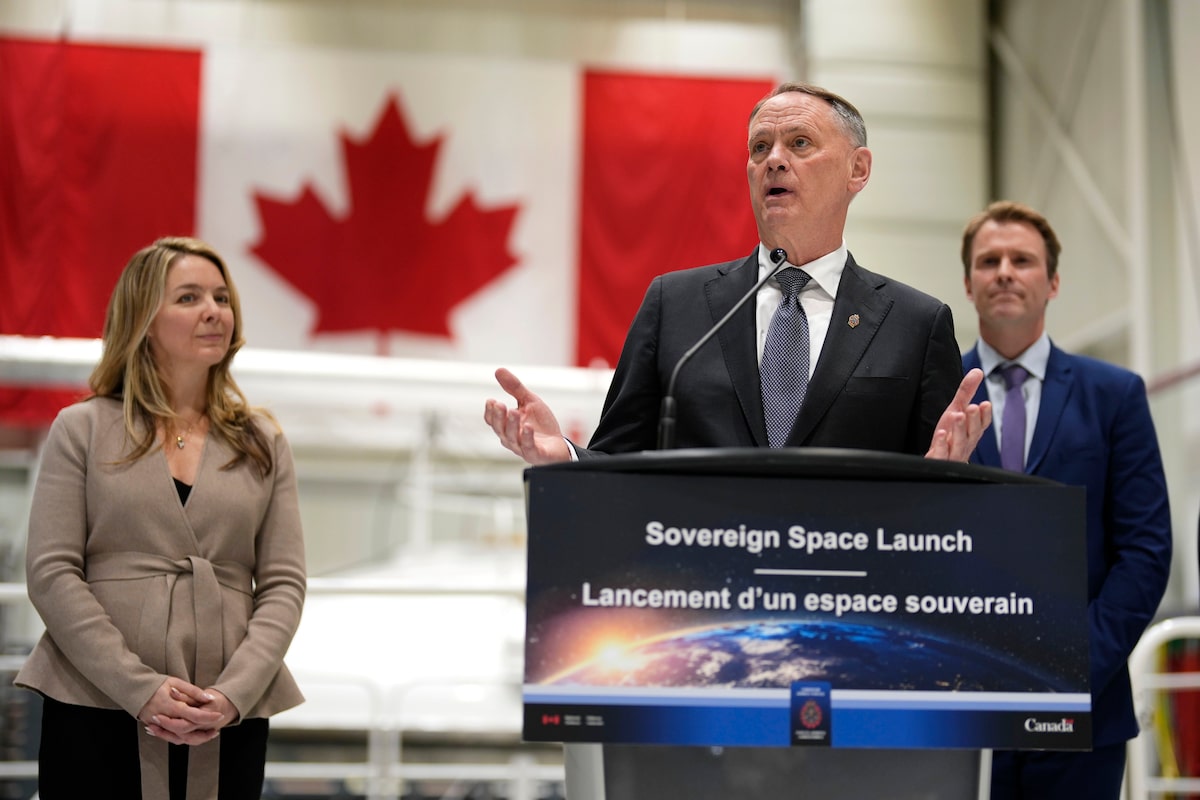
Minister of National Defence David McGuinty speaks at an announcement on Canada’s sovereign space program at the Canadian Space Agency’s David Florida Laboratory in Ottawa in March.Justin Tang/The Canadian Press
Ottawa is investing in rocket-launch capabilities, satellite technology and new specialized military roles as part of its effort to boost Canada’s space and defence sectors and encourage new investment in the industry.
Defence Minister David McGuinty announced the series of commitments at the SpaceBound conference at the Canadian Museum of History in Gatineau on Wednesday
The federal government has signed a 10-year, $20-million agreement with Markham, Ont.-based NordSpace Corp. to access its Atlantic Spaceport Complex in Newfoundland and Labrador. This will allow the Canadian Armed Forces to conduct launches and research and development.
Building sovereign launch capabilities means Canada will be able to replace damaged or threatened systems, “on our own terms and on our own timelines,” Mr. McGuinty said.
Canada making progress on defence strategy, but key aspects remain a challenge, industry members say
The deal builds on a similar 10-year agreement with Canso, N.S.-based Maritime Launch Services Inc. MAXQ-NE, another company building launch spaceports, that was announced in March.
Mr. McGuinty said Ottawa has earmarked $17.9-million through its Innovation for Defence Excellence and Security program to help Canadian companies develop satellite communications, particularly for remote and Northern regions.
So far, $4.7-million has been awarded to Toronto-based Kepler Communications Inc. for its Kepler Network project, the company’s satellite constellation providing connectivity to the North.
The two-year contract is intended to help Kepler develop and test the laser-based communication links that allow its satellites to exchange data directly, enabling faster and more reliable space-based networks.
“The war in Ukraine has demonstrated modern militaries’ deep dependence on space,” with satellite technology keeping personnel connected, supporting navigation and helping Ukraine monitor Russia’s movements, Mr. McGuinty said.
“The lesson is clear: Canada cannot afford to depend on capabilities that we can’t access, that we can’t protect, or that we can’t replace when we need them most.”
Ottawa could go further to boost access to capital for defence businesses, BMO chief executive says
Meanwhile, the Canadian Armed Forces are establishing new roles that will enable the Royal Canadian Air Force to attract, train and retain highly skilled personnel, he said.
CAF has established a new Space Mission Operator occupation, with the first training cohort to begin with 25 members, and public recruitment expected to open late next year, Mr. McGuinty said. The CAF is also working to establish a Space Warfare Officer occupation, he added.
He did not provide further details about what the responsibilities of these occupations would be.
Over the past year, Mr. McGuinty said, Ottawa has signed more than $3-billion in contracts and agreements across its four space priorities: monitoring and surveillance, space domain awareness, secure satellite communications, and sovereign space launch.
These include a $2.3-billion dollar contract with Telesat Corp. TSAT-T to deliver high-speed, secure military connectivity in the Arctic, a $688-million contract with MDA Space Ltd. MDA-T for new radar satellite to help survey the North, and the three-year, $105-million Launch the North program, to help Canadian companies build sovereign rocket launch technology.
While Canadians often see national defence as soldiers, ships, aircraft, trucks and tanks, he said, “increasingly, some of the most important capabilities we rely on are hundreds and hundreds of kilometres above our heads.”