
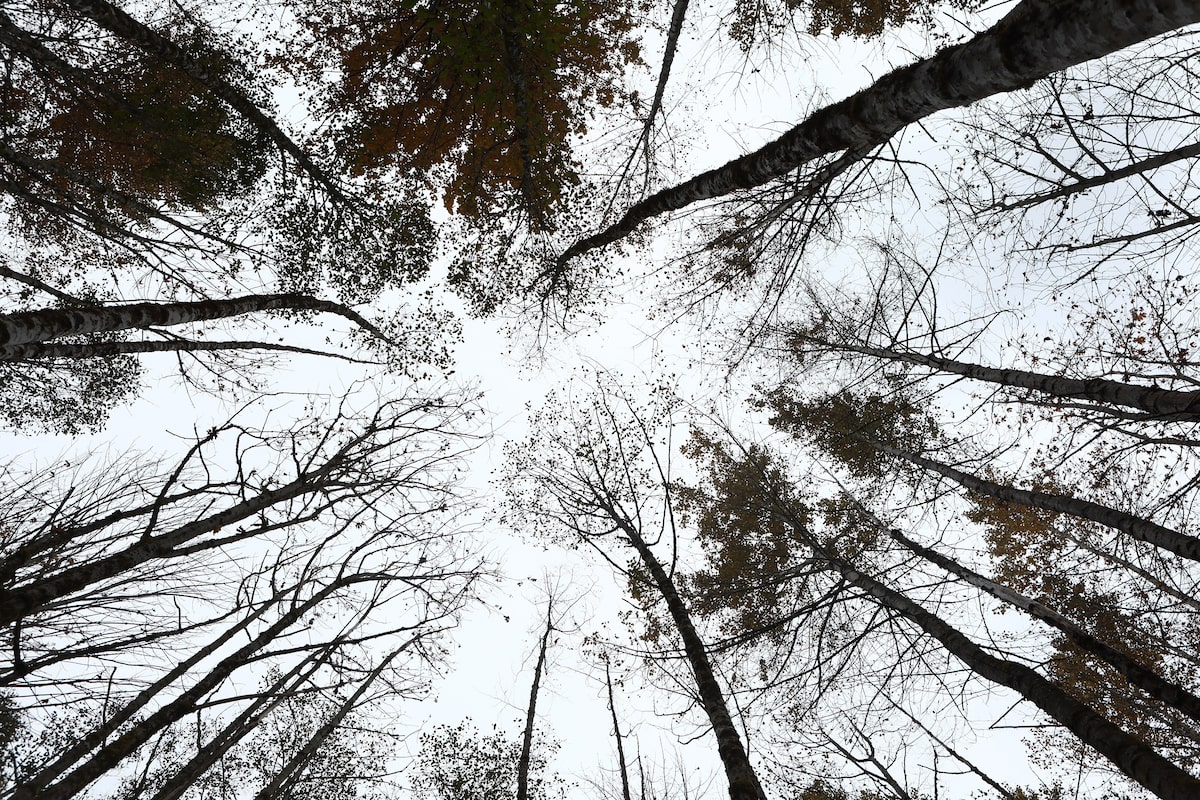
Trees form a canopy over the Morrison Creek Headwaters, a critical habitat for wildlife on Vancouver Island.CHAD HIPOLITO/The Globe and Mail
Canada’s most distinguished scientists warn that Ottawa’s bill to fast-track major projects risks irreparable damage to the environment and are calling for amendments before it becomes law.
In an open letter released Thursday, 56 fellows of the Royal Society of Canada are appealing to Prime Minister Mark Carney and parliamentary committees studying Bill C-39, the Building Canada Strong Act, to drop or rewrite provisions they say would weaken protections for species at risk and their habitats.
“Clauses, if left unamended, risk costly and potentially irreversible harm to Canada’s natural heritage and so will fail the stated aim of the law, that of building projects while maintaining strong environmental protections,” the letter states.
The recommendations are not the official position of the society, a prominent national academy of scientists, scholars and artists.
Sarah Otto, an evolutionary biologist at the University of British Columbia who initiated the letter, said the bill is moving quickly without expert input and asks Canadians to “just trust that the government will do the right thing for nature.”
The scientists want Ottawa to drop a provision in the bill that provides a federal environment minister with extraordinary authority. It would allow “enabling activities that the minister specifies” before a project is approved, if the minister considers it “in the public interest that they be carried out” first.
The bill does not define those activities. The letter warns that they could include site clearing, dredging and road work.
What you need to know about Bill C-39, Canada’s most consequential economic legislation in decades
Nancy Macdonald, a spokesperson for the Impact Assessment Agency of Canada, said in a statement that “these activities would continue to be subject to conditions, including to mitigate and remediate adverse effects in federal jurisdiction.” They “would also still require relevant permits.” The approval of early works, she added, “does not guarantee a positive outcome for the impact assessment.”
John Smol, an ecologist at Queen’s University in Kingston, asked what would happen if a lake or wetland were drained for a project that was later rejected. “What are you going to do? Put water back in? That’s not how ecology works,” he said. “The toothpaste is out of the tube.”
Catherine Potvin, a McGill University biologist, said in an e-mail that the bill “completely bypasses the precautionary principle,” the idea that potentially harmful activities shouldn’t go ahead until their risks are understood.
“What we’re concerned about here is burning the barn down while the horse is still inside,” said Jeremy Kerr, a biologist at the University of Ottawa.
The scientists also want the bill to drop the test requiring regulators to weigh whether environmental conditions on permits are technically, economically and practically feasible. They say this weakens safeguards “exactly where they are most needed.”
The letter further objects to fees companies could pay under revisions to the Fisheries Act, instead of restoring the fish habitat they damage. The scientists want the bill to require companies to avoid and minimize harm first, and to fully compensate for any harm that they do cause.
Mike Campbell, a spokesperson for Fisheries and Oceans Canada, said in a statement that fees “would be held to the same standard for counterbalancing project impacts as other forms of offsetting.” He added that “the calibration of fees relative to impacts for eligible projects would be done through regulations and policy.”
Green investment guidebook authors hold off on adding carbon capture for oil, gas after pushback
Dr. Otto said her biggest concern is the bill’s expansion of the Building Canada Act, which passed last year. Bill C-39 would scrap that law’s five-year sunset clause and let cabinet designate “regions of national interest” of undefined size. The letter asks that the sunset be kept and the regions defined.
The scientists also want the bill to drop new powers that would see a single minister remove environmental conditions on permits and assessments.
And they want the bill to allow decisions to take longer than its one-year deadline when needed. Villy Christensen, a UBC fisheries scientist who advised the Vancouver Fraser Port Authority on ecosystem modelling for its Roberts Bank Terminal 2 expansion, said the project’s review took around seven years.
“I agree with the government that the way it works now, it takes too long,” he said. “But on the other hand, I cannot see how one can do a credible job with the time constraints that they are adding.”
Mr. Campbell said the fisheries department “will meet the one-year timelines” for Fisheries Act reviews once companies “provide all required studies and information.” He did not say how long reviews typically take but said a new concierge service will help companies “prepare strong and complete submissions.”
But ecosystems run on a different clock, Prof. Smol said. “Political and industrial projects are by and large temporary, measured in years. Ecosystem damage can be permanent.”