
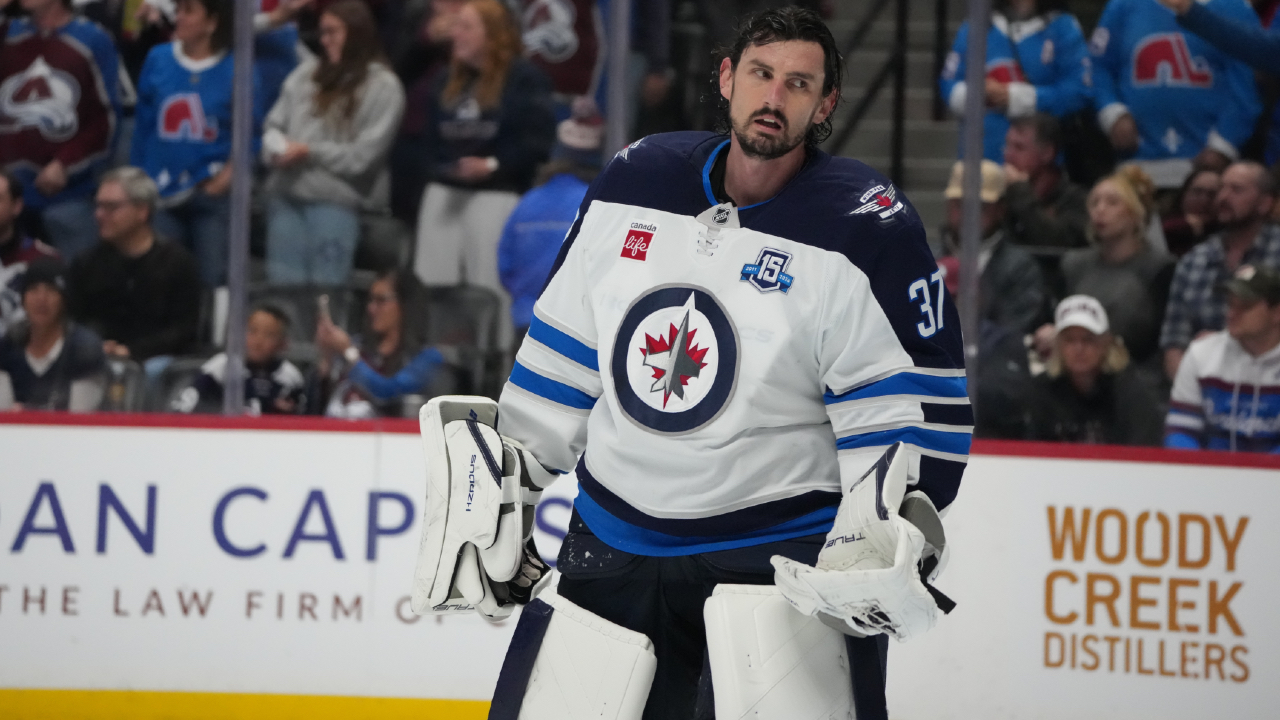
This past off-season was an inflection point in NHL power dynamics. The player pool imposed its will in a way we’ve never seen in the salary cap era, forcing trades and signing multiple record-breaking contracts, including a monstrous offer sheet.
Then training camps opened and outstanding business bubbled to the surface. The 2026-27 season is three weeks old and four high-profile cases remain unresolved – trade requests from Connor Hellebuyck and Dylan Larkin have gone unfulfilled, and restricted free agents Simon Edvinsson and Alexander Nikishin have yet to sign.
Larkin, the only one of the four to appear in a game thus far, no longer has a “C” on his Red Wings jersey. Hellebuyck is nearing the end of a Jets-issued suspension (nearly $1 million in lost salary!) yet is still very much in limbo. The Wings’ Edvinsson and Hurricanes’ Nikishin have spent time in Sweden and Florida, respectively.
The volume spikes any time a contract stalemate nears a crucial deadline.
Fans wonder why the two sides can’t get along, which party should be blamed, what kind of outcome is around the corner, and how that outcome will impact their favourite team.
 32 Thoughts: The Podcast
Hockey fans already know the name, but this is not the blog. From Sportsnet, 32 Thoughts: The Podcast with NHL Insider Elliotte Friedman and Kyle Bukauskas is a weekly deep dive into the biggest news and interviews from the hockey world.
What’s it actually like to be a player on the outside looking in, though?
We asked a handful of people with experience navigating contract impasses for some perspective on what the sidelined Hellebuyck, Edvinsson, and Nikishin may be dealing with day to day.
Fighting for miles, yards, or inches?
Ten years before the Hellebuyck mess, there was the Jacob Trouba saga.
Trouba, then a 22-year-old RFA, submitted a trade request to Jets general manager Kevin Cheveldayoff in May 2016. The team tried to move the promising 6-foot-3 defenceman in the off-season but didn’t like the return packages, pausing progress.
In late September, Trouba’s agent, Kurt Overhardt, released a statement confirming the request and made it clear his client would not be attending training camp. The standoff dragged on for weeks. The two parties eventually agreed on a two-year, $6-million deal in early November, and Trouba made his debut in Game 14 of 82.
“You want to play hockey. You’re a hockey player,” Trouba said Monday in an interview with Sportsnet.ca. “Then all this other stuff comes into it and it’s … Frustrating is not the right word. But you want to play, so you’re disappointed in that sense. But you also have to feel confident in the choices you’re making and why you’re doing it.”
Trouba felt stuck on the right side of a blue line that featured well-compensated and locked-in veterans Dustin Byfuglien and Tyler Myers. The ninth overall pick in 2012 craved a top-four role and didn’t envision a scenario in which he could grab one in Winnipeg.
Those 49 days from the opening of camp on Sept. 23 to his Nov. 11 debut were strange. Trouba, a Michigan native, trained with the U.S. National Team Development Program back in Ann Arbor, though nothing compares to NHL practices and games so it took a while to regain normal speed and endurance levels. Trouba watched Jets games on TV from home, which was a “little bit” weird, as was being the subject of constant rumours and speculation in a Canadian market.
Teammates would occasionally ping Trouba with a check-in text – How are you doing, man? – but otherwise No. 8’s communication with Jets personnel was muted. Trouba tried to strike a balance between keeping in touch and maintaining a healthy distance, in part because he knew returning to the club was one likely outcome.
“You’re not physically there, so you don’t want to be a distraction,” Trouba said.
Cheveldayoff finally pulled the trigger on a trade in 2019, sending Trouba to the Rangers amid another difficult negotiation. The hard-hitting defender spent five-and-a-half seasons in New York, one-and-a-half in Anaheim, and is currently 10 games deep with San Jose.
While the Winnipeg exit wasn’t fast, fun, or smooth, Trouba knew from the start the various risks and rewards associated with trying to take control of his career.
“It’s a process,” Trouba said. “You know what could possibly happen, so I don’t think you’re caught off guard by what you’re going to have to deal with during (the standoff) and going back to the team.” People stand up for themselves professionally in every industry, he noted, and athletes just happen to have a public-facing, heavily scrutinized job.
Overhardt, a veteran NHL Players’ Association agent with a law background, also represented Kyle Turris. The now-retired forward missed 23 regular season games in 2011-12 due to a contract dispute with the Phoenix Coyotes. Weeks later, he was traded to the Senators.
These tense situations don’t arise overnight, Overhardt said, and no holdout “should be done unadvisedly or hastily.” Months of planning and forecasting pass before a player misses even a day of camp. The client must know both parties’ leverage points and be willing to face the uncertainty and scrutiny if contract talks stall.
“You really have to do a costs-versus-benefits (analysis) based on the specific situation and where things lie,” said Overhardt, who’s currently an executive vice-president at The Team agency. “If you don’t do that, mistakes are made and you can really jeopardize and hurt your client’s opportunity to move forward.”
“That’s why you’ve got to know your client. That’s why you’ve got to know what you’re fighting for,” the player rep added. “Are you fighting for inches? Are you fighting for yards? Are you fighting for miles? You’ve got to be smart.”
‘Confidence goes a long way in life’
NHLers are creatures of habit with daily routines, on-the-job superstitions, and overall, a very particular way of moving through the world. The stakes are high in a short career and routine allows players to focus on preparing for and playing games.
“You’re used to the structure, and it can be very challenging when that structure, created by the team environment, is gone. You have to try to create your own,” said ex-defenceman Mathieu Schneider, who dressed for 10 teams over 21 seasons.
Schneider didn’t have a contract through Maple Leafs training camp in 1998. He chose to stay in Toronto through the process, working out at a public gym early in the morning to avoid crowds and skating with the St. Michael’s College high school team in the afternoon.
“The waiting is the most difficult part,” Schneider said of missing two regular season games before leaving the Leafs for the Rangers in an October trade. “Every day gets a little bit longer when you’re in those situations as a player. Every night your brain starts to go to different places. You’re thinking, ‘Is it ever going to happen?'”
Schneider, who recently joined 3G Sports as an agent following 13 years at the NHLPA, is grateful social media didn’t exist during his standoff. Still, he had to contend with the Toronto market’s intense TV, radio, and print coverage. “You had 30 guys covering the Leafs every day,” he said, “all with differing opinions of me.”
 Real Kyper and Bourne
Nick Kypreos and Justin Bourne talk all things hockey with some of the biggest names in the game. Watch live every weekday on Sportsnet and Sportsnet+ — or listen live on Sportsnet 590 The FAN — from 4 p.m. to 6 p.m. ET.
Current Leaf William Nylander missed a salary cap era-high 28 regular season games in 2018. The flashy Swedish winger came perilously close to sitting on the sidelines for all 82 contests, too, signing a six-year extension with only minutes to spare before the annual 5 p.m. ET Dec. 1 deadline for RFA contracts to be filed.
“Confidence goes a long way in life, and Willy is extremely confident, not only in himself and his ability, but just in his beliefs,” said Lewis Gross, Nylander’s agent. The longtime player rep laughed as he recalled the hectic finish to a drawn-out negotiation: “I said to him, ‘Willy, I know you might be the coolest guy in the world, but this is not the time to be so cool. Get that contract back to me in time here.'”
Gross educates clients on the marketplace and where the player fits into the NHL landscape ahead of any serious contract talks. The odd time Gross and a GM will have vastly different stances on what’s fair money and term. Some clients have the stomach to dig their heels in and fight with the club. Others don’t believe a fight is worth it and will advise Gross to find common ground sooner than later.
“We’re not here to tell the client what to do. We work for the client,” Gross said.
“It relates to how important the relationship is between player and agent,” he added of standoffs that have escalated, namely Nylander and Jeremy Swayman, in 2024 with the Bruins. “You have to be on the same page, working together, understanding all the dynamics, and why what we’re asking for really does make a lot of sense.”
Part of an agent’s job, Gross said, is to control the flow of information – which can often mean minimizing communication with people outside of the player’s inner circle. For instance, there were no reports about Nylander’s backup plan, despite the possibility of him playing overseas increasing by the day, because Gross went silent.
Overhardt believes agents must manage the client, the team, and the media with a level of stoicism and restraint. “If you’re emotional as an agent, I think you’ve really got to step back because I think you’re doing your client a disservice,” he said.
Bolder and better educated player pool
Every movement needs a disruptor, or two, or three. Jack Eichel and the Sabres butted heads over neck surgery options, leading to a trade to the Golden Knights in 2021. Matthew Tkachuk told the Flames he wouldn’t be signing an extension, triggering a trade to the Panthers in 2022. Cutter Gauthier refused to sign with the Flyers out of college, sparking a trade to the Ducks in 2024.
In less dramatic fashion, Jason Robertson missed the Stars’ training camp and entire pre-season in 2022 before inking a deal in time to make the regular season opener.
“It was important to me and important to the team that I didn’t miss games,” said Robertson, who’s still with the Stars four years later, albeit on an expiring deal.
Like Trouba, Robertson hails from Michigan. He too skated with the U.S. NTDP group to stay sharp as camp opened and he remained an unsigned RFA. Interestingly, Robertson headed to Little Caesars Arena one night with a local coach to catch a Red Wings pre-season game.
“I had nothing else to do. I was bored. I wanted to see the pace live,” the straight-shooting left winger said with a smile, later admitting, yes, his stress levels rose slightly during his time away. After all, the Stars had a new coaching staff and he was missing the early days of implementing a different system and style.
Nevertheless, Robertson and linemates Roope Hintz and Joe Pavelski picked up where they left off the season prior. Robertson finished 2022-23 with career highs in goals (46) and points (109) while appearing in all 82 games.
Time away can hamper a player’s performance, like we saw with Nylander. It can also be a non-factor, like in Robertson’s case. Schneider emphasizes that every situation – including the three currently in flux – is wholly unique. Different personalities, on-ice impacts, and set of team circumstances are involved, which means different variables are influencing negotiations positively and negatively.
Still, you can bet agents’ phones will be lighting up with messages once the Hellebuyck, Edvinsson, and Nikishin files are sorted. The modern player grew up in a data-driven society and is paying close attention to the changing landscape.
“If you have 10 or 15 years to play, every year really does mean a lot. So, missing time can hurt. Taking a contract that doesn’t come close to paying you fairly can hurt too,” said Gross, who’s been representing NHLers since 1987. “But, ultimately, you want to win a Stanley Cup and you’re not going to have a ton of chances to make that happen, either. Times are different. The players are much, much more educated because there’s so much more information out there than there used to be.”