

Almost two years after a tire blew on his car during an early-morning Montreal commute, Sami Aibout will get a cheque to cover the damage, having convinced a judge the city was at fault.
Getting the money was an uphill battle. To win the case, Aibout, who represented himself in court, had to overcome a Quebec law designed to prevent drivers from claiming reimbursement for vehicle damage on city roads.
In December 2024, Aibout was returning to his home in Repentigny from his night shift in Montreal’s Anjou borough when he drove through a large hole workers had dug in the middle of des Sciences Blvd.
“I felt a boom, boom,” he said. “It was really a big shock because the hole was very large and deep.”
Dashcam footage from that morning confirms his account, showing two big bumps as Aibout’s car drove through the hole. It flattened a tire and broke a mud flap, requiring more than $750 in repairs.
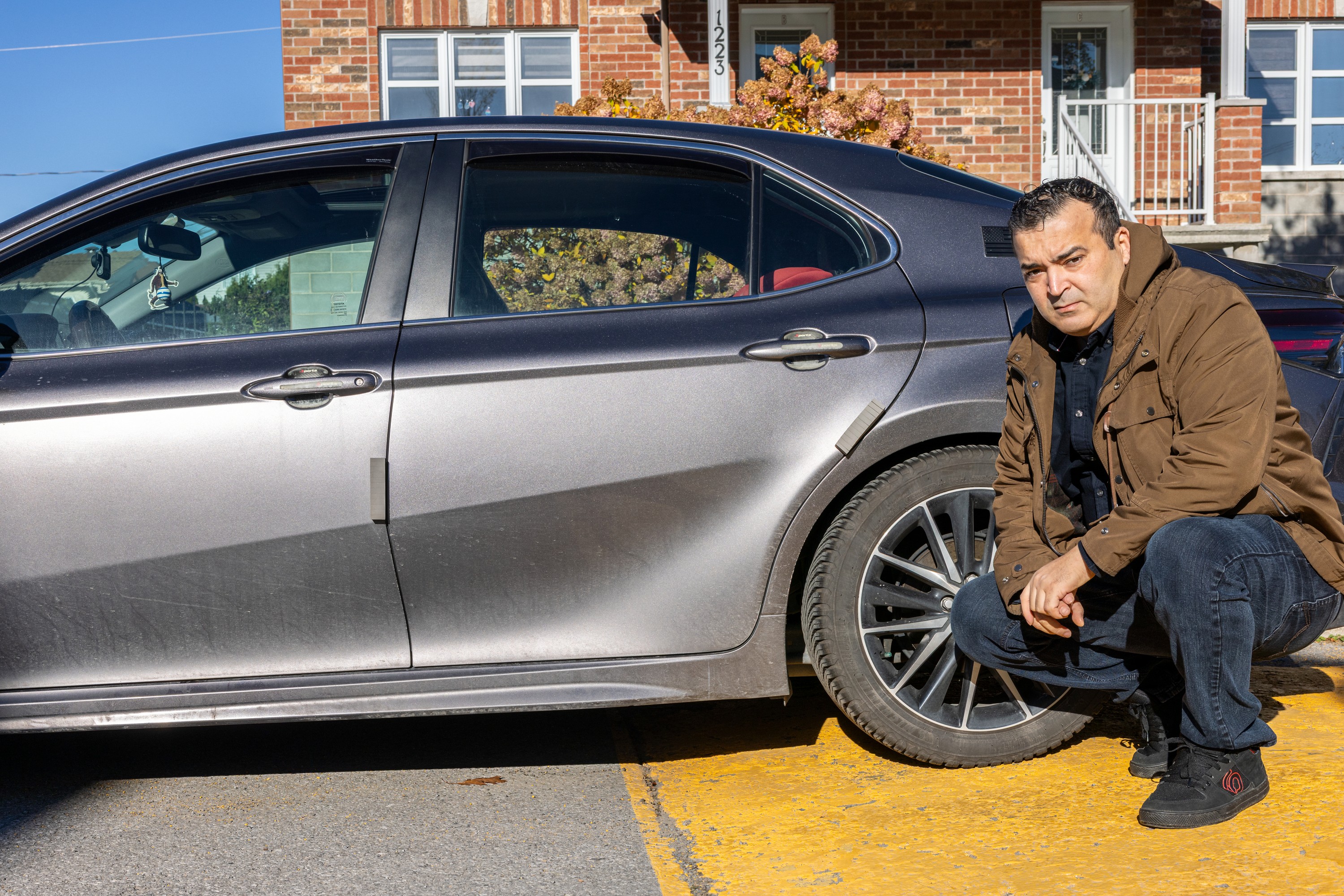 Sami Aibout, seen on Monday, Oct. 19, 2026, successfully sued the City of Montreal after his car got a flat tire while he was driving home from work. Dave Sidaway / Montreal Gazette
When he took his case to small claims court, Aibout learned of a measure in Quebec’s Cities and Towns Act that exempts municipalities from liability for damage to tires and suspension systems as a result of a road’s condition.
The City of Montreal raised the exemption in court, but Judge Louis Riverin ruled on Oct. 8 that the city’s negligence meant the rule didn’t apply, ordering the city to pay the damages.
A snowplow had knocked away a metal plate covering the hole before Aibout drove over the spot. The snowplow driver had stopped nearby, the dashcam footage shows, but failed to warn Aibout of the hazard.
“I was concentrated on the (snowplow) driver to see if he would make a sign … he didn’t do anything,” Aibout said, adding he hadn’t seen the hole before driving through it.
The road was empty, he said. The driver “could have easily signalled to me.”
The judge agreed.
“The snowplow driver knew very well … that the hole was a danger, even a trap, for any driver,” Riverin wrote, saying the operator, who worked for the city, had a responsibility to prevent the incident.
It was The Gazette that informed Aibout he had won his case.
“It’s clear that it was (the city’s) fault,” he said, happy with the outcome. “I wasn’t there for the $750. I was there for the principle.”
Other drivers have also convinced courts to hold cities responsible for road damage, despite the exemption in the Cities and Towns Act, said Aurélie Gagnon, a lawyer at Éducaloi, an organization tasked with explaining Quebec’s legal system to the public.
But overcoming the exemption requires drivers to prove gross negligence on the part of a municipality, she said, on top of the requirement to prove costs stemming from the damage.
The exemption “applies to all situations on a road maintained by a municipality,” she said, “but, according to the courts, if someone is able to prove negligence … (the exemption) becomes unenforceable.”
In 2020, for example, a judge found the City of Montreal liable for $1,000 in damages after a man drove through a major pothole. In that case, too, the municipality brought up the exemption under the Cities and Towns Act, but the judge ruled the city had been negligent in failing to properly signal the danger.
Editor’s Picks
“There’s really a possibility (to overcome the exemption) if it’s well documented, if it’s well argued,” Gagnon said.
She suggested drivers in similar situations take photos of the scene and gather evidence, such as 311 calls, that might prove a municipality didn’t do enough to respond to road damage.
The Cities and Towns Act exemption only applies to tire and suspension systems, Gagnon added, meaning drivers face a lower bar in court when another part of their vehicle is damaged.
The rule was criticized in 2019, when former Ensemble Montréal leader Lionel Perez tabled a motion in city council asking the province to take the exemption off the books. The measure is “profoundly unjust,” he said at the time.
Ensemble Montréal under Mayor Soraya Martinez Ferrada now runs city council. Asked if the party still opposes the measure, a spokesperson for Martinez Ferrada said “the subject is not being studied.”