
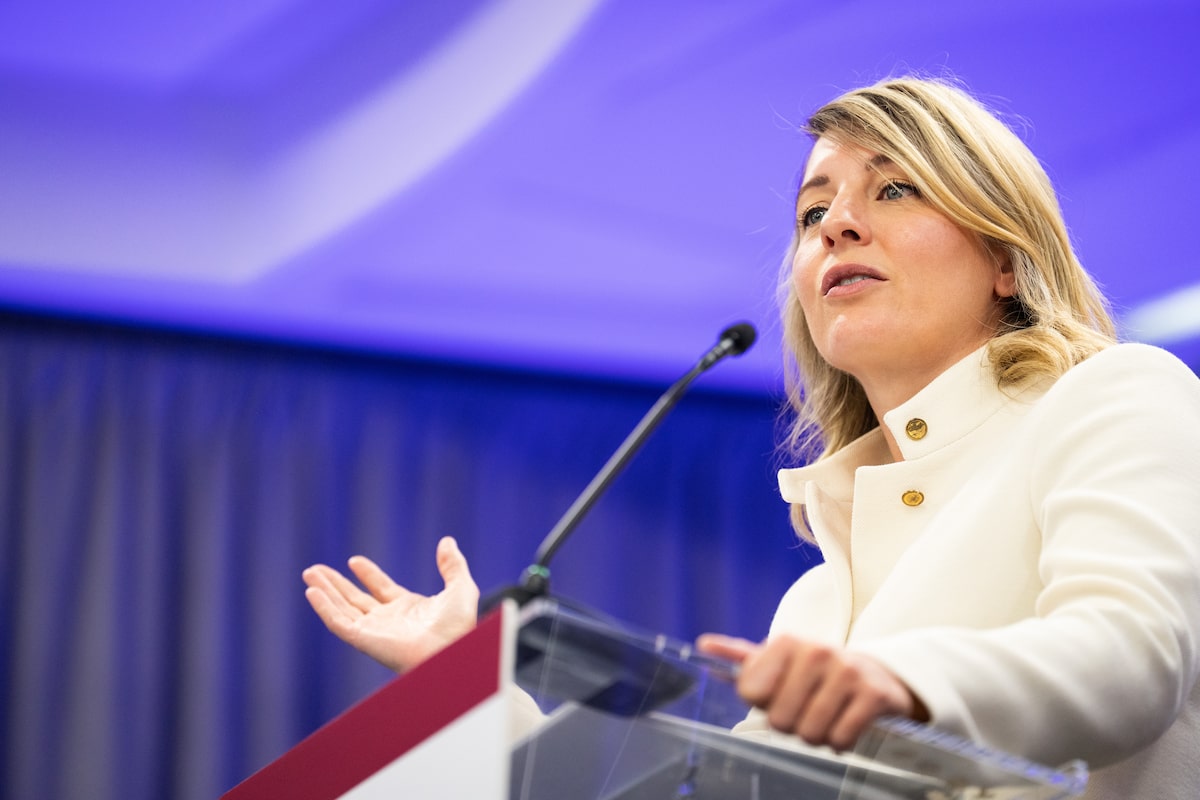
Industry Minister Mélanie Joly speaks during a news conference in Toronto last month. She is set to announce on Thursday how Ottawa will allot $1.75-billion to support the VC sector.Arlyn McAdorey/The Canadian Press
The federal government kicked off a long-awaited process Thursday to inject $1.75-billion in fresh money into Canada’s venture capital industry to fund fast-growing startups, part of a broader effort led by Prime Minister Mark Carney to bolster Canada’s economic independence and growth at a time of global uncertainty.
“Canada needs to do two things at once right now,” said Industry Minister Mélanie Joly at a press conference at the Toronto headquarters of Waabi Innnovation Inc., which has raised venture capital from Canadian and foreign investors. In addition to defending traditional industries targeted by U.S. President Donald Trump’s trade war, “we also need to move from defence to offence” by backing “the companies that will drive our prosperity tomorrow.”
Last November’s budget proposed $1-billion over three years for Business Development Bank of Canada (BDC) to launch the fourth iteration of a venture capital (VC) support program started by Stephen Harper’s Conservative government 13 years ago, recommitting an amount first proposed in the December, 2024, fall economic statement when Justin Trudeau was prime minister. The latest version of the program, called Venture and Growth Capital Catalyst Initiative (VGCCI), is much larger than its three predecessors, which ranged in size from $390-million to $450-million.
The budget also proposed $750-million for a new program “to support Canadian firms facing early growth-stage funding gaps.”
Third startup group joins battle to convince Ottawa how to spend $750-million on innovation
Ms. Joly said VGCCI would include a $700-million allotment to “funds-of-funds” managers – funds that finance VC firms, which in turn back growing companies directly. Like its predecessors, VGCCI funding comes on condition that recipient funds-of-funds raise matching capital from private investors – $3 for every $1 from Ottawa.
The government money is an investment, not a grant, though Ottawa only gets its share of returns after fellow investors are paid out.
VGCCI is also committing $200-million to domestic VC fund managers that back Canadian life sciences companies and $100-million for emerging, or less-seasoned, fund managers, particularly those focused on strategic sectors or located outside traditional VC hubs. Those recipients will need to raise at least $1 for every $1 from government.
Under the new $750-million program, government will provide $675-million through BDC to Canadian investors that fund later-stage domestic companies to help them “scale and remain anchored” here, plus $75-million to support nascent companies that are raising seed- or even earlier-stage financing.
The size and scope of that $75-million commitment is a setback for the National Angel Capital Organization, which represents angel and other early-stage investors. It had pressed Ottawa with $750-million work of asks to fix what it said was a huge funding gap at the earliest stages. NACO called for $500-million to match investments made by early-stage financiers, plus $250-million to fund “operational infrastructure” to help “stabilize and professionalize” investors.
Private investors, founders, urge Canada to remove barriers to attract foreign capital
Nonetheless, NACO chief executive officer Claudio Rojas said in an interview: “We see this as being a positive development and a starting point,” that could lead to further support.
The government also faces questions about how quickly it can get the money moving. It kicked off a call Thursday for expressions of interest for the $700-million fund-of-funds program; applicants have three months to apply. Previous programs have moved slowly, frustrating industry participants, taking 18 months from budget announcement to selection of fund managers. It’s now 22 months since the federal government first announced the $1-billion funding for VGCCI, and the winners likely won’t be chosen until spring 2027.
Benjamin Bergen, CEO of the Canadian Venture Capital and Private Equity Association (CVCA), urged the government to move quickly and enable fund managers “to raise on market schedules” rather than political timelines. He suggested Ottawa could create perpetual “evergreen” funds like those in Britain and Germany that wouldn’t be subject to sluggish government process. Ms. Joly told the The Globe and Mail she was “always open to new ideas” including such a structure.
Four funds-of-funds have received money under VGCCI’s predecessor programs: Teralys Capital of Montreal, Toronto-based Northleaf Capital and Kensington Capital, and the Canadian arm of Boston-based HarbourVest Partners. HarbourVest managing partner John Toomey last month called the funding initiative “one of the most successful public-private projects on the planet,” during a CVCA event in Toronto during the week of Mr. Carney’s Canada Investment Summit.
As for the new $750-million initiative, the government is only now seeking stakeholder input for its proposed program design.
There could also be continued debate about how much and for how long the government should continue to bankroll private capital providers. Some Canadian funds, including Radical Ventures, Vistara Growth and Plaza Ventures, have thrived without drawing any support from VGCCI’s predecessors. Ms. Joly said she believed governments “have a greater role to play” intervening in markets as an investor, financier, customer and support.
VGCCI’s progenitor program was devised to rebuild the VC sector by luring pension funds and other institutional investors back to the domestic VC space after they retreated in the late 2000s. But the “Maple 8″ – Canada’s largest pension fund managers, including Canada Pension Plan Investment Board – still face criticism for not funding the domestic venture capital sector as much as many would like.
Ms. Joly addressed the giant funds directly, urging them during her remarks to back promising Canadian companies in such areas as artificial intelligence, quantum computing life sciences and advanced manufacturing. (Several pension funds have backed Canadian quantum developers). “Our entrepreneurs are ready to be bold, our government is ready to be bold,” she said. “The question is, are you?”
But behind the scenes, Ms. Joly and her officials have been pressing the Maple 8 to participate in the VC programs. She told The Globe said she’d spoken with several in recent months and suggested some could jointly form a fund-of-funds to access the matching government funding. “I think we’ll have good news in the coming weeks regarding that,” she said. “I’m very optimistic” they will participate.
Many industry participants have credited the program with helping to rebuild a domestic early-stage funding market that posted poor returns through the 2000s before being decimated by the credit crisis and 2008-09 recession.
That rebuilding effort is required again, some industry observers say. The amount of VC financing deals and dollars raised by domestic fund managers has declined since 2021, and there remain notable homegrown financing gaps for young companies from early to late stages, say industry observers.
“Without deeper pools of local capital and more effective exit pathways, Canada risks capturing only a fraction of the economic value generated by its most promising companies,” BDC said in a May report on the VC industry.