

Listen to this article
Estimated 3 minutes
The audio version of this article is generated by AI-based technology. Mispronunciations can occur. We are working with our partners to continually review and improve the results.
A small plane that crashed into trees near the Ottawa International Airport last summer, killing the pilot, suffered engine failure while flying over a densely populated area of the capital, according to the Transportation Safety Board of Canada (TSB).
The TSB made its crash report public on Friday.
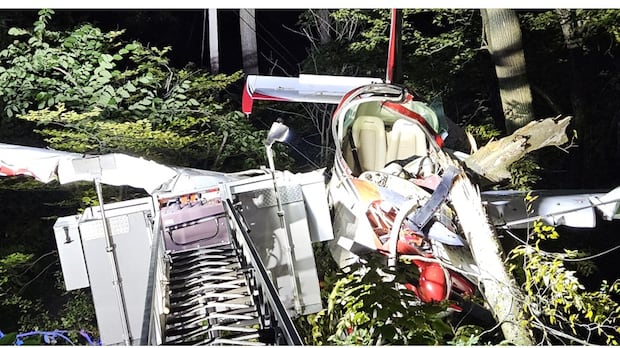
Pilot Stéphane Tessier died when the four-seat Grumann American AA-5A slammed into a forested area near Riverside Drive and West Hunt Club Road on July 31, 2025.
His two passengers survived with minor injuries.
According to the TSB report, the small plane took off from the Gatineau/Ottawa Executive Airport at 5:34 p.m. in clear conditions.
At 5:48, as the aircraft flew about 800 metres over an area west of the core, one of its engine coverings suddenly popped open.
“Various pieces detached from the engine, and engine oil sprayed across the windshield, significantly impairing forward visibility,” the TSB wrote.
As CBC News has reported, the TSB later asked Ottawa residents to check their properties for any fallen debris from the plane, and one couple turned a 20-centimetre metal rod found in their garden over to police.
Tessier radioed the control tower at the Ottawa International Airport to report the oil leak and continued toward the Rockcliffe airport on a flight path that would have taken the damaged plane directly over the city’s downtown.
Less than a minute later, the pilot elected to divert to the city’s main airport and was immediately cleared to turn south and begin his descent toward Runway 14.
“The flight path overflew built-up areas and the Ottawa Central Experimental Farm,” the TSB noted.
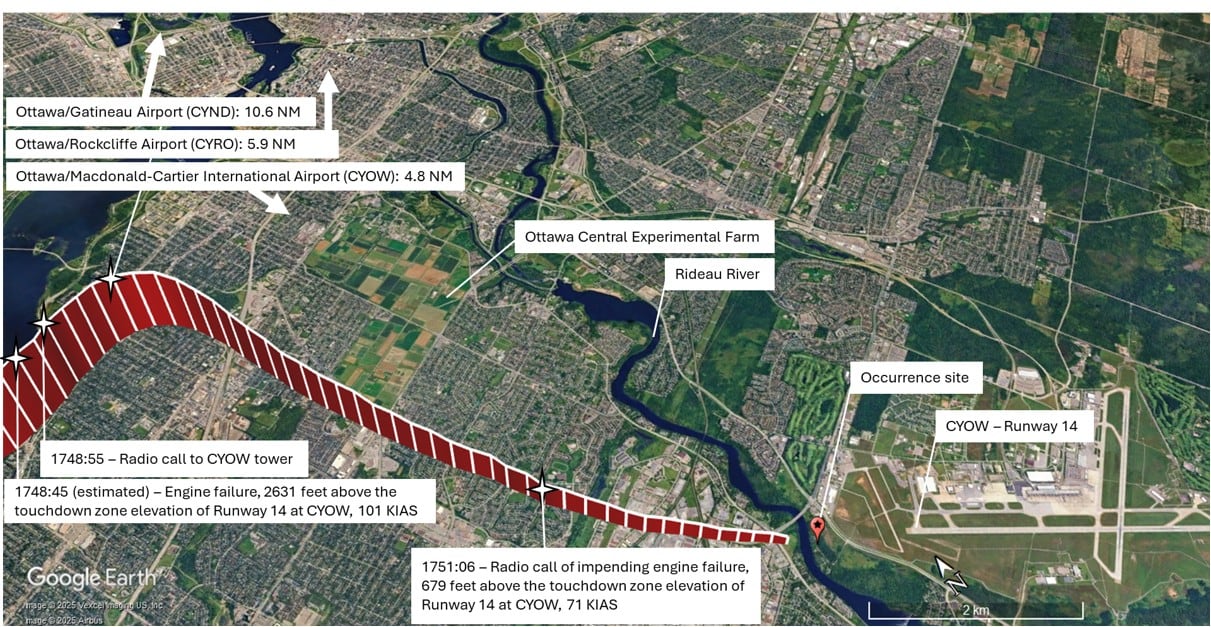
A map from the TSB report shows the small plane’s final flight path. Much of it was over an area between Fisher Avenue and Merivale Road. (Transportation Safety Board of Canada)
Tessier “reassured the passengers that the aircraft could reach the runway and continued manipulating the engine controls throughout the approach,” but at 5:51 p.m. as the plane descended to about 200 metres over the city’s Fisher Glen neighbourhood, he told the control tower the engine was about to fail.
Shortly after, the plane’s propeller stopped spinning.
(According to the TSB, the subsequent investigation deemed it “highly probable” the plane had already suffered complete engine failure three minutes earlier.)
At about 20 metres, the plane disappeared from radar. It crashed into trees about 960 metres short of Runway 14.
According to the flight data, the TSB investigators determined that no attempt had been made to land the plane anywhere other than Runway 14. Their calculations also show that “at the time and altitude of the engine failure, the aircraft would not have been able to reach any runway … even with immediate action.”
An examination of the engine at the TSB’s engineering lab revealed “several major failures and discrepancies.” Investigators concluded the engine failure was most likely caused by misapplication of a sealant during previous maintenance, residue of which was found throughout the engine’s crankcase.
This past July, nearly a year after the crash, Transport Canada issued a safety alert to private plane owners, pilots and mechanics warning of “the potential of an engine failure due to improper application” of the same kind of sealant.