
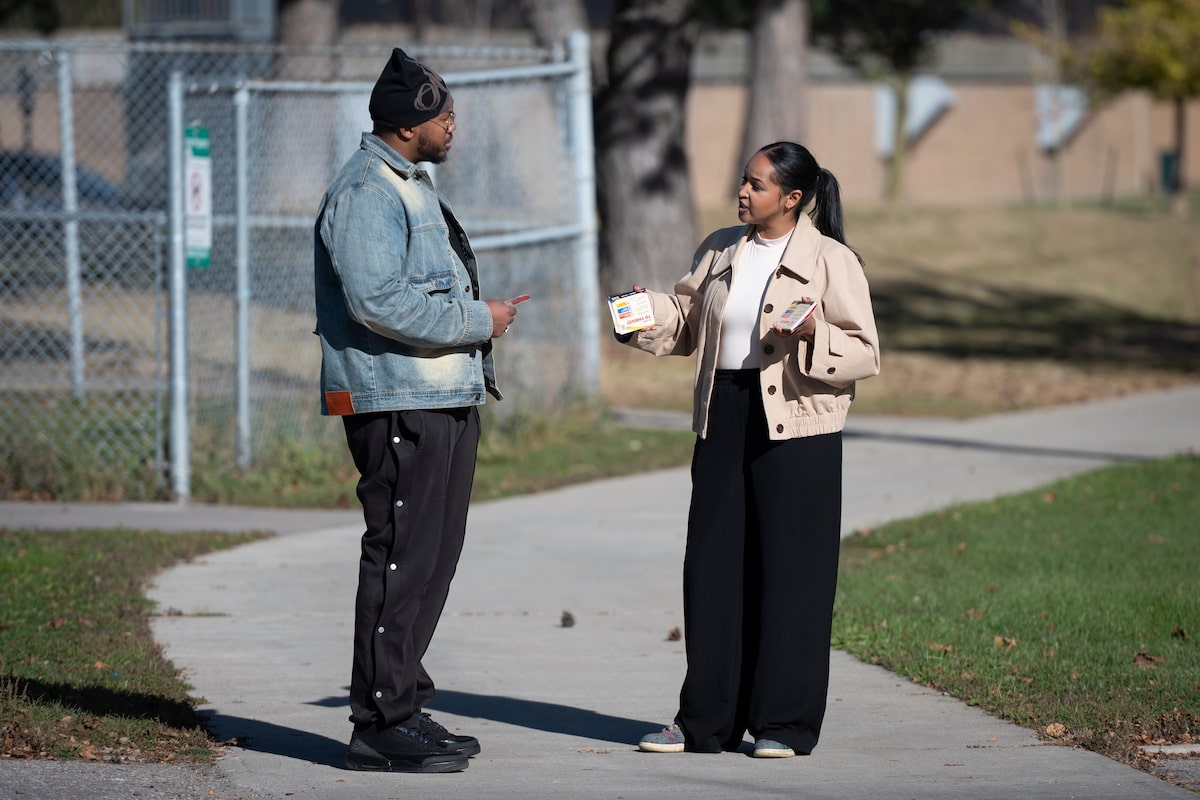
Community advocate Ala’a Adib, right, who is running for city councillor in Ward 1, speaks with residents of the Tandridge area while canvassing in Etobicoke North, Toronto, Oct. 23.EDUARDO LIMA/The Globe and Mail
Ala’a Adib raises her fist and raps the door in well-practised rhythm.
Knock-knock-knock-knock-knock.
“It does start to hurt after a while,” she says, studying her knuckles while listening for movement beyond the door at 44 Willowridge Rd., a public housing complex where just 17 per cent of eligible voters cast ballots in the last city election. In the surrounding ward of Etobicoke North, home to 115,000 people, just 6,800 votes was good enough to elect the incumbent councillor, Vincent Crisanti.
She tries again. Knock-knock-knock-knock-knock. The door swings open to reveal a man in a Megadeth T-shirt and a waft of marijuana smoke. She doesn’t miss a beat.
“Hi, I’m Ala’a and I’m running for city council,” she says. “The vote is coming up this Monday. I want to make sure we have affordable housing, safer communities and faster, reliable transit.”
“Right on, I’ll check it out,” says the man. The door closes, ending a 10-second pitch to boost her candidacy and bolster the deteriorating foundations of local democracy.
Who will be Toronto’s next mayor? What to know before the Oct. 26 election
Toronto notched a record-low turnout of 29.2 per cent in the 2022 election. The ebb affected the entire province. Just one out of three eligible voters went to the polls, down considerably from Ontario’s historical average of 40 per cent. Recent municipal results from B.C. and a surge in advance voting suggest the tide could be turning, but it’s difficult to project whether the sentiment will stretch eastward.
Academics have pointed to a jumble of factors, including the COVID-19 pandemic, rising political toxicity, election fatigue, loss of local media and a political system that snubs new and young Canadians. But the effect is clear: weaker mandates, weaker candidate fields and weaker democracies.
“People here just don’t feel like their lives are going to change based on decisions the city is making,” Ms. Adib says about the Toronto Community Housing building, where daily life is organized around fickle elevator service and long trips for groceries.
After the abysmal 2022 turnout, the Association of Municipalities of Ontario (AMO) set out to study the problem. It determined that voters show up when they have a sense of civic duty, trust the political system and want political change.
“When these things are not there, that’s when we see apathy taking over,” AMO executive director Lindsay Jones says.
But AMO found many local electorates didn’t get that change option in 2022. A record number of candidates had been acclaimed with no competition.
Since then, the organization has run a series of free workshops for anyone interested in running for councils, some targeting youth, Indigenous peoples and people with racialized backgrounds. More than 6,000 people signed up. AMO also ran social media ads encouraging people to come forward.
An election debate over public disorder frays nerves in Toronto’s Gay Village
When the nomination period ended this year, the acclamation picture had improved dramatically. Candidate acclamations are down from 548 in 2022 to 400 this year. And the number of municipalities where the entire council was acclaimed has dropped from 32 to 19.
B.C. managed a marginal increase in voter turnout during its Oct. 17 municipal elections, from 29.2 per cent in 2022 to 32.8 per cent. The bump was more pronounced in several major municipalities, with Vancouver turnout increasing by about seven percentage points and Richmond turnout up by 16 percentage points. A number of prominent incumbents, including Vancouver mayor Ken Sim, were given the boot.
“People turn out when they want to make a change,” says political strategist and former Vancouver city councillor Geoff Meggs. “That always draws extra people.”
It’s difficult to tell whether the change sentiment will translate nationally. B.C. has long held its own political microclimate.
Polling in Toronto has shown the race between incumbent Mayor Olivia Chow and her main challenger, Brad Bradford, to be neck-and-neck.
Toronto turnout is generally highest when there’s a member of the Ford family on the ballot. Rob Ford’s insurgent campaign to “end the gravy train” at City Hall drew 51 per cent of eligible voters in 2010. The subsequent 2014 election victory for John Tory over Doug Ford drew 55 per cent.
Opinion: The dangers of Brad Bradford’s Toronto
Those polarizing elections – and large turnout they attracted – have few analogues today.
“I don’t foresee a big surge in Ontario turnout,” University of Ottawa political studies professor Daniel Stockemer says.
In his recent research on the factors that contribute to high turnout, Dr. Stockemer hypothesized that a candidate’s youth could be key to attracting new voters.
The theory didn’t hold up to his statistical analysis of 47 elections in 28 countries.
“I was kind of disappointed by the finding,” he said.
“There’s a problem, a democratic deficit right now,” he added. “I thought younger candidates could boost youth turnout, but it actually does very little.”
Ms. Adib hopes he’s wrong. At age 35, she’s hoping her age can spur younger generations in the ward to vote.
In 2020, her brother, 21-year-old Adan (Sache) Dubet, was shot and killed. He had attended Toronto Metropolitan University and planned to become a lawyer. She started a charity, Smiles For Sache, that provides a Ramadan meal program, youth mentorship and other initiatives.
“That gives me the confidence to put myself out here,” she says, moving on to another door, another pitch, another potential voter.